

A Rolex is often defined by excellence, robustness, and endurance. Yet, behind every fluted bezel’s shine and Oyster case’s authority, Rolex’s story is one of perpetual responsibility.
For Rolex, sustainability follows the same philosophy that has shaped its watches for more than a century: quality must endure. A watch built to last resists disposability. It’s designed to be restored, inherited, and reworn. Rolex places quality, innovation and excellence at the heart of its sustainability commitments, while continuing to make exceptional watches built to last. And doing so, with a commitment towards a perpetual planet.
Rolex’s Philosophy of Sustainability
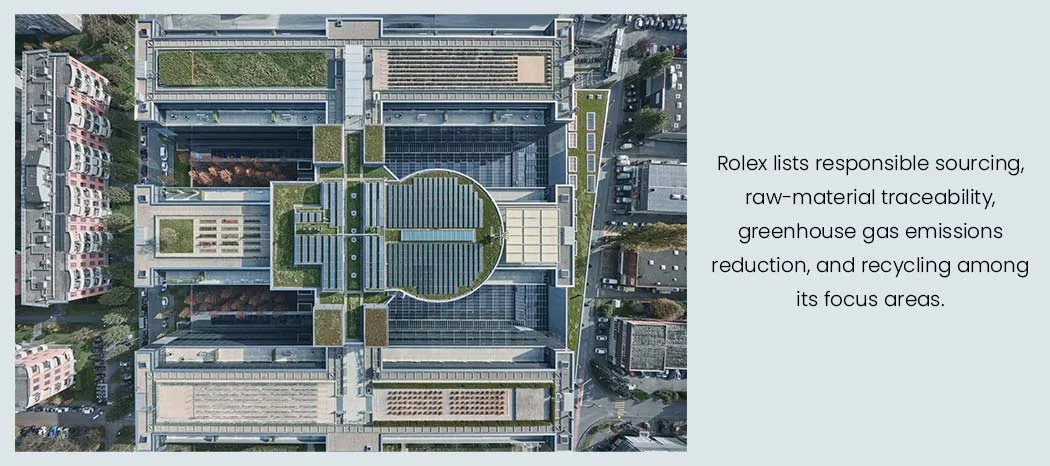
The romance of exceptional craftsmanship begins with passion, but care begins with control. Formalizing Rolex’s vision of environmental and social responsibility across Switzerland, its affiliates, and the wider value chain, the brand announced the “Impact and Sustainability” Department, a structured approach towards deployment of the sustainability strategy. Rolex lists responsible sourcing, raw-material traceability, greenhouse gas emissions reduction, and recycling among its focus areas.
In order to place their standards of quality, innovation, and preservation at the highest regard, Rolex incorporates sustainability commitments at the very heart of their excellence. This is reflected through a series of manufacture decisions, practices, designs, and frameworks – where quality is built to last.
A Noble Lustre
As one of watchmaking’s most elegant metals, Rolex’s gold delivers a pristine lustre backed by responsible sourcing and a commitment to trackability. Using two types of gold: mined and recycled gold, purchased externally or retrieved from the manufacture itself. For mined gold, Rolex sources this elegant metal from industrial mines and ethical artisanal mines in Peru, selecting mines according to its own social and environmental criteria. Countries of origin listed for mined gold include Canada, the United States, Peru, Chile, Argentina, Sweden and Finland.
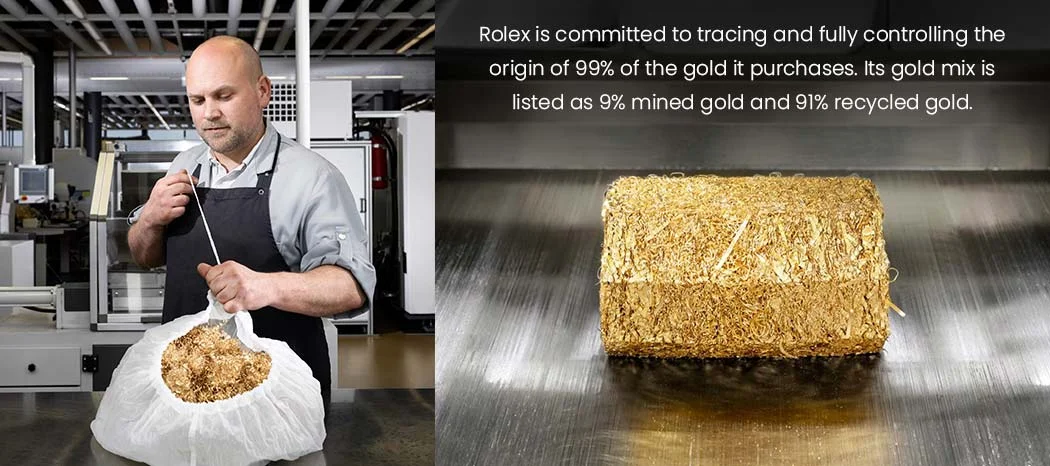
With direct access to refiners and trusted partners, Rolex also strives to consciously minimize the number of subcontractors. This helps Rolex manage production flows internally, committing to tracing and fully controlling the origin of 99% of the gold it purchases. Its gold mix is listed as 9% mined gold and 91% recycled gold.
Humane Shine
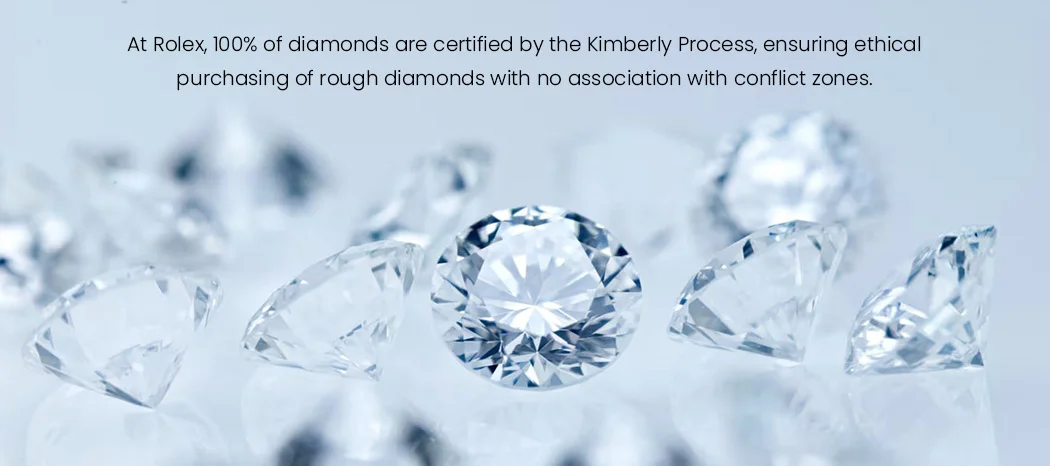
The beauty of diamonds has historically been shadowed by conflict and questions. At Rolex, 100% of diamonds are certified by the Kimberly Process, ensuring ethical purchasing of rough diamonds with no association with conflict zones, and through a highly limited list of suppliers. Each of them is required to declare the provenance of each batch, assessing risks towards geopolitical stability and fighting corruption. With utmost traceability of their diamonds, Rolex aims to move from a declared map to a documented map. Rolex also promises the highest quality of natural-origin diamonds assessed by their own expert gemologists.
Transparency & Traceability
Rolex is proud to trace the entire life cycle of a material – from source to final use. This strengthens guarantees relating to transparency and supply chain integrity. Rolex states it has enhanced traceability across supply chains to better control the commercial channels used to purchase raw materials, while developing a risk attenuation plan with suppliers.
Alongside national and international regulations and frameworks established by the ILO and OECD, Rolex adheres to various environmental certifications like the London Bullion Market Association (LBMA), London Platinum and Palladium Market (LPPM), Responsible Minerals Assurance Process (RMAP), Responsible Minerals Initiative (RMI), The Conflict Minerals Reporting Template (CMRT)/Responsible Minerals Assurance Process (RMAP), Responsible Jewellery Council Chain of Custody (RJC COC), Convention on International Trade in Endangered Species of Wild Fauna and Flora (CITES), The Kimberley Process (KP), Registration, Evaluation and Authorization of Chemicals (REACH). This covers materials like gold, diamonds, platinum, tungsten, tantalum, and tin at Rolex.
Greenhouse Emissions Targets
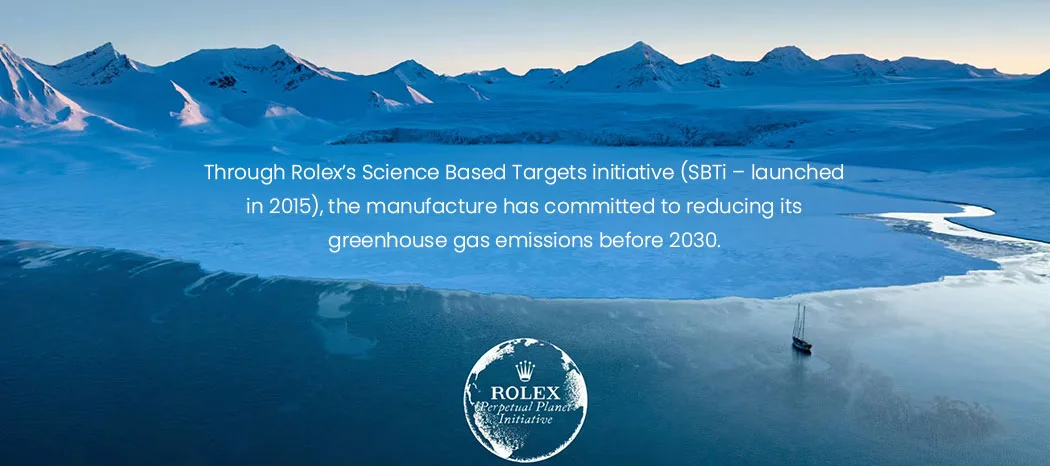
Through Rolex’s Science Based Targets initiative (SBTi – launched in 2015), the manufacture has committed to reducing its greenhouse gas emissions before 2030. This objective aligns with the decarbonization requirements needed to limit global warming by 2050 – according to the Paris Agreement. Right since 2019, Rolex has measured its emissions annually, and as per its 2021 carbon footprint, they’ve established reduction targets as follows: Scopes 1 and 2: −42% and Scope 3: −25%.
As Rolex’s heritage is built upon the word “Perpetual”, it not only speaks to a mission of time telling, but also planet preservation.



Recent Posts
Recent Comments
Archives