
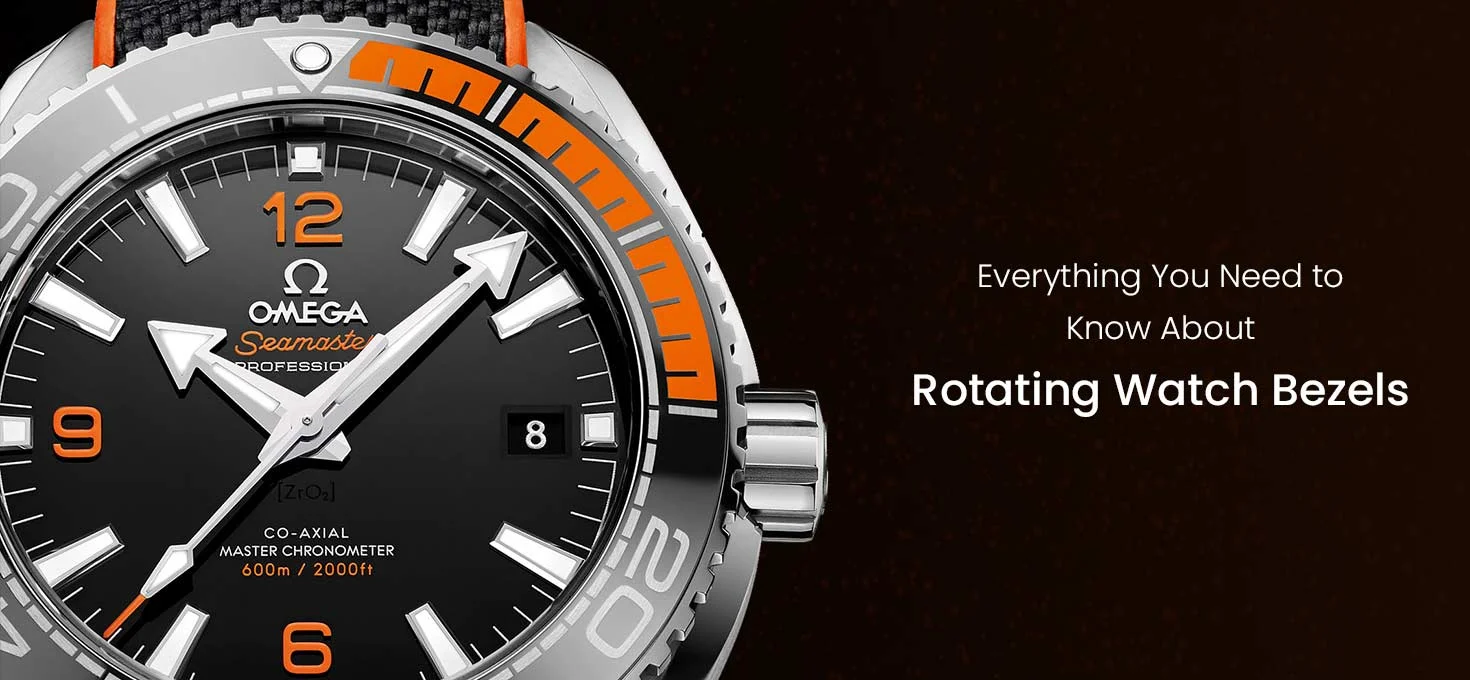
In a luxury watch, the bezel is the ring that surrounds the crystal. It protects the glass, holds it firmly in place, and often carries functional markings or a rotating mechanism.
The rotating bezel in its various forms is a distinctive feature of a watch. Although it is generally separated into two types, unidirectional and bidirectional, the overall complexity goes further than that. Whether it is inscribed with a 60-minute or 24-hour scale, or featuring inserts made of ceramic or precious metals, and so on, the importance of the rotating watch bezel to a watch cannot be understated. Its design and direction of movement are determined by the intended use on the professional luxury timepieces from brands such as Omega, Blancpain, Longines, TAG Heuer, and Hublot.
What is a Rotating Watch Bezel?
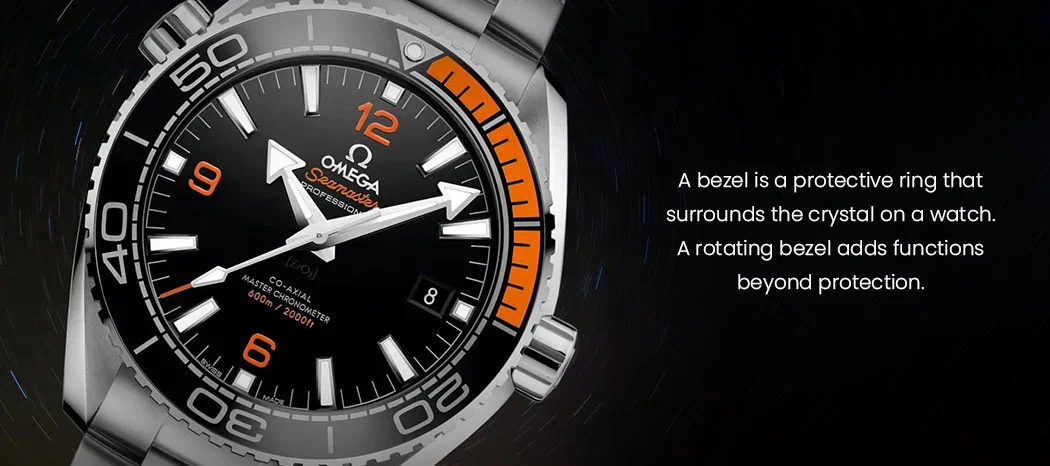
A rotating watch bezel is a movable ring that surrounds and protects the watch face on certain models such as diving and chronograph watches. The wearer can manually turn this ring to track additional time measurements beyond what the hands alone can indicate. In its early form the bezel served mainly as a protective component. Over time it evolved into a functional tool that can act as a timer, countdown device, pulse meter, tachymeter or similar scale depending on the markings. Most commonly this feature appears on diving watches, where the diver rotates the bezel so the zero marker lines up with the minute hand and then reads the elapsed time directly from the scale as the hand moves. Other watches also carry a rotating watch bezel, and the watch bezel function changes according to the purpose of the model. Understanding these variations forms the basis for the different watch bezel types in use today.
Types of Watch Bezels and Their Various Functions
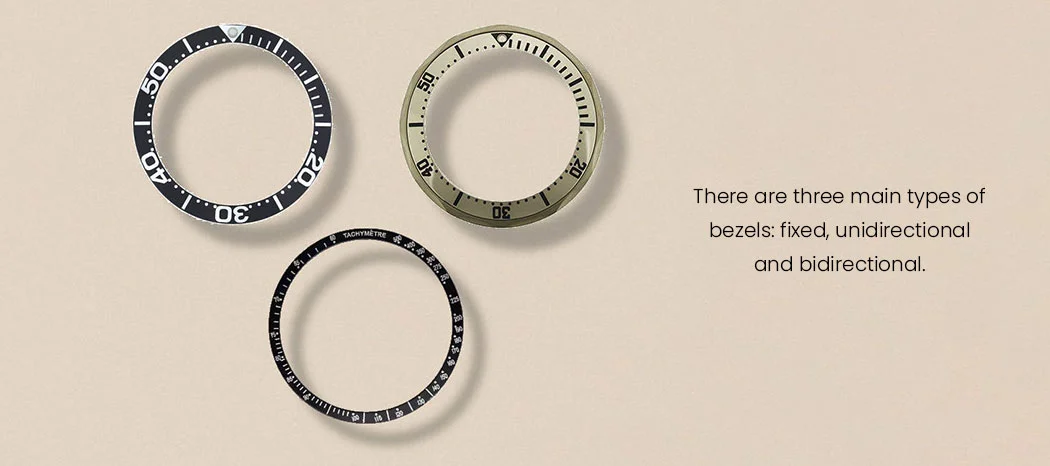
Bezels are generally divided in two main categories, fixed and rotating. A fixed bezel remains stationary and focuses on the simple elegance, serving the watch more through its appearance rather than the active utility.
The rotating watch bezel types are further divided into two types, unidirectional and bidirectional. The unidirectional rotatory bezels, common in divers’ watches, turn only one way to prevent accidental adjustment underwater and supports accurate timing for safety. The bidirectional rotatory bezel, on the other hand, turns both ways and appears on watches that need quick adjustments and track more than one timezones like pilot’s watches, GMT and dual timezone.
For a divers’ watch, the diving bezel plays a crucial role in helping divers monitor their immersion time with precision. The unidirectional bezel rotates only in the direction that decreases the remaining dive time, ensuring that it doesn’t accidentally indicate more time than is actually available. This essential safety feature helps reduce the risk of overestimating dive duration.
Each of these applications demonstrates how the rotating watch bezel and its related watch bezel function adapt to the needs of the wearer offering various tools for certain tasks and designs for personal style.
Why Do Some Watch Bezels Rotate
Some watches include a rotating watch bezel because certain activities require continuous timing without relying on a digital display or certain secondary instruments.
Divers need to know the bottom time and remaining gas. Travellers and pilots need the rapid reference to a second or third time zone. Aligning the zero marker with the minute hand at the start of an interval turns the scale into a continuous timer.
The same principle applies when the bezel carries a 24-hour scale, the rotation offsets the scale relative to a GMT hand. In both cases the rotating watch bezel provides a mechanical solution that remains readable under water or low light conditions. Hence, this is a significant watch bezel function in professional watches.
Why Do Watch Bezels Rotate in Different Directions
Different Watch bezel types are engineered for either safety or speed of adjustment. Unidirectional bezels move only counter-clockwise whereas the bidirectional bezels can move in either direction. The choice follows the intended watch bezel function. When an accidental bump could create a dangerous misreading, the mechanism is restricted to one direction.
When the wearer needs to advance or retard a scale quickly, both directions are permitted. This distinction appears consistently across various luxury watch timepieces like Omega, Blancpain, and other established watchmakers. The rotating watch bezel therefore rotates according to the priority of the task it supports.
The Counterclockwise Rotation of Dive Watch Bezels
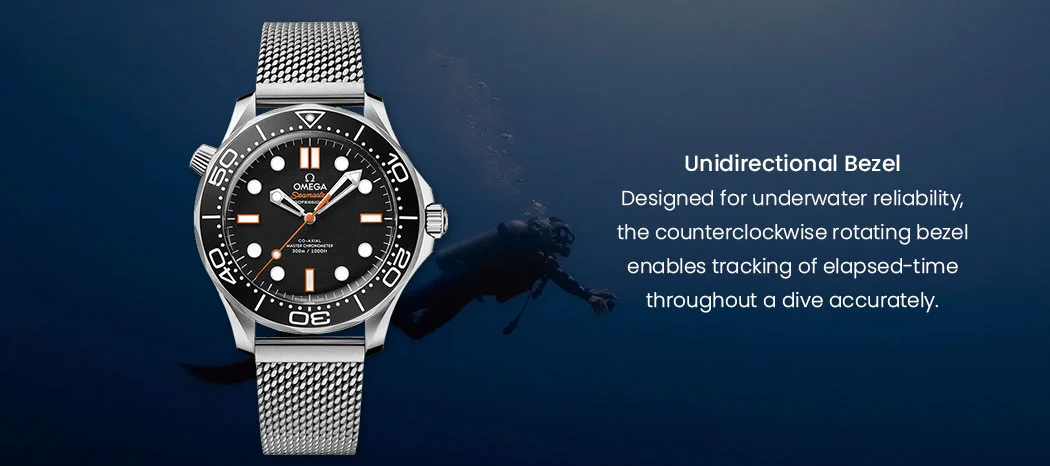
The bezel on a dive watch is engineered to turn only counterclockwise. This one-way movement forms a critical safety feature. Before descending, the diver aligns the zero marker, often a luminous pip at the 12 o’clock position, with the minute hand. As the dive continues, the minute hand advances and the elapsed time is read from the difference between its current position and the zero marker. If the bezel is accidentally moved, its counterclockwise-only rotation ensures it indicates more elapsed time rather than less, preventing an overestimation of the remaining dive time.
The wearer is therefore more likely to surface early instead of late, reducing the risk of running out of air. This focused watch bezel function shows how the dive-watch engineering prioritises practicality and purpose in every detail of the rotating watch bezel.
The Bidirectional Rotation of GMT Bezels
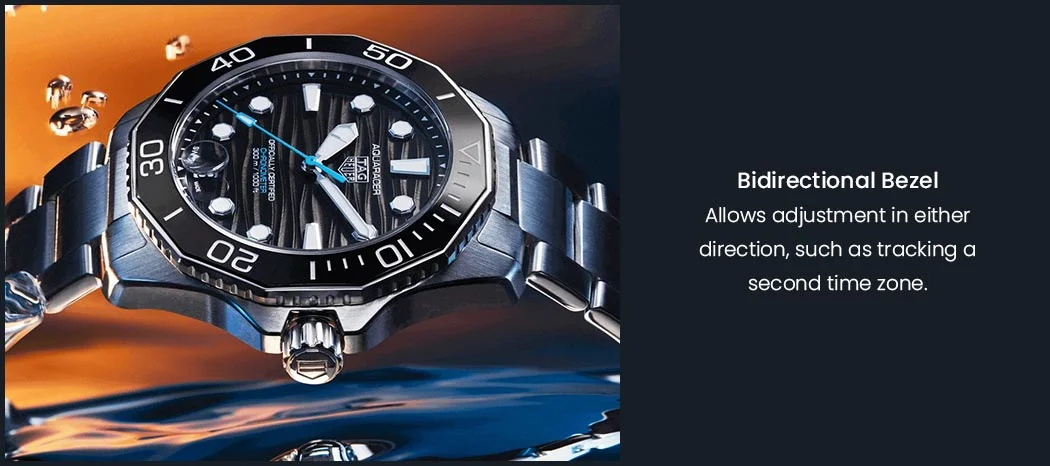
A GMT bezel features a 24-hour scale designed to track a second or third time zone together with a dedicated 24-hour hand on the dial. These bezels are almost always bidirectional so the wearer can adjust quickly for zones to the east or west without completing a full rotation if the setting overshoots.
While using it, the main hour hand is set to local time and the GMT hand is set to Greenwich Mean Time. The bezel is then rotated until the desired hour mark on the 24-hour scale aligns with the GMT hand; the minute hand remains shared across all zones. This bidirectional design matches the core watch bezel function of convenient multi-zone reference and appears on travel-oriented luxury models from brands such as Omega, Longines, and TAG Heuer.
Kapoor Watch Company
At Kapoor Watch Co., we bring together an exceptional collection of luxury watch brands, including TAG Heuer, Longines, Rado, Cartier, Chopard, Franck Muller, Hublot, Omega, and many more. Every timepiece reflects a unique blend of precision, craftsmanship, and innovation, featuring various functions and refined designs.
Visit Kapoor Watch Co. Stores to explore such iconic luxury timepieces and experience the horological excellence behind the world’s leading watchmakers, firsthand.


Recent Posts
Recent Comments
Archives