
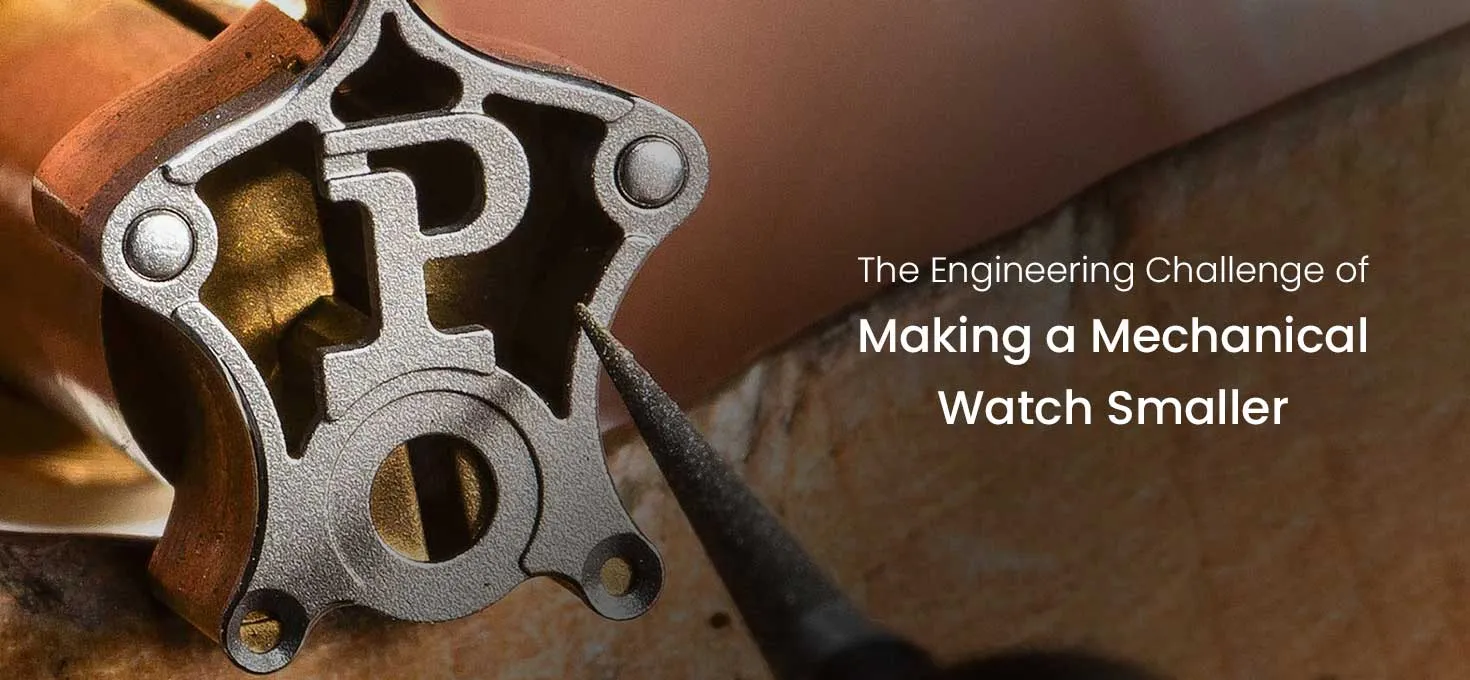
The art of creating a smaller timepiece involves far more than reducing the dimensions of its case and components. Behind the elegance of small luxury watches lies a complex process of precision, where every gear, spring and bridge must function within increasingly limited space. This is where watchmaking engineering faces some of its most demanding tests. Developing compact mechanical movements requires watchmakers to rethink component arrangements, energy efficiency and structural strength without compromising accuracy or reliability. Among the many challenges of watchmaking, miniaturisation remains particularly demanding as even the smallest adjustment can influence the performance of the entire movement.
Inside the Movement: Every Component, A Smaller Dimension

Reducing the size of a mechanical watch involves reworking several interconnected components rather than simply shrinking its outer case. The mainspring and barrel must retain sufficient energy storage while the gear train needs precisely proportioned wheels to transmit power efficiently. The escapement and balance assembly must continue regulating time accurately despite having less room to operate. Plates and bridges also require careful redesign to support these components without compromising their alignment or structural stability. Even the synthetic jewels, which minimise friction at critical contact points, must be positioned with exceptional precision. This intricate process of micro-engineering in watchmaking demonstrates how watchmaking engineering depends on maintaining mechanical efficiency, accuracy and reliability within increasingly restricted dimensions.
The Space Equation: More Precision, Less Room to Work
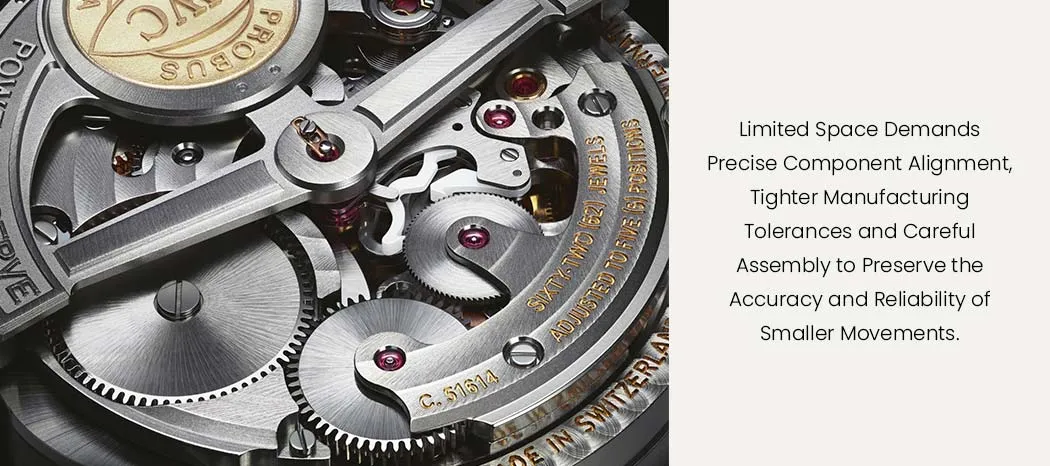
Creating a smaller watch means accommodating an intricate mechanical system within increasingly restricted dimensions. One of the biggest challenges of watchmaking lies in maintaining the precise relationship between components when there is very little room for adjustment, hence, the elements must be positioned with greater precision, leaving very little room for dimensional variations or assembly errors. Gears must remain properly aligned, pivots need sufficient clearance and moving parts must operate without unnecessary friction. Even a minor dimensional variation can affect the movement’s accuracy and long-term reliability. These demands become particularly significant when developing compact mechanical movements, where several components must work together within a tightly organised structure. Watchmakers also need to consider the practical difficulties of assembling, lubricating and servicing these mechanisms. For small luxury watches, the objective is not simply to reduce size but to preserve the mechanical sophistication, durability and precision expected from a fine timepiece. Achieving this balance requires considerable engineering expertise and meticulous attention to detail.
The Power Constraint: Storing Energy Within a Smaller Movement

A mechanical watch relies on its mainspring to store and release the energy required to keep the movement running. When the available space is reduced, designing the barrel and mainspring to deliver sufficient energy becomes increasingly demanding. A smaller barrel can limit the spring’s dimensions, potentially affecting the movement’s power reserve and energy delivery. This is where micro-engineering in watchmaking becomes particularly important. Through careful adjustments to component proportions and mechanical efficiency, watchmakers work to maximise available energy while minimising friction. Among the significant challenges of watchmaking, maintaining consistent performance within restricted dimensions remains a demanding aspect of watchmaking engineering.
The Structural Equation: Balancing Thinness with Durability

Making a watch thinner requires careful consideration of the strength and stability of its internal structure. Plates and bridges must support miniature components while maintaining precise alignment, even when their thickness is significantly reduced. If these structures become too delicate, they may be more susceptible to deformation, potentially affecting the movement’s accuracy and long-term reliability. This presents a particular challenge when developing compact mechanical movements, where every reduction in dimension must be carefully evaluated. Through micro-engineering in watchmaking, manufacturers explore materials, component geometries and construction techniques that preserve structural integrity without adding unnecessary bulk. For small luxury watches, achieving this balance is essential to ensuring that an elegant, reduced profile does not come at the expense of mechanical performance and durability.
Beyond the Mechanics: Designing for Everyday Usability

Miniaturisation must extend beyond the movement to ensure that a watch remains comfortable and practical to wear. As the case diameter decreases, watchmakers must carefully proportion the dial, hands and hour markers to preserve readability. Smaller hands and closely spaced indices can make time difficult to read, while an overcrowded dial may compromise visual clarity. The crown also needs to remain accessible, allowing the wearer to adjust the time without difficulty. These considerations introduce another dimension to the challenges of watchmaking, where functionality must complement reduced proportions. Through thoughtful watchmaking engineering, manufacturers ensure that compact mechanical movements can be housed within smaller cases without making the overall timepiece difficult to operate or read. The objective is to retain everyday usability alongside mechanical sophistication.
How Watchmakers Make Miniaturisation Possible
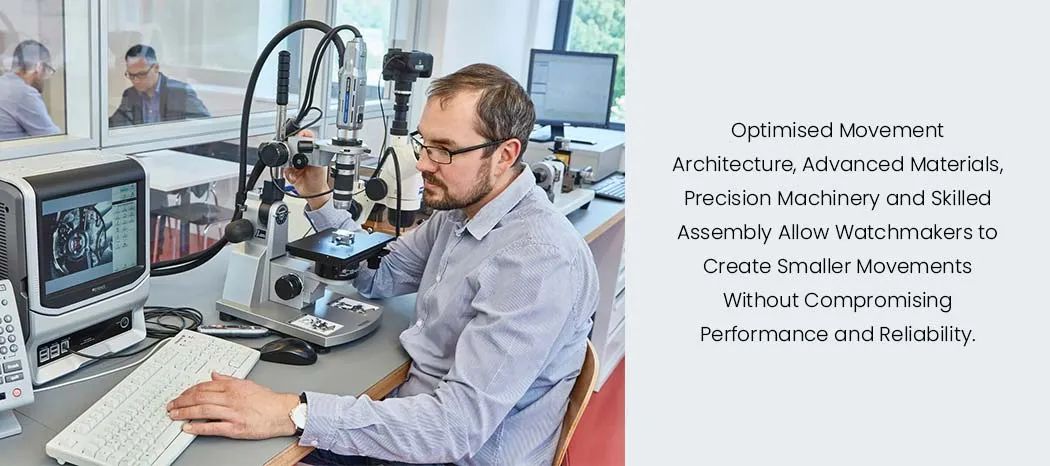
Overcoming the limitations of reduced dimensions requires watchmakers to rethink how a movement is designed, manufactured and assembled. Rather than simply shrinking individual components, they often reconsider the movement’s architecture, rearranging gears and other mechanisms to make better use of available space. Material selection also plays an important role, with modern alloys, silicon and synthetic jewels offering specific advantages in strength, weight and friction reduction.
However, precision design alone cannot achieve successful miniaturisation. Advanced manufacturing techniques, including CNC machining, allow components to be produced with exceptionally tight tolerances, while skilled watchmakers ensure their accurate assembly, lubrication and adjustment. This combination of technology and craftsmanship lies at the heart of micro-engineering in watchmaking. It allows manufacturers to create small luxury watches that retain the precision, reliability and mechanical sop
Kapoor Watch Co.
Kapoor Watch Co. has firmly established itself as one of India’s premier destinations for discerning luxury watch enthusiasts. With an outstanding selection of the world’s most prestigious watch brands, including Cartier, Omega, Breitling, and many others, we offer an exceptional curation of both heritage classics and modern masterpieces. Renowned for our unwavering commitment to authenticity, trust, and an unparalleled customer experience, we have become a name synonymous with premium horology across the country. Visit Kapoor Watch Co. Stores or explore our website today and experience the pinnacle of luxury watch retail.
Frequently Asked Questions
Why is it difficult to make a mechanical watch smaller?
Making a mechanical watch smaller requires reducing the dimensions of its internal components without affecting their ability to work together. Gears, springs, escapements and other mechanisms need precise alignment and sufficient clearance. Limited space also makes energy management, assembly and lubrication more demanding.
Does a smaller watch have a less powerful movement?
Not necessarily. A smaller movement may have less room for a mainspring and barrel, potentially limiting its energy storage. However, careful movement design, improved mechanical efficiency and reduced friction can help maintain a satisfactory power reserve and consistent performance.
Are smaller mechanical watches harder to manufacture?
Yes. Smaller components require extremely precise manufacturing, tighter tolerances and meticulous assembly. Even minor dimensional variations can affect the movement’s accuracy and reliability. Watchmakers must also ensure that the finished mechanism remains durable and practical to service.
What is one famous example of miniature watchmaking?
The Jaeger-LeCoultre Calibre 101 is a celebrated example of miniature watchmaking. Introduced in 1929, it remains renowned for its exceptionally small dimensions and intricate construction. Comprising 98 components, this hand-wound movement demonstrates how considerable mechanical sophistication can be achieved within an extraordinarily limited space.



Recent Posts
Recent Comments
Archives