
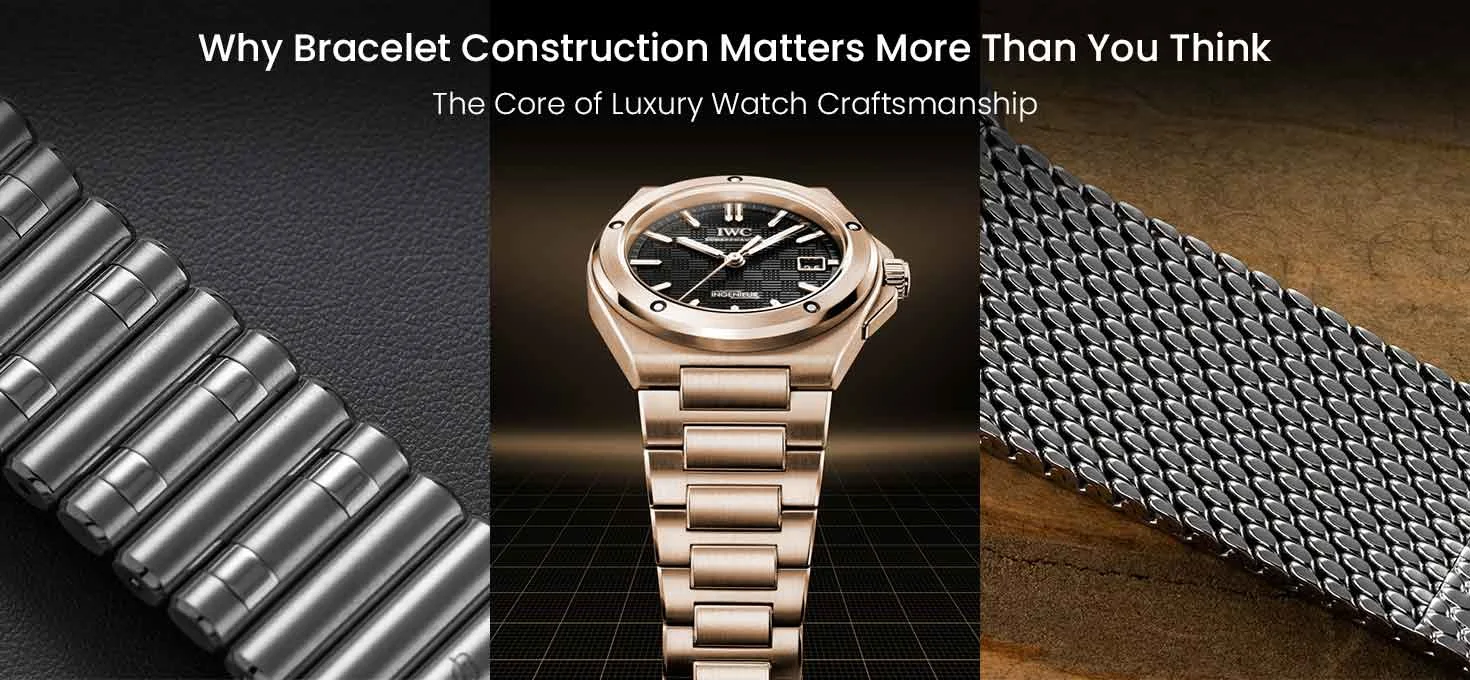
While buying a luxury watch, most buyers focus on the case size, dial colour, movement, and brand of the watch, while the bracelet construction receives far less attention, yet it is equally important. The way a luxury watch bracelet is designed, engineered, and assembled directly affects how the watch sits, moves, and feels during daily wear. Two watches with similar case dimensions can deliver completely different on-wrist experiences solely because of differences in links, tapering, articulation, clasp systems, materials, and adjustment mechanisms. Understanding watch bracelet construction helps buyers evaluate long-term comfort, weight balance, stability, and practicality rather than relying only on visual appeal or brand reputation.
Anatomy of a Watch Bracelet and Its Core Construction Elements
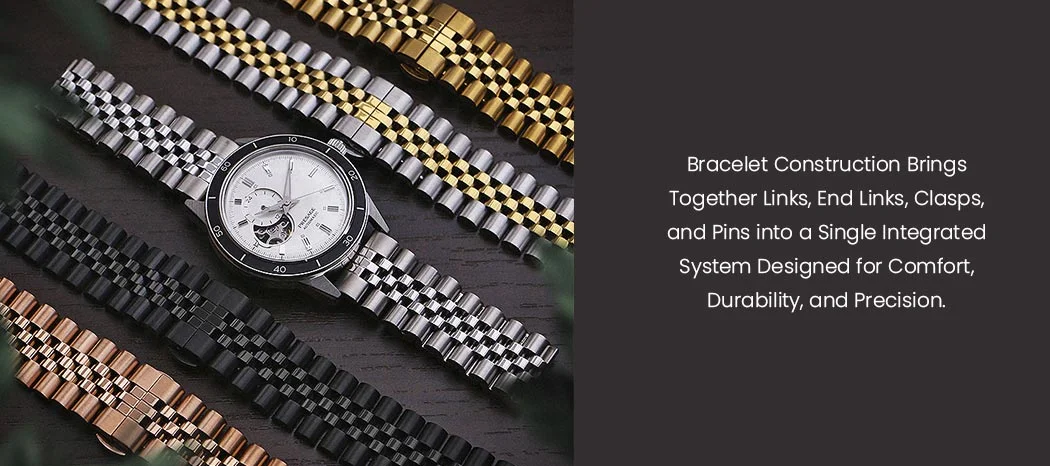
Bracelet construction covers the complete design, engineering, and assembly of a metal watch bracelet. It is built from several interconnected elements, each contributing to the comfort, durability and the overall performance of a luxury watch bracelet.
At its core are the links, the individual segments connected by pins or screws. These links may be solid or hollow, straight or curved, and finished with polished or brushed surfaces to achieve different aesthetics and functional characteristics. The end links connect the bracelet to the watch case and can be hollow or solid, with solid versions generally providing greater stability and better load transfer.
Securing the bracelet on the wrist is the clasp, a mechanism that ranges from simple folding designs to advanced systems with integrated micro-adjustments for a more precise fit.
Together, these elements work in harmony, determining the bracelet’s articulation, and its long-term durability. In luxury watch bracelet craftsmanship, these components are machined to exceptionally tight tolerances, allowing the luxury watch bracelet to function as a single integrated system rather than a collection of loosely connected parts.
Why Bracelet Construction Changes How a Watch Feels on the Wrist
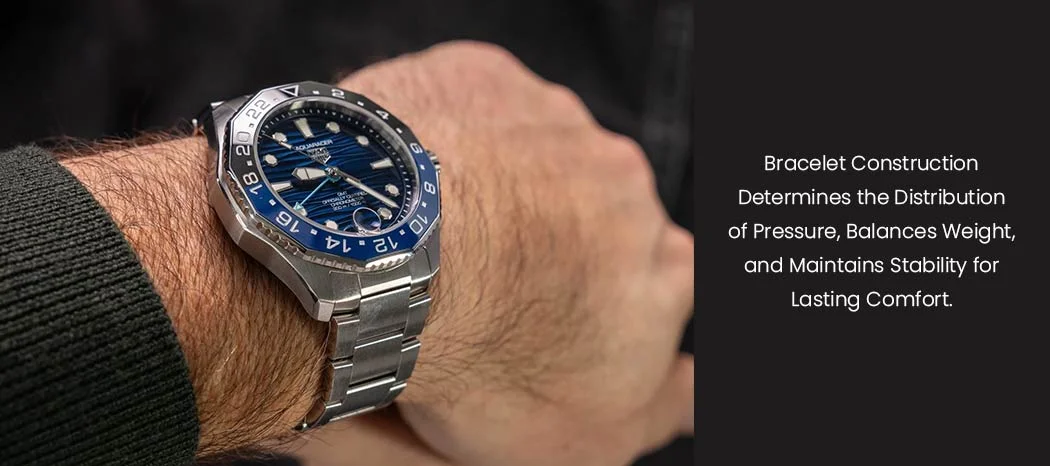
Two watches with identical case diameters can wear and move very differently once the bracelet enters the equation.
Long-term Comfort: Beyond the case itself, long-term comfort depends on how evenly the pressure is distributed across the wrist and whether the sharp edges or stiff sections dig in during the movement.
Weight Distribution: In a luxury watch bracelet the weight distribution improves when the bracelet effectively balances the mass of the case. A poorly balanced design, by contrast, leaves the watch feeling top-heavy and more prone to shifting.
Wrist Stability: The stability of a luxury watch on the wrist relies on the bracelet’s consistent contact without excessive play or rotation. Fit also plays a crucial role, as wrists naturally expand and contract with changes in temperature and activity.
Ease of Adjustment: As the wrists expand and contract with temperature and movement, a bracelet should be easy to adjust as limited coarse link removal in a watch bracelet construction can often result in an imperfect fit, throughout the day.
So, by addressing each of these factors, a high-quality watch bracelet construction ensures the watch remains secure, and comfortable even during extended periods of wear.
Features that Make a Well-Designed Watch Bracelet
- Link Design That Supports Comfort and Flexibility
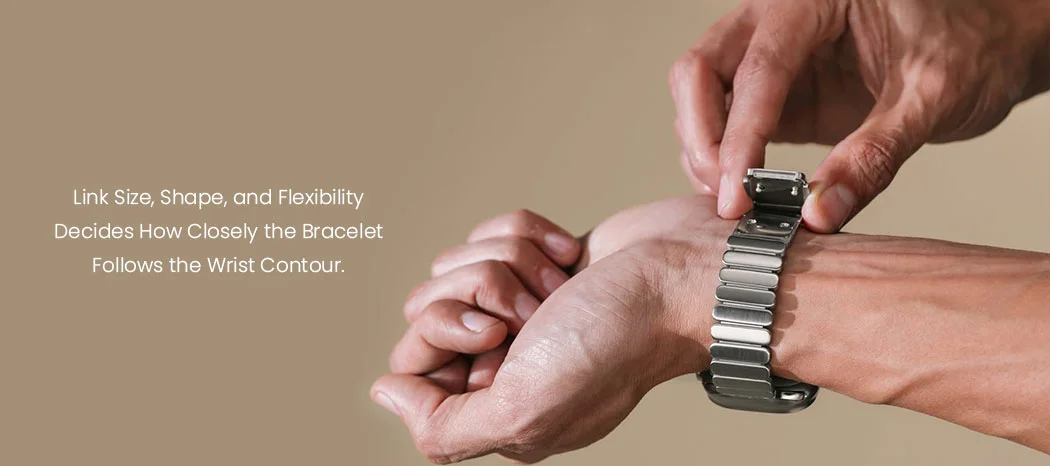
Link design begins with size and shape, where broader flatter links create a more rigid structure suited to sportier aesthetics while smaller or multi-piece links introduce additional articulation points that increase flexibility and allow the bracelet to conform more closely to the wrist’s irregular contours, thereby reducing friction and minimising pressure spots.
Chamfered or polished edges prevent sharp contact with the skin, and the precision of the pivots between links controls side play so that excess movement does not produce rattle or hair-pulling while insufficient play does not leave the bracelet stiff.
In luxury watch bracelet craftsmanship these links and pivots are machined to tight tolerances that maintain smooth articulation over years of daily flexing, and although five-link layouts often feel more supple than three-link designs because of the greater number of pivot points, overall comfort depends more on machining quality and link pitch than on the link count alone.
- Clasp Design for Security and Everyday Use
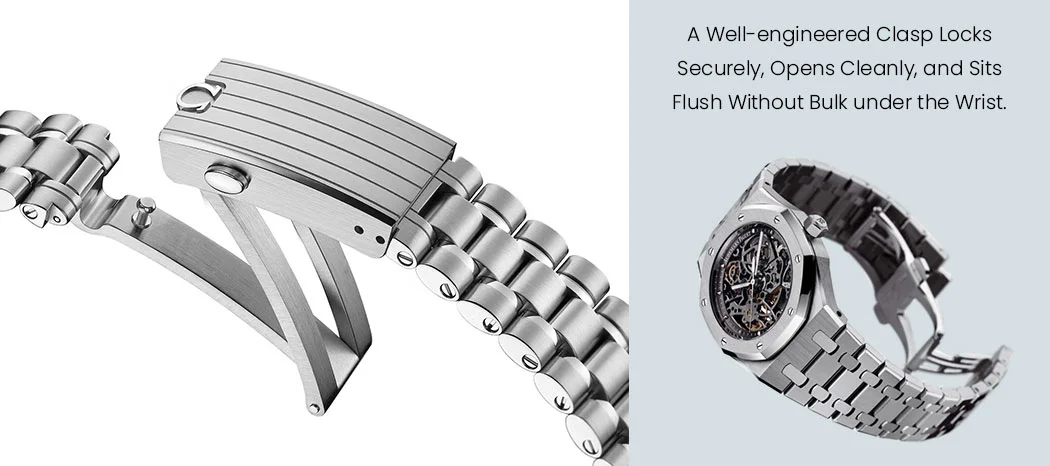
The clasp is one of the most critical components of watch bracelet construction because it carries the full tensile load and endures the highest number of open-and-close cycles. A well-engineered clasp engages with a positive, crisp action and often includes a secondary safety lock for added security.
Deployant and butterfly designs fold flat so the mechanism remains discreet once closed, while push-button releases operate with minimal effort and open wide enough to pass over the hand without stressing the links. An overly thick profile creates an uncomfortable ridge under the wrist, so the clasp must integrate smoothly with the bracelet’s taper and finish to keep a continuous visual line.
Modern designs often add micro-adjustment systems that allow small length changes without tools or link removal, improving everyday practicality and fit.
Tapering from Lugs to Clasp and Its Practical Effect
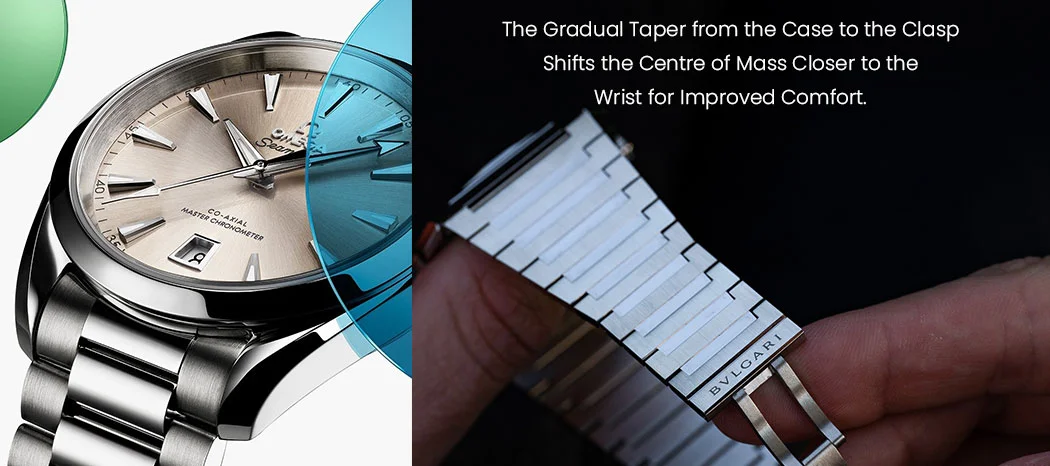
Tapering is the gradual reduction in the luxury watch bracelet width and sometimes thickness from the case lugs toward the clasp. It serves both aesthetic and engineering purposes.A wider section at the lugs creates a stable interface with the case and helps close the gap that can form between the watch and the wrist. As the bracelet narrows toward the clasp, the smaller links reduce the moment of inertia and shift the centre of mass closer to the wrist, making the watch feel more balanced and less top-heavy.
This transition is achieved by milling successive links to incrementally smaller dimensions so the change remains smooth. When done correctly, tapering improves visual proportions and physical balance without reducing structural strength. This technique is a fine example of watch bracelet craftsmanship.
Material Choice and Hypoallergenic Performance
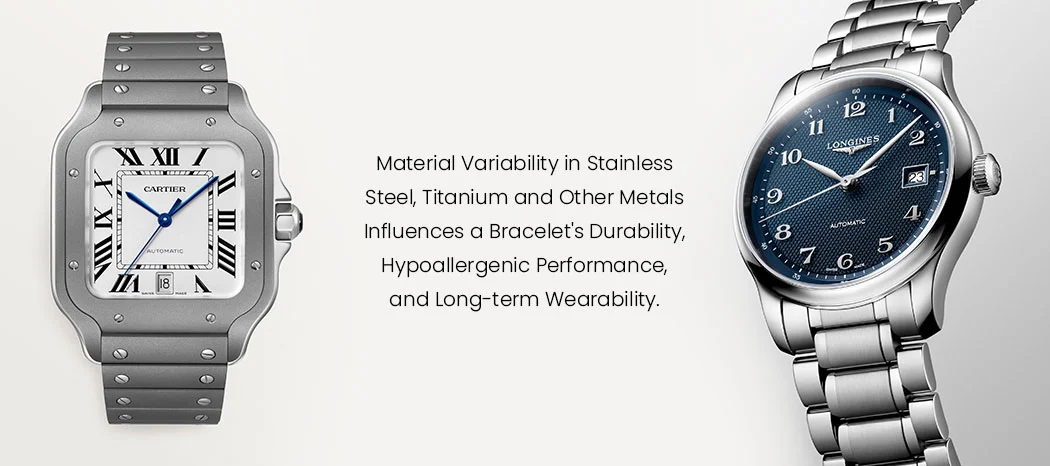
Material selection determines a bracelet’s durability, comfort, and long-term performance. Luxury watch bracelets commonly use 316L or higher-grade stainless steel, titanium alloys, and precious metals.
Stainless steel delivers strong corrosion resistance at moderate weight, while titanium cuts mass without losing strength and remains hypoallergenic for most wearers. Precious metals add density and a distinct feel but need careful alloying for everyday hardness.
Surface finishes, brushed, polished, or mixed, affect both appearance and skin contact. For continuous wear, hypoallergenic properties matter because materials that limit nickel release or stay inert reduce irritation risk. Solid construction resists stretching better than hollow links, and quality alloys keep their surface integrity longer.
Kapoor Watch Company
At Kapoor Watch Co., we bring together an exceptional collection of luxury watch brands, including TAG Heuer, Longines, Rado, Cartier, Chopard, Franck Muller, Hublot, Omega, and many more. Every timepiece reflects a unique blend of precision, craftsmanship, and innovation, with careful attention to the watch bracelet construction that shapes comfort, weight distribution, wrist stability, and ease of adjustment.
Visit Kapoor Watch Co. Stores to explore such iconic luxury timepieces and experience the horological excellence behind the world’s leading watchmakers, firsthand.
Frequently Asked Questions
What is bracelet construction in a luxury watch?
Bracelet construction in a luxury watch refers to the high-precision engineering, articulation, and integration of metal links designed for maximum comfort, durability, and seamless aesthetic flow. Key features include solid metal links, fluid articulation, and on-the-fly micro-adjustments.
Why do some bracelets feel more comfortable than others?
Comfort differences arise from link flexibility, edge finishing, weight distribution, taper profile, and the presence of micro-adjustments in the bracelet.
What is bracelet tapering?
Tapering is the progressive narrowing of the bracelet width from the case lugs toward the clasp. It improves balance by shifting the mass closer to the wrist and reduces bulk under the arm.
What is a micro-adjustment system?
A micro-adjustment system is a fine-tuning mechanism built into a watch clasp or buckle that lets you change the band length by small millimeters. It helps you fix the fit when your wrist changes size from heat, cold, or activity.
Can bracelet design affect watch comfort?
Yes. Link shape, articulation quality, taper, clasp bulk, and material all influence how the watch sits, moves, and feels during extended wear.
Are five-link bracelets more comfortable than three-link bracelets?
Yes, five-link bracelets (often called Jubilee styles) are generally considered more comfortable than three-link bracelets (like the Oyster style) because their smaller, more numerous parts bend more easily and hug the wrist shape closely.


Recent Posts
Recent Comments
Archives