
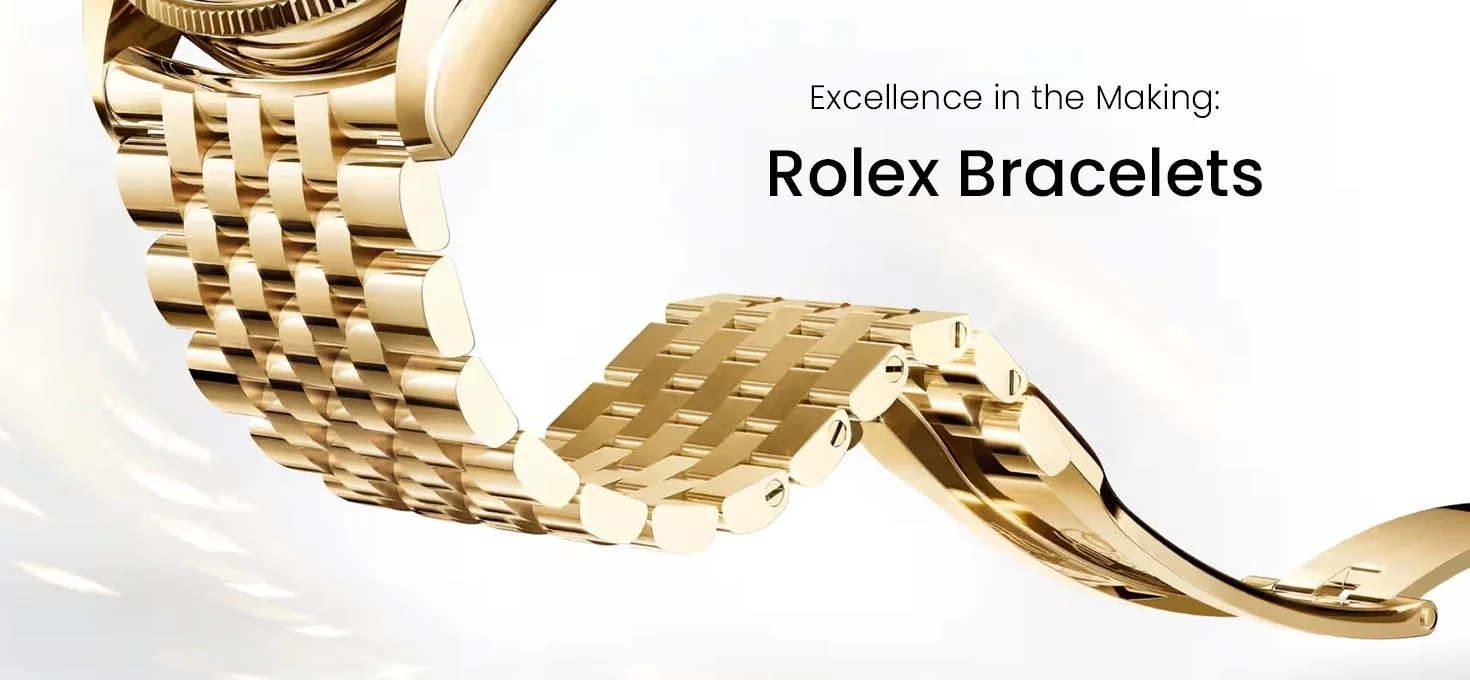
The part of a watch which plays an extremely crucial role, yet one that flies gently under the radar, would be the bracelet. It holds the watch around your wrist, it sets a tone and sense of balance, defining proportions and silhouette. With a Rolex, the bracelet is an integral part of the watch, one that sits flush and yet stands out. In that sense, it isn’t “integrated” – although they have introduced that too – meaning that it doesn’t simply become a small part of the larger design language of the watch. All Rolex bracelets command a presence of their own – announcing their identity even before the deliberately teasing wrist-roll has revealed the timepiece.
In the Beginning
Unlike many watchmakers of the time, Hans Wildorf, all of 24 in 1905, briefly worked for a Swiss watch company in Bienne. Later in the same year, he had already devised a way to fit those relatively compact Swiss movements into cases, thereby launching the brand as a wrist-watch producer.
This was a time when most people thought that a wrist watch was nothing more than women’s jewellery and that there could never be a way to fit a solid and reliable watch movement into a case so tiny and well-built that it could survive being swung around all day at the end of your arm.
The Chronology
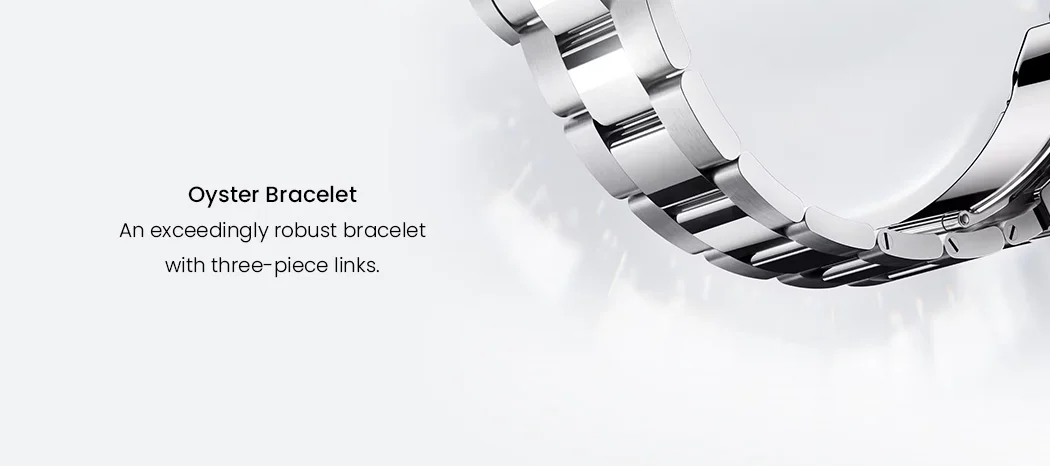
The late 1930s marked the advent of one of Rolex’s key visual cues – the Oyster bracelet. The Oyster case was the world’s first waterproof and dustproof watch case and was invented almost a decade earlier, back in 1926. So, when the famed swimmer Mercedes Gleitze swam across the English Channel wearing one (a good way to advertise the watch’s hermetically sealed case), it was worn on a strap and not a bracelet.
But the oyster bracelet was another attempt at furthering the limits of what was expected of a watch. For Wildorf, it was a tool first, one that should evolve with the times. This was what led to the birth of the original 3-link metal bracelet, possibly in steel. This trinity of sorts is the first mention of a bracelet in the Rolex archives – sometimes with a polished centre link flanked by two satin-finished ones, or else with all in a satin finish.
Today, the Oyster bracelet is present across watches in the collection, except on the Day-Date and the Land-Dweller. Depending on whether the watch is from a Classic category or a Professional model, said bracelet will sport an Oysterclasp or an Oysterlock clasp, respectively.
Jubilee Bracelet
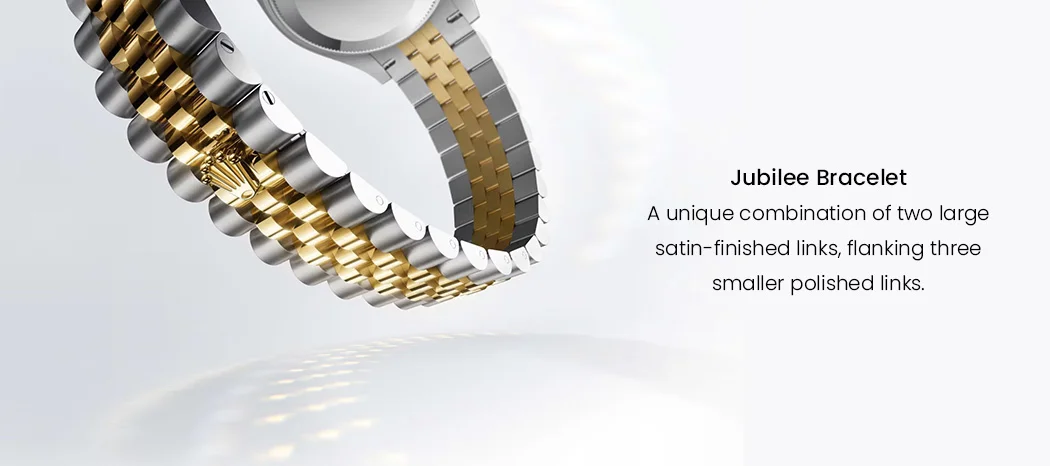
Next came the Jubilee bracelet and although it took years of research, it was launched in 1945 on the Datejust, all timed to coincide with the brand’s 40th anniversary. A wrist chronometer which could display the date was a first for the time and quite the mechanical achievement. The 5-link combination of 3 small polished inner links connected to broader satin-finished ones on the sides was designed specifically for this watch, and it carries an extremely strong sense of recognition and emotion in the world of horology. The Jubilee bracelet is fitted with a concealed Crownclasp (Lady-Datejust and Datejust 31), an Oysterclasp (Datejust 36, Datejust 41 and Sky-Dweller) or an Oysterlock clasp (GMT-Master II) and remains one of the most iconic visual brand elements for the Datejust, along with the fluted bezel and the date window (with a cyclops lens after 1953).
President Bracelet
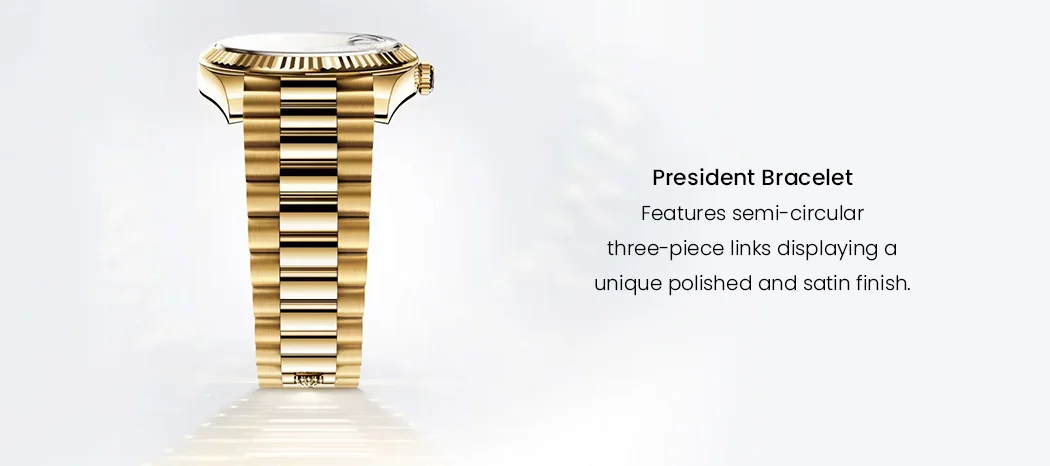
The President bracelet was introduced in 1956, on the Day-Date watch, and has only ever been produced in 18 ct yellow, white or Everose gold or 950 platinum and fitted with a concealed Crownclasp. The semi-circular three-piece links is symmetric and lets the eye glide over its harmonious textured sheen. It is exclusively found on the Day-Date or the precious metal versions of the Datejust (Datejust 31).
Oysterflex Bracelet
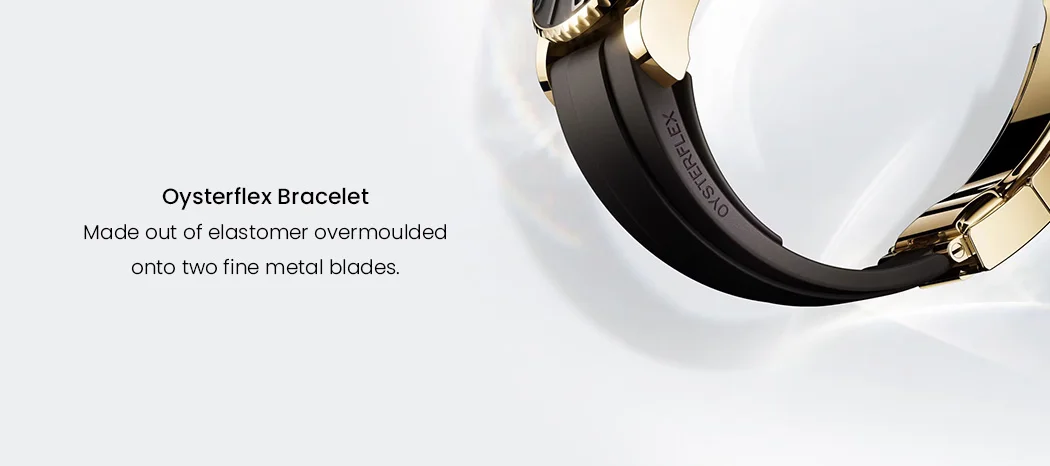
2015 was the year when the brand took innovation with materials to new frontiers with the Oysterflex bracelet made out of elastomer overmoulded onto two fine metal blades. It was intended as a technical innovation, one that could amalgamate the flexibility and each-of-wear of an elastomer strap without compromising the reliability of a metal strap. The Oysterlock safety clasp further prevents any sudden or accidental opening. Two longitudinal cushions run on the inside, almost like two ribs, which add a layer of cushion to deliver unmatched comfort. All these factors explain why it was first introduced on the Yacht-Master 37 when it was launched in 2015. Thereafter, it made its way onto the Yacht-Master 40 and subsequently, the Cosmograph Daytona and the Yacht-Master 42. It remains reserved for certain models and even then, only for 18 ct gold variants. It does, however, make an appearance on one watch from the Classic category – the Rolex Sky-Dweller, but with an Oysterclasp. This was the only non-metal inclusion here, but it does have a metal skeleton running underneath.
Flat Jubilee Bracelet
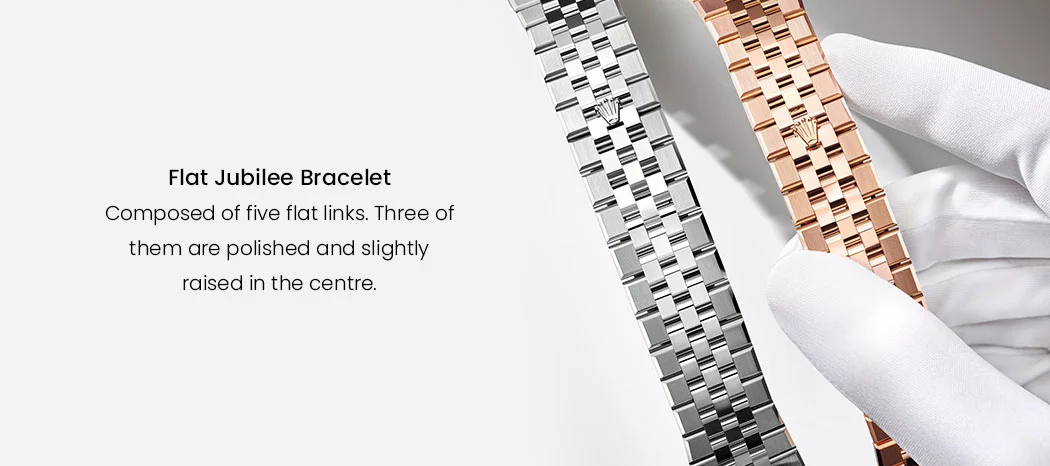
In 2025, Rolex treated us to the Land-Dweller, their first integrated bracelet wristwatch, which was showcased on a Flat Jubilee bracelet. The continuity of this watch almost feels enhanced when viewed as a whole, as the eye rolls off the case and onto the five flat links — the three middle ones are polished and gently raised while the two wider links on the flanks exhibit a technical satin finish. The case and the bracelet are attached by an invisible ultra-resistant attachment system which makes this seamlessness possible.
Settimo Bracelet
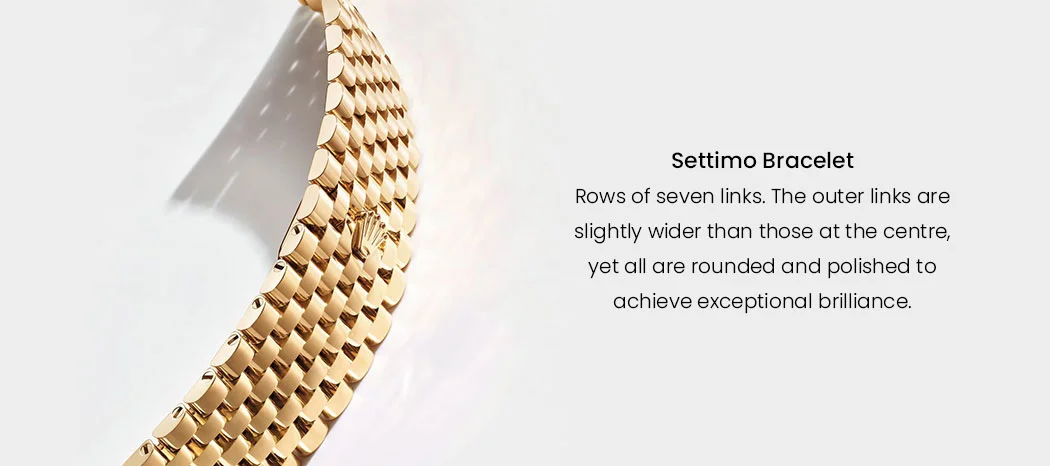
Rolex wasn’t done, for, also in 2025, we got to witness the birth of another masterpiece, the Settimo bracelet. For those who attended Italian 101, this one is made of seven links, very small and slightly contoured, with the outer ones being slightly wider, and all links polished to what the house terms, ‘exceptional brilliance’. The Crownclasp is almost invisible on this one, and overall, this bracelet is a lovely balance of strength and elegance. It is delicate and precious, sophisticated and refined, high on comfort and novel in appearance. This one is reserved for the 1908 in yellow gold.
But Also This…
Just having a unique bracelet isn’t enough – one has to ensure longevity while accounting for hours of usage and the wear and tear that time inflicts. To this end, in models like the Oyster, Jubilee, Flat Jubilee and President – Rolex works with small ceramic inserts in these pieces, especially when they are crafted in all 18 ct gold, 950 platinum or RLX titanium (except on the Lady-Datejust in 18 ct yellow or Everose gold).
For locking the systems are Oysterclasp, Crownclasp, and the Oysterlock are the three used across the metal bracelets, depending on the watch nomenclature. Beyond this, some bracelets incorporate an extension system
- Easylink (1996) – Patented concealed under the clasp and with an ability to extend the girth by 5mm without needing any special tools.
- Glidelock (2008) – A patented system allowing for 15-20mm of notch-by-notch adjustment on the go, this is found on dive watches and those fitted with the Oysterflex.
- Fliplock – This is exclusive to Oyster Perpetual Deepsea and it can expand by 26mm, which will make it easy to wear even over a 7mm thick wetsuit, the kind which are used for diving in cooler waters.


Recent Posts
Recent Comments
Archives