

Modern ṣis filled with complications designed to make everyday life easier. From chronographs to moonphase displays, each feature serves a specific purpose beyond simply telling the time. For frequent travellers, pilots or anyone working across different parts of the world, one complication stands out as particularly useful and that is the ability to track more than one time zone. As international travel and global communication became more common, watchmakers began developing mechanisms that could display multiple time zones simultaneously. This innovation gave rise to two well-known watch complications that are often confused with each other. Discussions about Dual Time vs GMT are common among enthusiasts because both functions seem to offer the same capability at first glance. However, while they serve a similar purpose, the way they display and manage additional time zones is quite different. Understanding how these mechanisms work helps appreciate the technical creativity behind them and makes it easier to choose the right watch for your needs.
Understanding GMT Watches
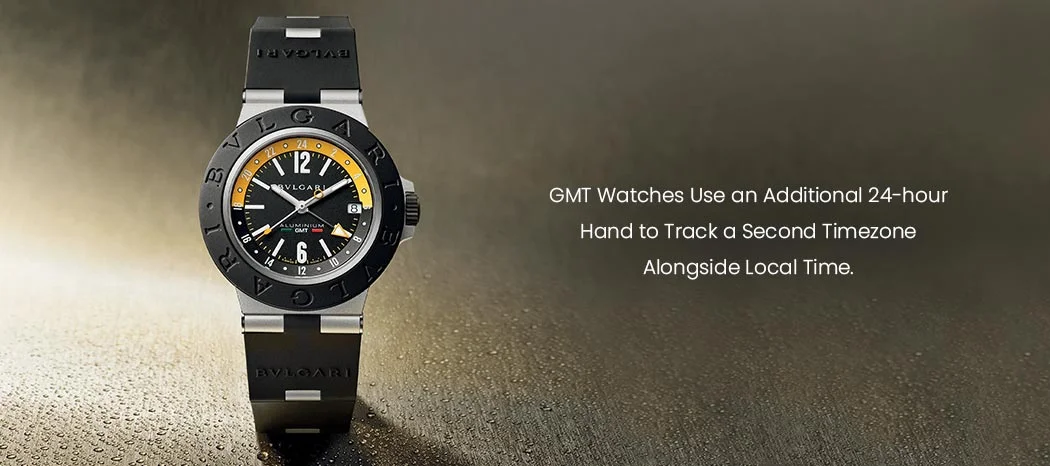
The concept behind GMT watches traces back to the era of long-distance aviation, when pilots needed a reliable way to track both local time and Greenwich Mean Time during flights. Coordinating flights across continents required a standardised reference point, and GMT served as that universal time standard. Watchmakers responded by creating a complication that allowed a watch to display two time zones simultaneously without compromising readability.
A typical GMT watch includes an additional hand that completes a full rotation around the dial every 24 hours. Unlike the regular hour hand, which circles the dial twice a day, this extra hand moves once every 24 hours. It works together with a 24-hour scale, which is usually printed on the dial or placed on a rotating bezel. Reading the watch is fairly straightforward once you understand the system. The main hour and minute hands show the local time in the usual 12-hour format. The additional hand points to the 24-hour scale, indicating the time in another location. Because the scale covers the full day, it also makes it easy to distinguish between day and night in the second time zone. Some designs go even further by incorporating a rotating bezel with a 24-hour scale. When adjusted, this bezel can allow the wearer to track a third time zone temporarily, making the watch especially useful for travellers or professionals coordinating across multiple regions.
Beyond practicality, the appeal of GMT watches also lies in their heritage. Their association with aviation and exploration has given them a reputation as functional tool watches, designed for real-world use rather than purely aesthetic purposes. Over time, the complication became popular not only among pilots but also among collectors who appreciate the blend of utility and mechanical ingenuity. Because of their distinctive extra hand and the presence of a 24-hour scale, these watches are often immediately recognisable. For many enthusiasts, they represent one of the most practical and historically significant travel complications in modern horology.
Understanding Dual Time Watches
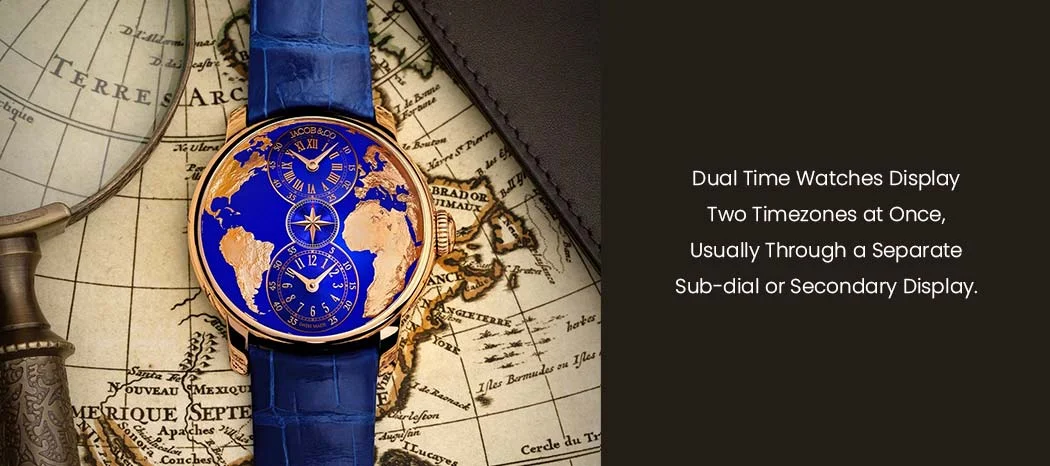
While GMT mechanisms rely on a 24-hour hand and scale, Dual time watches approach the problem of multiple time zones in a more visual and straightforward way. Instead of using a single dial with a special hand, they often display the second time zone through a separate indicator such as a sub-dial or an additional hour display.
This layout allows the wearer to read two time zones at a glance without interpreting a 24-hour scale. In many cases, the main dial shows the local time while a smaller sub-dial displays the time in another location. Some designs also include a day-night indicator to help distinguish between morning and evening in the second time zone. Because the two displays are separate, the mechanism is often easier for first-time users to understand. You simply read each dial like a regular watch face. This simplicity makes Dual time watches particularly appealing for people who frequently coordinate with colleagues, friends or family members in another country.
Another advantage is design flexibility. Watchmakers can integrate the second time zone in various ways, from subtle sub-dials to clearly separated displays. This allows the complication to appear in both sporty travel watches and more formal timepieces suited for everyday wear. Despite their simplicity, these watches remain highly practical for travellers. Instead of mentally converting the time using a 24-hour scale, the wearer can simply glance at the second dial. For professionals who regularly communicate across time zones, this convenience can make a noticeable difference during busy schedules.
Dual Time vs GMT: What Sets Them Apart
Display Format:
When comparing Dual Time vs GMT, the most noticeable difference lies in how the second time zone is displayed. GMT mechanisms rely on a 24-hour hand paired with a 24-hour scale, while dual time designs typically use a separate dial or display. Both methods achieve the same goal but present the information in distinct ways.
Reading the Second timezone
Another key distinction in the Dual Time vs GMT discussion is how the second time zone is read. With a GMT system, the user must interpret the additional hand against a 24-hour scale. This approach is precise and efficient but it can take a moment to get used to. Dual time displays, on the other hand, present the second time zone in the familiar 12-hour format making it instantly recognizable.
Dial Designs and Aesthetics:
Design also plays a role in the Dual Time vs GMT comparison. GMT watches often have a more technical appearance due to the extra hand and the presence of a 24-hour scale or rotating bezel. Dual time designs tend to look cleaner, especially when the second time zone is placed in a discreet sub-dial.
Functionality:
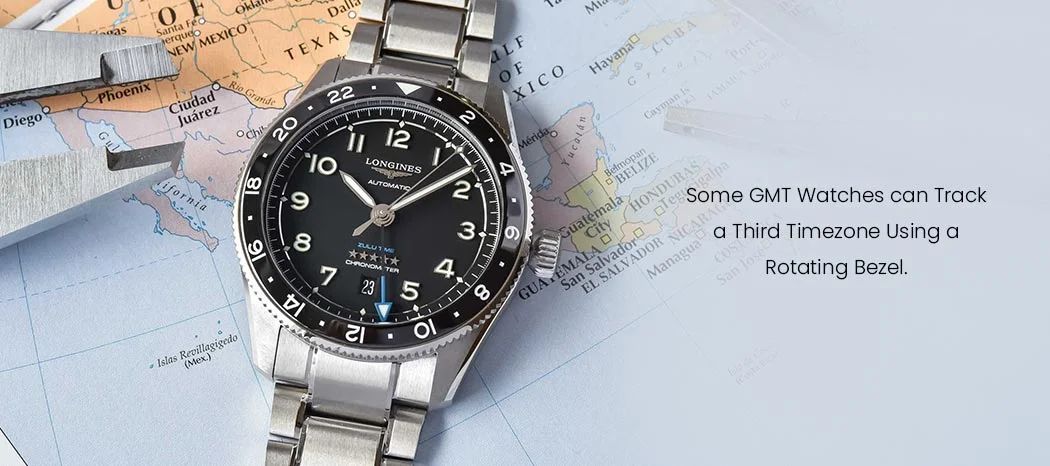
Functionality can differ slightly as well. Some GMT watches can track a third time zone by rotating the bezel which is not typically possible with dual time designs. However, dual time watches prioritize clarity making them particularly convenient for everyday use.
Ultimately, the debate around Dual Time vs GMT is less about which complication is better and more about which style of display suits the wearer’s preferences and lifestyle.
Which One Should You Choose?
Choosing between GMT watches and Dual time watches depends largely on how you plan to use the watch and what kind of display you prefer. Both complications are designed to help track multiple time zones but they cater to slightly different preferences.
For travellers who enjoy the technical aspect of watchmaking, GMT watches offer a fascinating mechanism and a strong connection to aviation history. The rotating bezel and 24-hour hand also provide additional flexibility for tracking multiple regions. Dual time watches, on the other hand, are often favored for their straightforward readability. The separate display for the second time zone removes the need to interpret a 24-hour scale making them particularly practical for everyday communication across countries.
Collectors often find themselves appreciating both styles for different reasons. One emphasizes mechanical ingenuity, while the other prioritises simplicity and clarity.
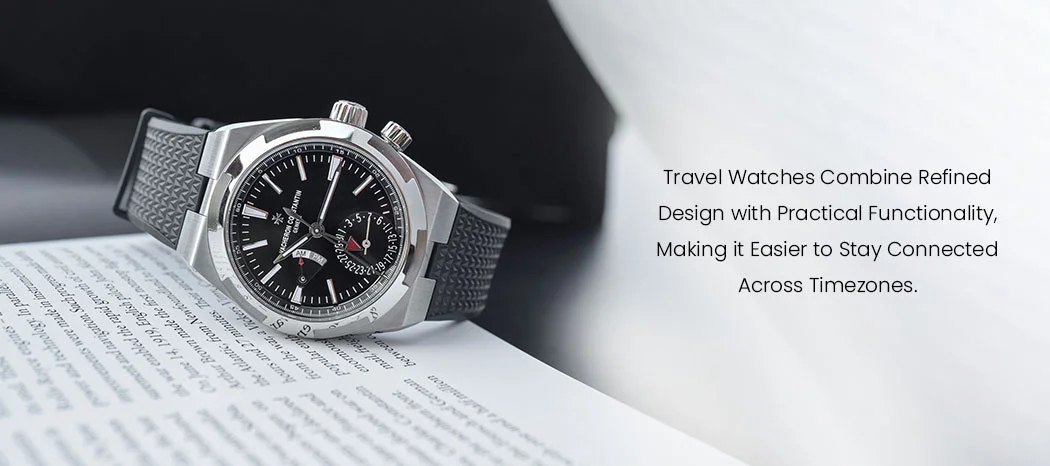
The evolution of travel complications reflects how watchmaking adapts to the needs of a connected world. While both designs aim to help the wearer track multiple time zones, they approach the challenge in distinct ways. GMT watches rely on a technical system involving a 24-hour hand and scale, while Dual time watches display a second time zone through a separate dial or indicator. Each method offers its own advantages in terms of readability, design and functionality.
Understanding the differences not only makes it easier to choose the right watch but also highlights the creativity that defines modern horology. Whether one prefers the mechanical charm of GMT watches or the straightforward clarity of Dual time watches, both complications remain practical tools for navigating life across time zones.
Kapoor Watch Co.
At Kapoor Watch Co., we take pride in being one of India’s leading authorized retailers of luxury watches. Since our founding we have grown into a trusted destination serving watch enthusiasts and collectors across the country. Through our curated selection of prestigious luxury watch brands, dedicated service centre and expert guidance, we strive to provide an authentic luxury watch experience while helping our customers discover timepieces that truly reflect their style and passion. Visit the Kapoor Watch Co. Stores or the website now and get your perfect piece for the wrist.

Recent Posts
Recent Comments
Archives