
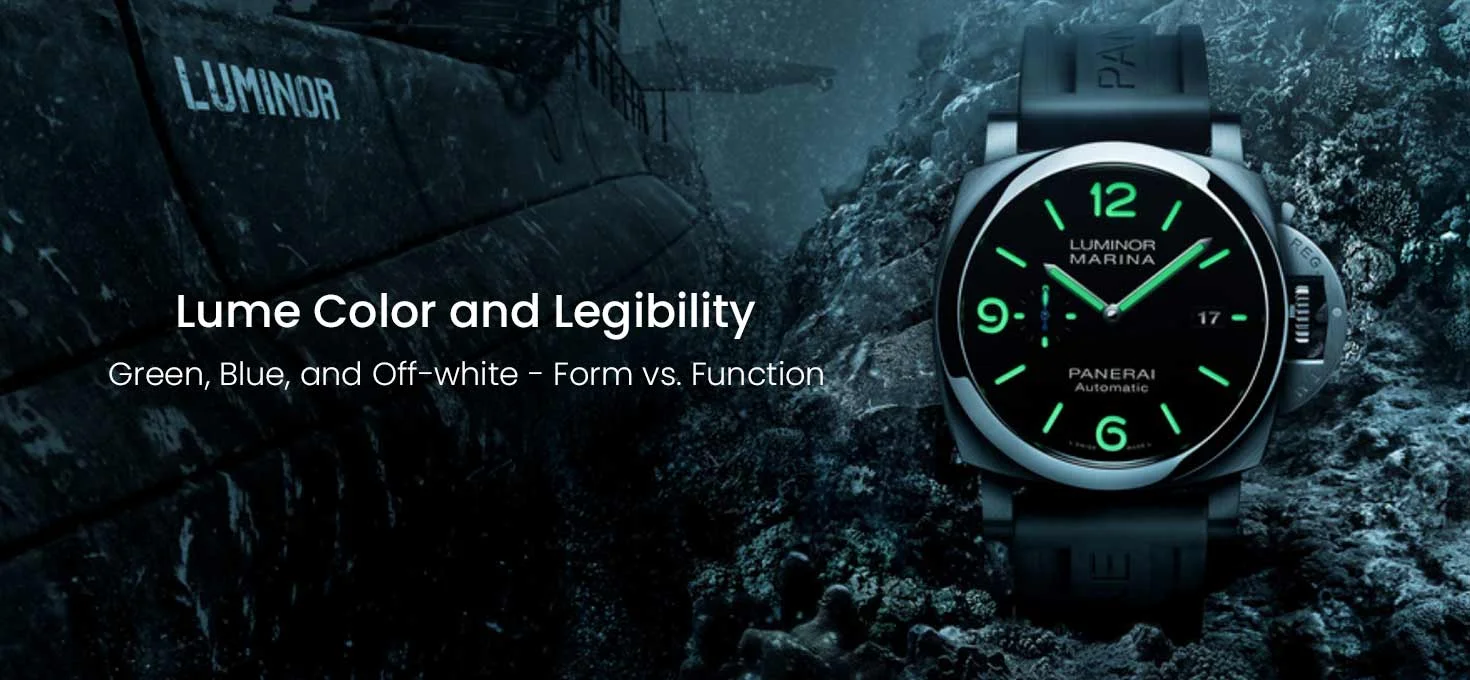
The first rule of watch collecting is that nobody has enough watches. Also, not all watches are born equal, more than the price, the effort put into acquiring them can make for a lovely story – a simple hand-wound analog, a hand-me-down with family ties, or a grand complication-loaded once-in-a-lifetime purchase, each story commands a different level of reverence and respect.
But, once the lights go off, then it is every lume for themselves. Darkness is like democracy then, and only the brightest shine through.
As a kid, luminescence (or lume, for short, for not only is it easier to write, it is also easier to pronounce) in a watch was a mark of quality. If a watch could glow and tell time at midnight in a forest on a New Moon and that too without needing a battery or any other mechanism to make it happen, that was truly a warrior on the wrist – an illuminated David, standing up to the Goliathan giant that was in darkness. Surely that was a sign of a solid piece of quality material. That is all my little mind could comprehend back then. Mechanically, a flawed belief, but philosophically, I was quite the rockstar!
Why Lume
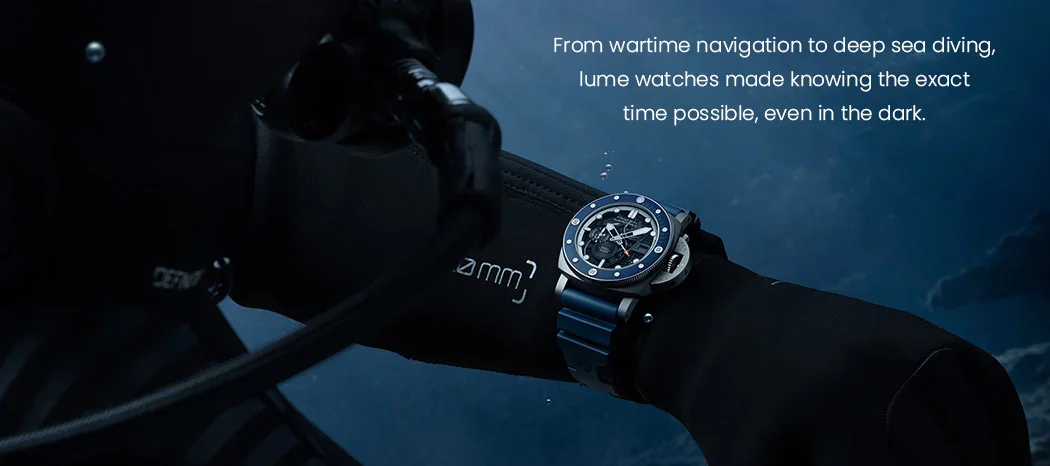
Why do watches glow? As in, why do they need to? Or more correctly, why do we need them to illuminate? Well, for one, certain conditions arose which necessitated for us to know the exact time well past sunset. Managing a lighthouse by the sea, sending time-sensitive information especially war-time messages for coordinated manoeuvres, calculating time underwater during a dive sortie, all these would have required the clockwork precision of a ballet and the accompanying orchestra. Lume made all this possible, no matter the time of the day.
Or night.
History of Lume
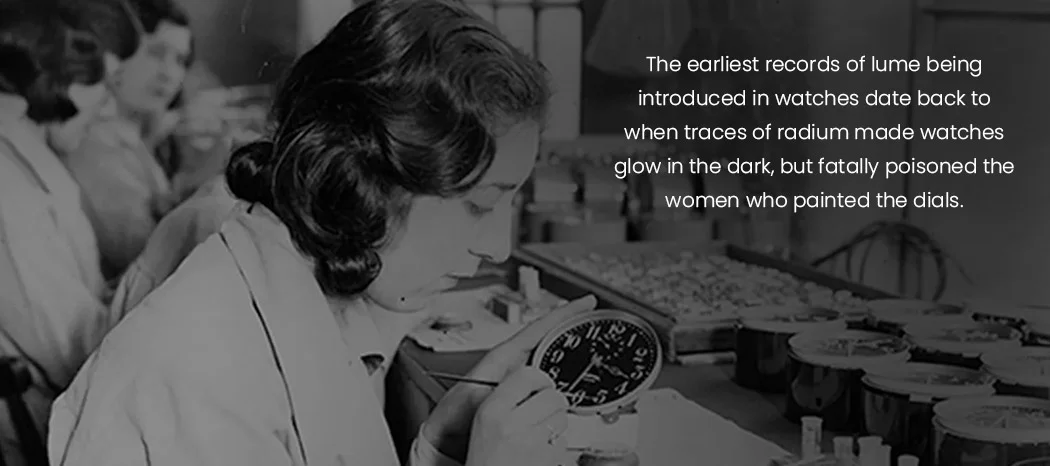
The earliest records of lume being introduced in watches date back to when traces of radioactive materials were introduced into watch dials. A gentle coating of Radium, which is radioactive, would emit a mild glow, and paint enriched with this could be applied on the hands of watches, which would have facilitated time telling in the dark. Ironically, the wearers of these radioactive watches didn’t face as much risk of radiation as the women in the factories who applied the luminescent paint onto the watch hands. As the gory story goes, women were asked to dip the brushes in the paint and then lick the tips of said brushes before application, in order to make the ends more pointed and precise in application. As one can imagine, this could not have been advisably sane. Consequently the women fell severely ill and died, which later on led to major safety reforms in the workings of the watch industry (Radium Girls’ lawsuit in the 1920s).
As for the wearers, well, most of the radiation emanating from Radium is alpha, the kind which a watch case can shield the wearer against. It is the gamma ray component (and a lot of it at one time) that can turn one into the Hulk. But the watches, luckily, just didn’t have enough juice to bring on the mutation. But Radium decays to Radon gas and if that escapes, it is quite lethal. With a few such radium-painted pieces in your drawer, one could be said to have, pun intended, a ticking time bomb.
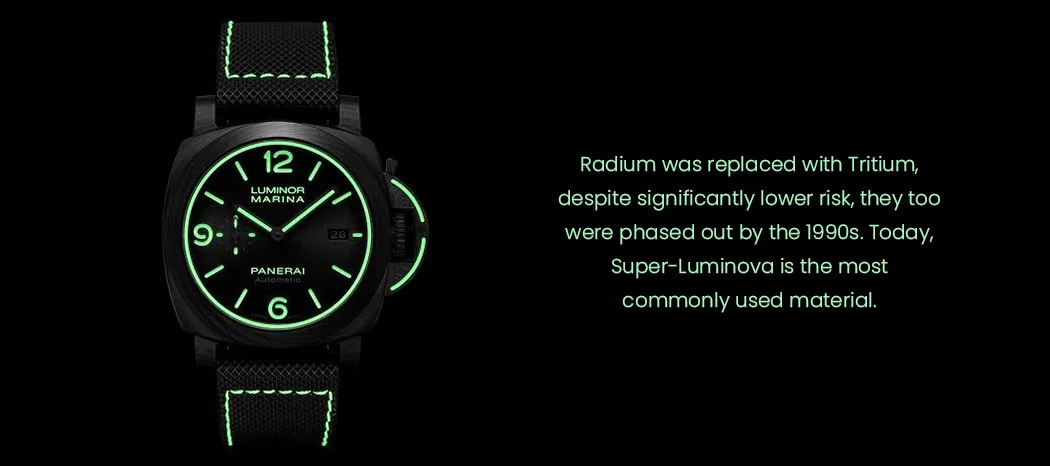
Eventually, Radium was replaced with Tritium (tubes) and, in spite of the significantly lower risk they pose, they too were phased out by the 1990s.
Lume Today
Safety accounted for, what colour should the Lume be? That was the next raging debate for years, pitting brands and scientists and researchers against each other. Here are the facts though. The human eye is most sensitive to wavelengths around 555nm which corresponds to shade green-yellow. Colours in the vicinity of this wavelength would appear brightest to the human eye under all conditions. This quickly became the benchmark for luminescence in watches. The nomenclature C3 of Super-LumiNova is the strongest shade on the scale and everything else is measured (down) from here. It is uncoloured but shines green in the dark.
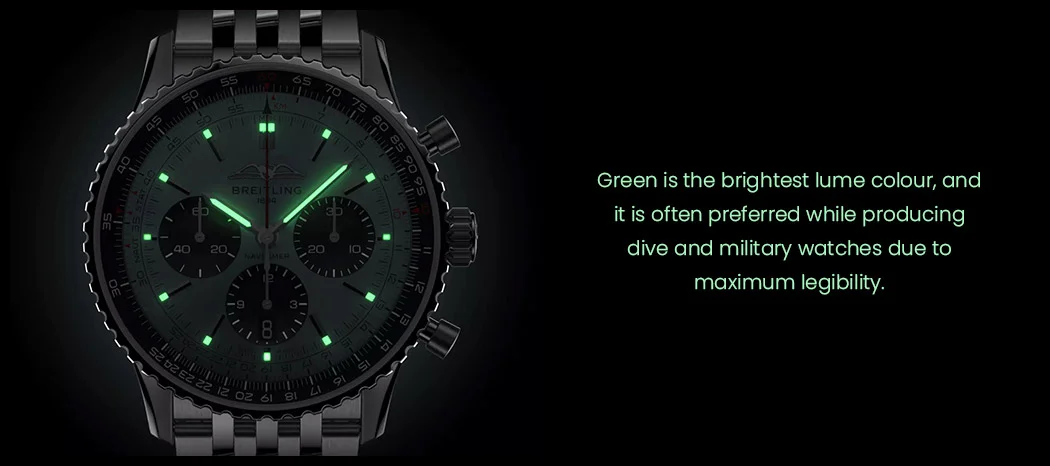
Green is not only the brightest but it is also the easiest to shift to for the human eye when luminosity situations change rapidly. This is the colour preferred by most dive watches and even many military watches as the maximum legibility is much sought after in those fields.
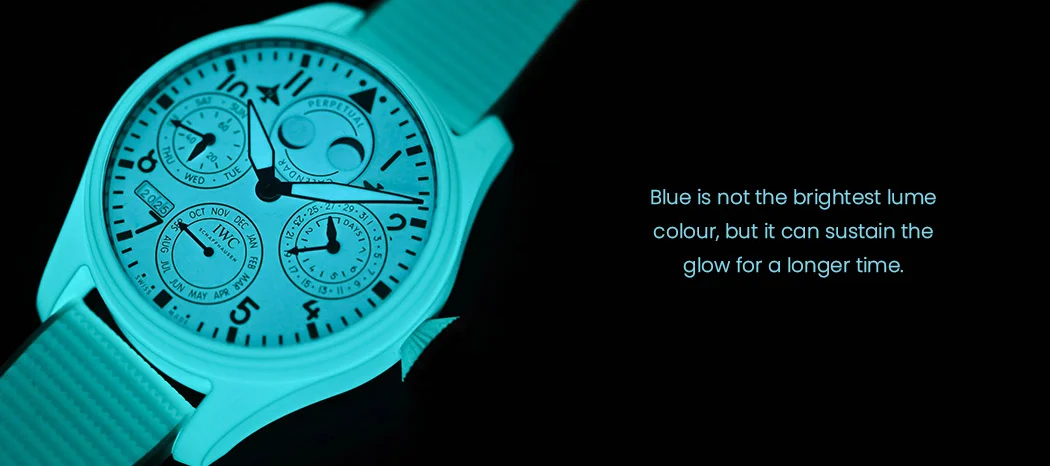
(examples:
Blue comes next, not the brightest but one that can sustain the glow for a longer time. So, it had a case to make and many takers like the alternative – variety, spice and all that. Design-driven pieces with more urban usage than a standard tool watch is what made blue popular and why it is still around. Pilots seemed to prefer blue, (matches their workplace aesthetic perhaps) and hence it came to be that dive watches went for green while the aerial ones went blue.
(examples:
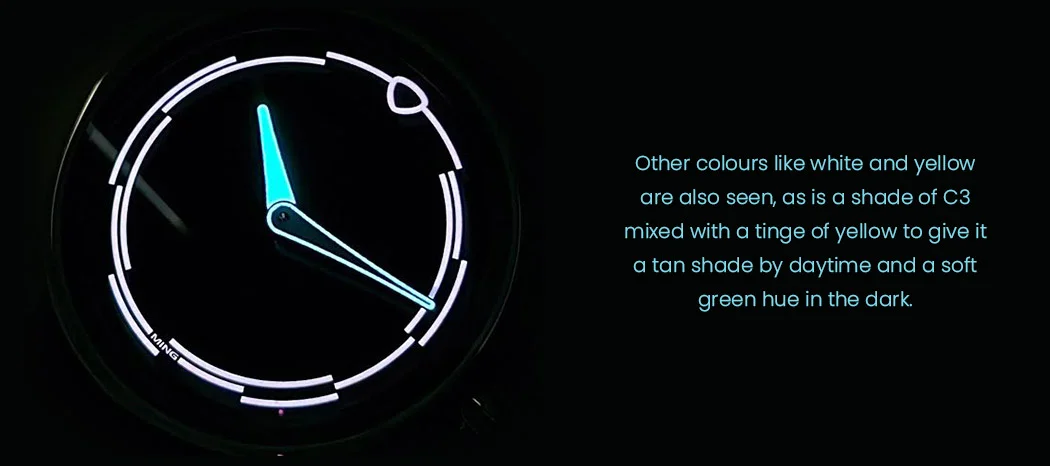
Other colours like white and yellow are also seen, as also is a shade of C3 which is mixed with a tinge of yellow to give it a tan shade by daytime and a soft green hue when in the dark. History enthusiasts call it Old Radium but the new age collector feels it’s a crafty shortcut to achieve vintage vibes without doing the wrist time. Nostalgia can be so conflicting sometimes, n’est-ce pas. Just drop the ‘Fauxtina’ at your next wrist-roll community catch-up and see the room split into two camps.
Through all this, one thing to remember is that more than the colour or quality (they are graded too, from Standard to Grade A to X1, the highest), what matters more is how thick the coat was and how many layers of it were applied.
Should You Lume
Well, there is no harm in getting a watch with lume, but there will be some compromises to be made. For one, you can’t have blue metal hands as the base and then have thorough lume application, or anything with a polished metallic sheen really; they will clash. To mark lume on the dial, the markers have to be a certain size which then means the design can’t be dainty or delicate. So, while lume works great with dive watches and tool watches (military, field, pilot) it isn’t the most sought-after feature for a dress watch. Which is funny because those are precisely the watches one wears when heading out in the evening, for dinner or social soirees, when it is dark, and one could use some lume. But then, when one is out having a good time in august company, enjoying food, drinks and music, should one really need to (or want to) keep track of time?
As I said, I should have been a philosopher instead, mostly for the way I can shed some lumia on thoughts and ideas.



Recent Posts
Recent Comments
Archives