
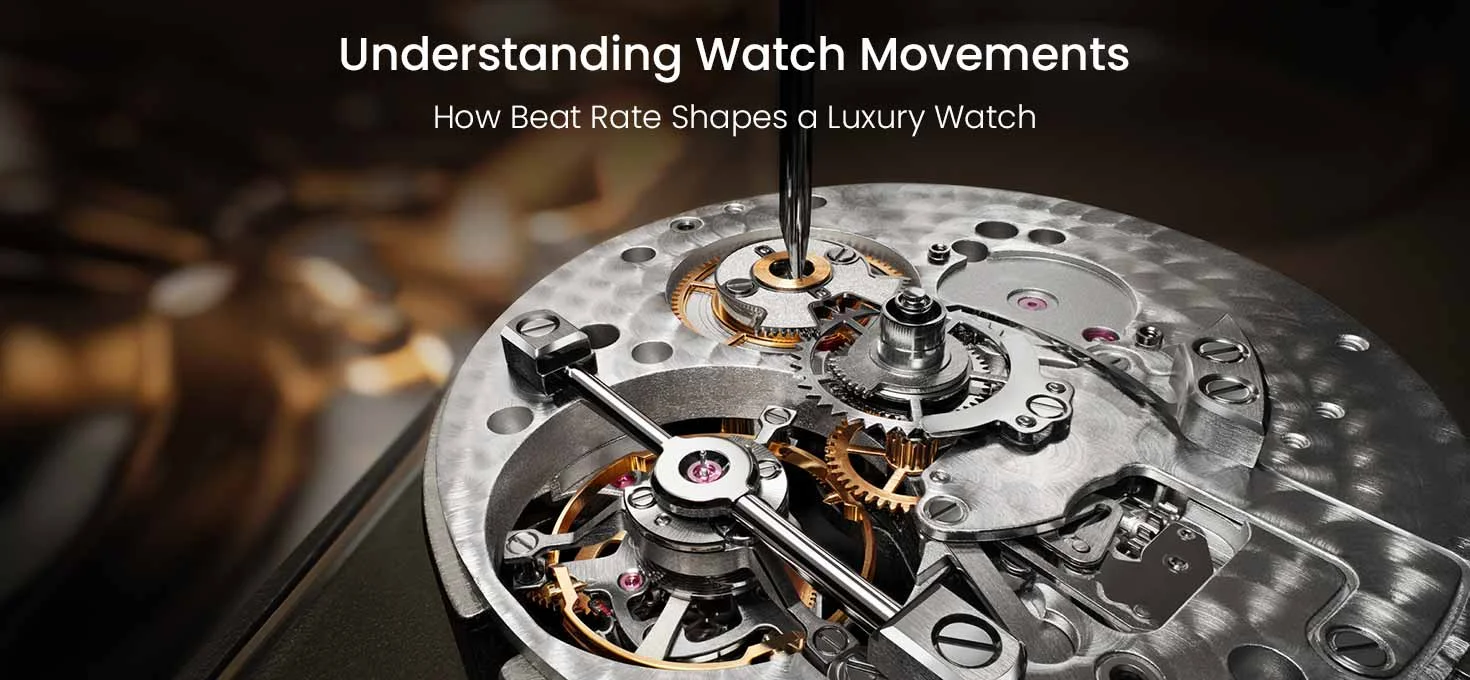
When buying a luxury watch, most people focus on the case size, the dial colour, the crown specifications and other complications. A watch’s beat rate is one specification that most buyers skip past on a product page. It’s not as visible as the case size or the dial colour, but it decides how smooth the seconds hand moves, how long the watch runs on a full wind, and how the watch is priced and serviced over its life. Here’s what it means, how it developed, and what to actually weigh before choosing.
Beat Rate – The Watch’s Heartbeat
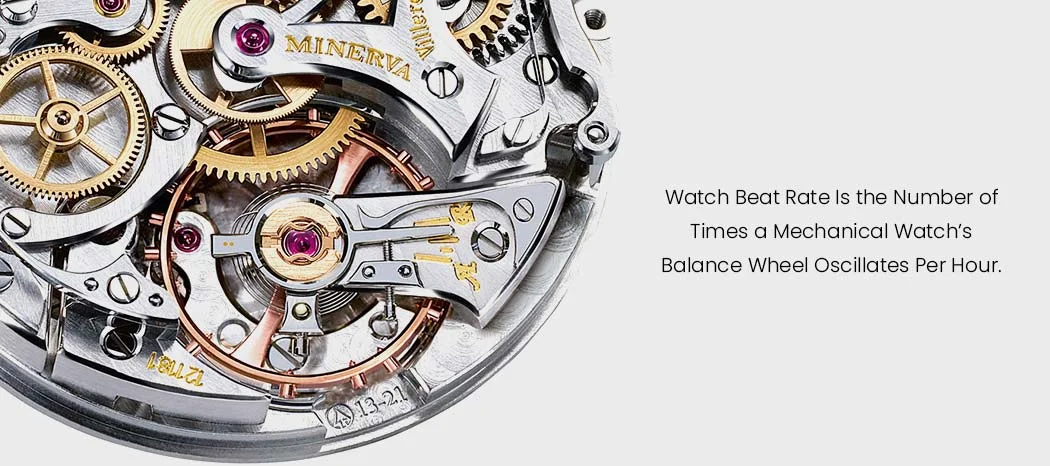
A watch movement beat rate refers to the number of times a watch’s balance wheel oscillates in one hour, acting as the timekeeping rhythm of the movement. It is measured in vibrations per hour (VPH), beats per hour (BPH), or Hertz (Hz). Most mechanical watches operate between 18,000 VPH in traditional calibres and 36,000 VPH in modern high-beat luxury watches.
A Timeline of Beat Rate Innovation
Early mechanical watches typically operated at lower frequencies around 18,000 VPH (2.5 Hz), constrained by available materials and energy management.
The real turning point landed in the late 1960s and carried through the 1970s, when Girard-Perregaux released a 36,000 VPH movement in 1966. Seiko followed with its Hi-beat range at the same frequency. And in 1969, Zenith’s El Primero, the first automatic chronograph ever built, ran at 36,000 bph too, a mechanical watch beat rate that didn’t just look impressive on paper. This pursuit of heightened accuracy delivered smoother operation and finer timekeeping but that leap forward came with a trade-off which introduced challenges, like wear on components that needed more frequent maintenance.
Not every watchmaker chases higher frequency, as conversely, plenty of models stayed at lower beat rates around 18,000 BPH, embodying energy efficiency. A slower watch movement frequency consumes less power and produces a more pronounced ticking second hand, while a higher beat movement delivers a smooth continuous sweep collectors still chase today.
Latest Technology and Innovation
Modern innovations focus on balancing high beat rates with efficiency. Grand Seiko’s 9SA5 hi-beat movement achieves 36,000 VPH with an 80-hour power reserve using a dual impulse escapement that reduces friction.
Silicon has reshaped how watchmakers tackle the limitations of high-beat movements, like the Omega’s Co-axial escapement which runs at 25,200 VPH, with a Silicon Si14 balance spring, setting a slower beat rate to optimize power transfer rather than a step forward to a higher mechanical watch beat rate.
At the extreme end, concept pieces like Zenith’s Defy Inventor, which features the in-house Zenith Calibre 9100 movement, operates at 18Hz, pushing the limits to show what’s technically possible.
Working and Mechanism of Beat Rate in a Luxury Watch
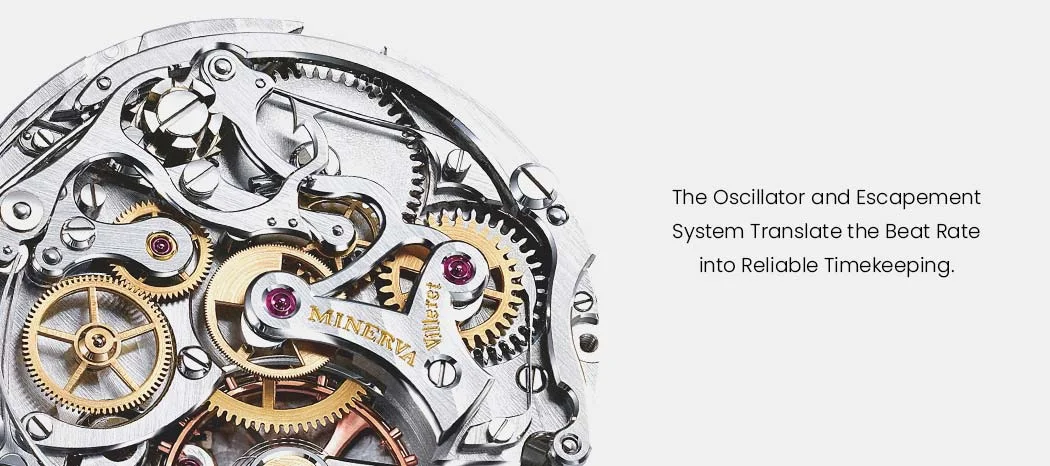
The balance wheel and hairspring form the oscillator at the heart of the movement. Each full oscillation (a complete back-and-forth swing) produces two beats. The escapement releases small, controlled bursts of energy from the mainspring to the balance wheel, maintaining its consistent rhythm.
This regulated motion drives the gear train, which in turn moves the hands. Higher watch movement frequency divides time into smaller increments, enabling smoother seconds hand motion and more precise regulation points. The rate is calibrated during assembly and servicing to achieve the optimal amplitude and accuracy.
Types of Beat Rates and Their Characteristics
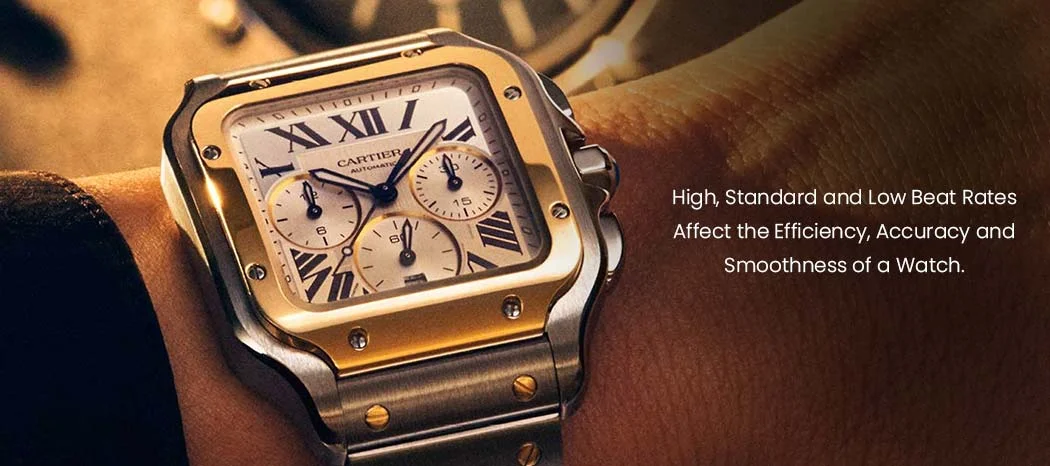
Luxury timepieces are available with a variety of mechanical watch beat rates, each designed to offer distinct performance characteristics.
High Beat Rate: Those at 28,800 BPH or above (including hi-beat examples at 36,000 BPH), deliver smooth seconds hand sweep and strong potential for impeccable timekeeping, making them popular in many modern luxury pieces.
Standard Beat Rate: Typically ranging from 18,000 to 21,600 BPH, provides reliable accuracy in traditional designs.
Lower Beat Rate: Around 14,400 BPH or below, emphasizes energy efficiency with impressive power reserves that can last days or even weeks on a single winding, resulting in a more pronounced ticking second hand and a charming, deliberate pace.
Impact of Beat Rate on Accuracy and Power Reserve
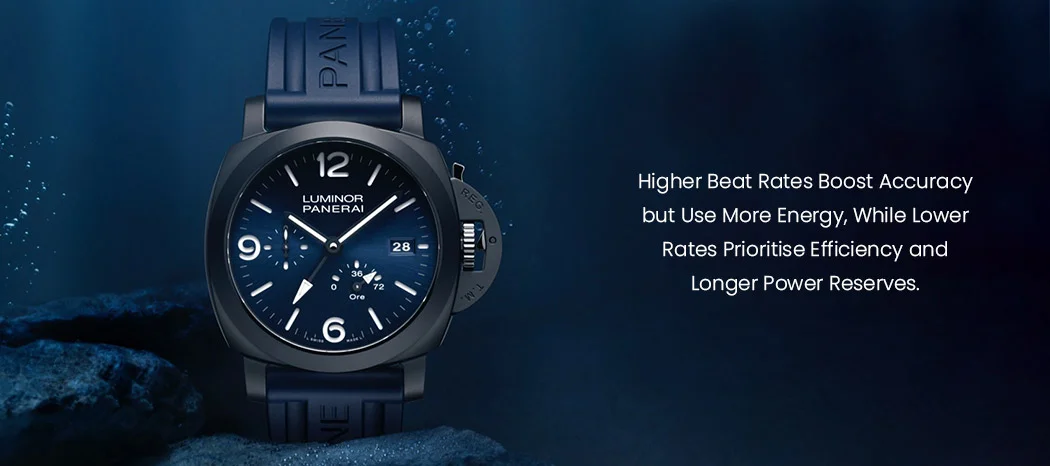
The mechanical watch beat rate significantly influences both accuracy and power reserve in various luxury timepieces.
Higher beat rates generally offer superior potential accuracy by allowing finer regulation adjustments and better resistance to disturbances, as the balance wheel returns to position more quickly. However, they tend to consume more energy, which can result in shorter power reserves unless offset by innovations such as twin barrels or low-friction escapements.
Lower beat rates excel in energy efficiency, delivering longer power reserves, sometimes lasting days, while still providing reliable accuracy, though with a more noticeable ticking seconds hand. The optimal choice depends on the specific watch movement frequency and its intended use.
Different Beat Rates in Different Kinds of Watches

Luxury watchmakers tailor watch movement beat rate to specific demands. Dive watches often use standard to moderate frequencies like 25,200-28,800 BPH for a strong underwater reliability. A prime example is the Omega Seamaster Diver 300M Co-axial Master Chronometer, Reference Number 210.30.42.20.03.001, with its 25,200 VPH Calibre 8800 movement, delivering METAS-certified precision and 55-hour power reserve.
Chronographs benefit from a high mechanical watch beat rate such as 36,000 BPH. The Zenith El Primero Chronomaster collection exemplifies this with its iconic 36,000 VPH high frequency escapement and 1/10th of a second function, offering exceptional chronograph performance in luxury sports watches. Higher watch movement frequency helps in smoother operations under dynamic conditions, while moderate rates prioritize endurance for dive use. Selecting the right beat rate ensures the movement aligns perfectly with the watch’s purpose.
Choosing the Right Beat Rate for Your Luxury Watch
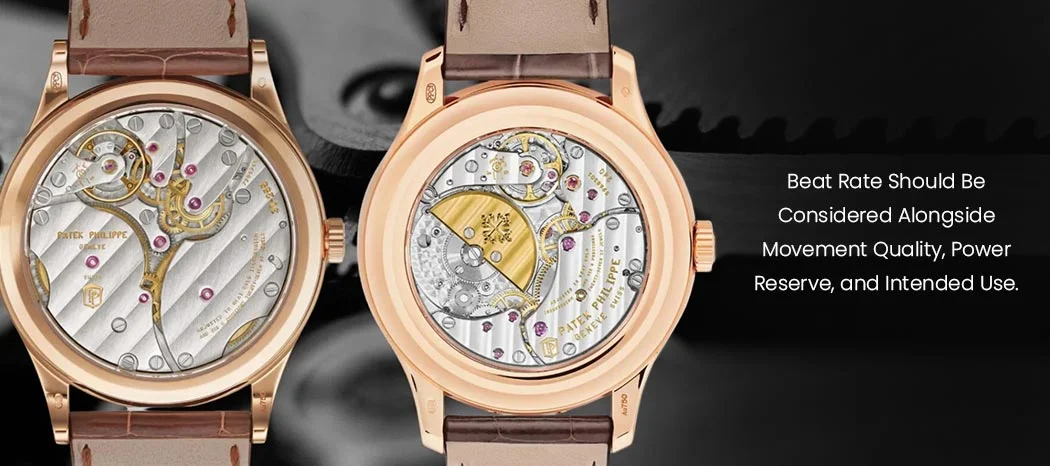
The watch movement beat rate shouldn’t be the optimum deciding factor while buying a luxury watch, but it’s worth checking against its other features. If you want a smoother seconds hand and don’t mind slightly shorter service intervals, a higher beat rate suits that. If you’d rather have a longer power reserve and don’t need chronograph-level timing precision, a lower or mid-range beat rate makes the perfect choice. Lifestyle and specific needs should guide the decision and not just the assumption that a higher number always means a better watch.
Kapoor Watch Company
At Kapoor Watch Co., we bring together an exceptional collection of luxury watch brands, including TAG Heuer, Longines, Rado, Cartier, Chopard, Franck Muller, Hublot, Omega, and many more. Every timepiece reflects a unique blend of precision, craftsmanship, and innovation, with features such as the mechanical watch beat rate contributing to its performance, and character. Whether you appreciate traditional mechanical calibres or modern high-beat movements, our curated collection offers something for every watch enthusiast. Visit Kapoor Watch Co. Stores to explore iconic luxury timepieces and experience the horological excellence behind the world’s leading watchmakers.
Frequently Asked Questions
What is beat rate in a luxury watch?
The watch movement beat rate is the speed/ frequency at which a mechanical watch’s balance wheel oscillates, measured in vibrations or beats per hour (BPH) and Hertz (Hz), driving the watch’s timekeeping.
What does VPH/BPH mean?
VPH and BPH mean vibrations per hour and beats per hour, which measure the frequency or “tick speed” of a mechanical watch movement.
How does beat rate affect watch accuracy?
Higher beat rates can generally improve the mechanical watch’s accuracy by providing a greater oscillatory stability, recovering faster from physical shocks, and averaging out small timing errors more effectively.
Which beat rate offers the best power reserve?
Lower beat rates offer the best power reserve because they consume stored energy more slowly. Traditional slower frequencies like 18,000 VPH or 21,600 VPH use less power than the high-frequency alternatives.
Should You Choose a Watch Based on Beat Rate?
The watch movement beat rate is only one aspect of a mechanical watch’s performance. The ideal choice depends on the movement’s overall engineering, power reserve, servicing needs, brand craftsmanship, and how you plan to wear the watch.


Recent Posts
Recent Comments
Archives