
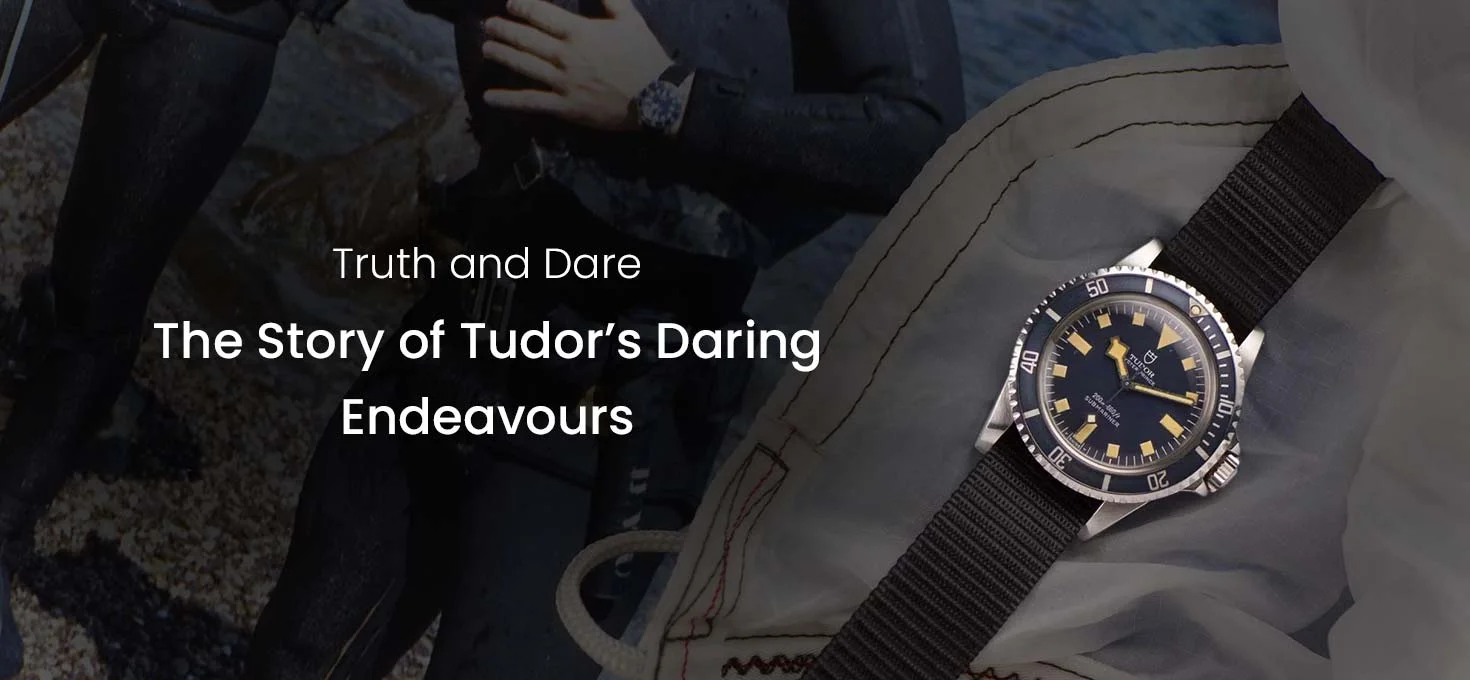
The brand name “Tudor” was registered in 1926 by Hans Wildorf with a very specific set of USPs in mind – a dependable timepiece which was built to exacting standards but one which was more accessible to the people at large. With Tudor, the aim wasn’t to erect a hallowed and somewhat intimidating persona but rather to deliver high quality with no compromises that was more accessible to all.4
This would be a tall order for someone launching a brand today with all our scientific and mechanical innovations and their subsequent democratization which makes high technology available to all and sundry. But, a 100 years ago, an era when we were just out of the “war to end all wars”, when vaccines were still looked upon with suspicion and pasteurized milk was all the commercial trend, imagine setting out to mass produce a qualitative tool as a product, and one that would measure something as intricate, delicate and important as time.
Early Days
Since inception, Tudor always had to take the road less travelled. A hundred years down, Tudor stands on a hill of its own, one that it scaled singularly and bravely. It also explains how, “Born to Dare” came to be their tagline, because even though it has only been around since 2017 officially, it was how they had chosen to exist since their inception.
What is a Dare?
In the world of luxury and horology, a dare can have a range of definitions – from a slight alteration of the materials used to a drastic design overhaul, from a zany colourway to an unprecedented collaboration. Tudor, for one, eats dares for breakfast. They have chosen the path of the uncharted and unprecedented as a way of being.
But let’s not let mere words define what a brand is or isn’t. Much better to instead reminisce and ruminate over what steps has Tudor taken along the way which bestow them with such a moniker.
The Chronograph Gamble (1970)
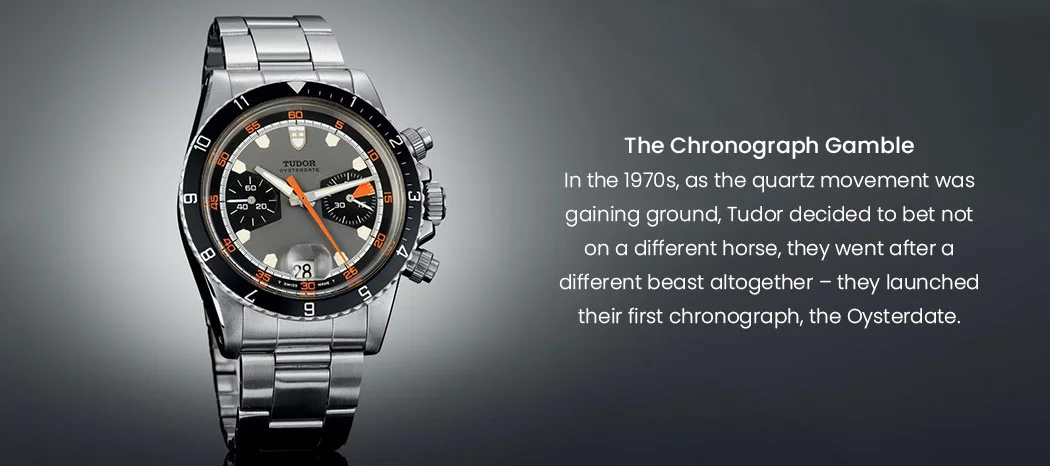
In the 1970s, as the quartz movement was gaining ground, Tudor decided to bet not on a different horse, they went after a different beast altogether – they launched their first chronograph, the Oysterdate. They had no established heritage in manufacturing this complication, and it was a risk to run. And yet, the piece found much traction, the audience loved it, especially the motorsport industry. Tudor went all in, fielding an actual racing team across Asia, running Porsche 906s against much larger competitors. And, they won! The chronograph marked Tudor’s entry into a new realm and the reassuring win cemented their status as a category leader, not to mention the affection that was being showered upon them by followers of the sport. A new level was thus unlocked.
Tudor today serves as official timekeeper of the Dakar Rally and partners with Visa Cash App Racing Bulls in Formula 1. The thread from 1970 remains unbroken.
The Snowflake Hand (1969)
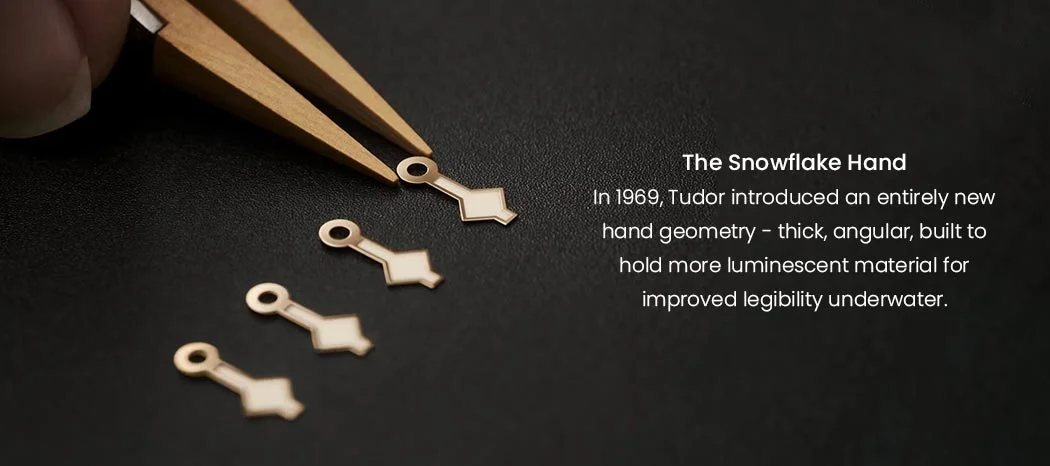
Tudor had launched its Submariner in 1954, and for over a decade it kept the same circular hand design. Well, come 1969, they decided to change that, when divers who relied on the watch underwater asked for improved legibility in low-light and murky conditions – they switched to a novel yet distinct shape. References 7016 and 7021 introduced an entirely new hand geometry — thick, angular, built to hold more luminescent material for improved legibility underwater. Collectors named them snowflake hands and the name stuck, so much so that Tudor eventually adopted the name officially.
Tudor made this choice for functional reasons first, with distinctive design as the consequence. More than fifty years on, the snowflake hand remains the single most recognisable Tudor design element, appearing on most Black Bay and Pelagos models produced today. Tudor publishes the manufacturing process on its own website: a brass ribbon, stamped hollow, filled with lume by hand. The detail is characteristic of a brand that considers how things are made to be as interesting as what they look like.
The Movement-from-Scratch (2015)
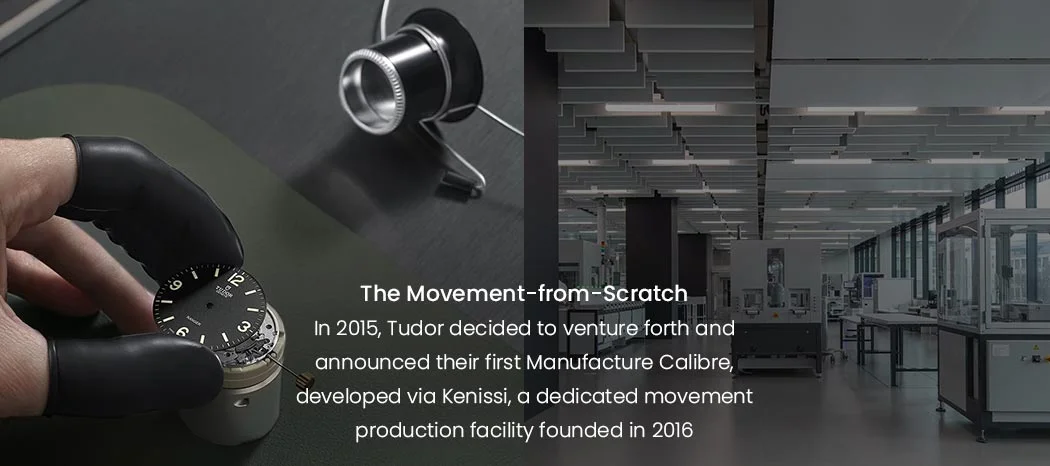
For most of its history, Tudor relied on outsourced movements. Not uncommon a practice and many of the finest and most reputed brands even today subscribe to this MO. But in 2015, Tudor decided to venture forth and announced their first Manufacture Calibre, developed via Kenissi, a dedicated movement production facility founded in 2016 – many iterations came out of this, featuring embellishments like COSC-certification, silicon balance spring, a 70-hour power reserve, and a column wheel and vertical clutch in the chrono.
Building an in-house movement is expensive, time-consuming, and technically demanding. Given Tudor’s positioning, this could have been labelled overkill by many an industry pundit. It wasn’t a consumer ask and yet, Tudor did it because it completed the argument the brand was making about itself — that it was not merely a delivery mechanism for a durable Swiss watch, but a manufacturer with its own engineering convictions.
A Matter of Materials
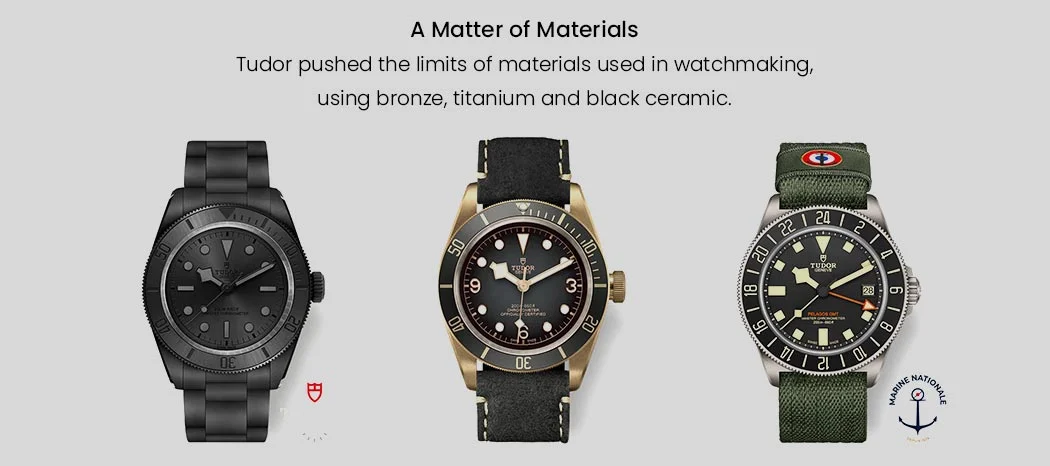
Tudor’s daring innovations have rarely been limited to one aspect of a watch. The Black Bay Bronze was introduced in marine-grade aluminium bronze case at a time when, for most parts, the material was a rarity in the world of sports watches. It was also a highly polarising one as some people love the idea of a watch which acquires a unique patina over time while others stand stoically resolute aligned with the idea of their steel watches staying steadfastly, well, steel-y.
And then along came the Pelagos in full titanium – case and bracelet – at a price point where others were happy to cater forth with steel. They went further and developed their own patented bracelet extension system for it. And finally, we had the Black Bay Ceramic in 2026, Tudor’s technical mastery in a blacked-out aesthetic which they cheekily called, “Going dark.”
The Case of the Colourful Dials
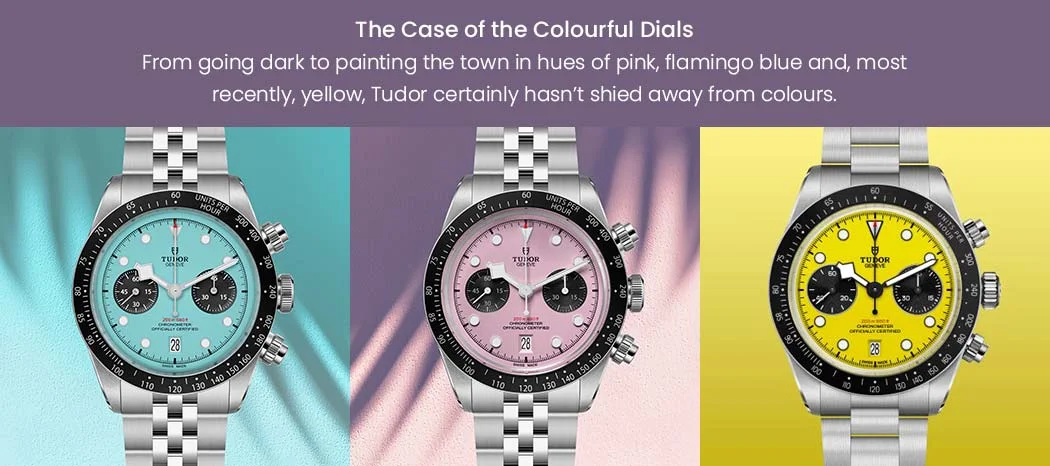
From going dark to painting the town in hues of pink, flamingo blue and, most recently, yellow, Tudor certainly hasn’t shied away from colours. What makes the choice of colours even more brazen is the choice of watch for carrying these – The Black Bay Chrono. That’s right, a rugged steel sports was chosen to serve as a vehicle while Tudor painted the industry in shades of a unicorn rainbow, a luxury sea azure, and a bumblebee. Sports and pink aren’t the first combination but that didn’t stop Tudor. The Flamingo Blue requires an extra minute of ponder since Flamingoes, characteristically, aren’t blue, and Tudor surely knew that. As for the latest release in yellow, it manages to go smaller and sleeker while being more conspicuous at the same time, a classic Tudor contradiction. These aren’t for everyone and yet everyone is precisely the number of people queuing up for them.
The 9 O’Clock Crown
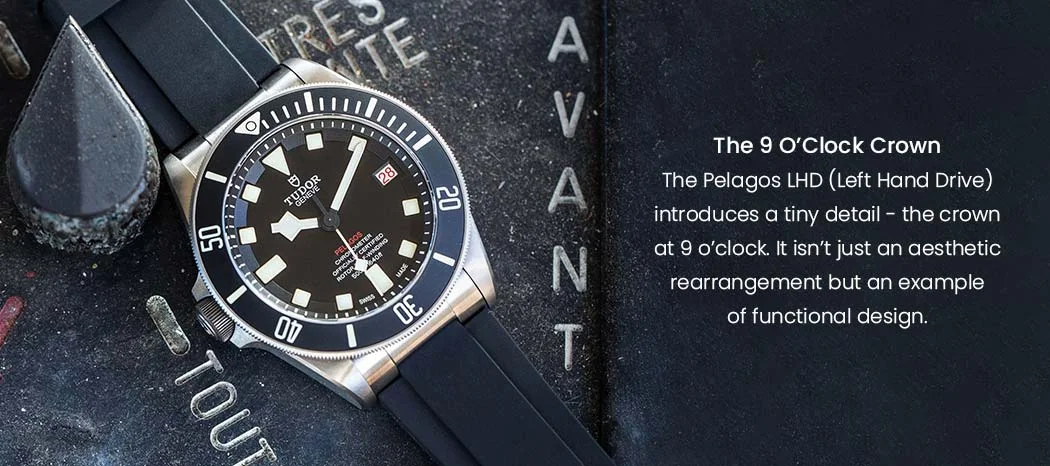
The Pelagos LHD (Left Hand Drive) introduces a tiny detail – the crown at 9 o’clock. Conventionally, the crown is at 3 but military divers, who wear the watch on the right wrist, find a crown at 3 o’clock physically obstructive. It isn’t just an aesthetic rearrangement but an example of functional design.
After reading about Tudor, it is hard to think of “Born to Dare” as simply a tagline that the high brows in marketing conjured up. Instead, chez Tudor, it feels like a working philosophy, an ethic so deeply ingrained and so meticulously mastered over time that it has come to define everything they create. In light of such, one can but only wait in anticipation of just what daring endeavour they set themselves to next.


Recent Posts
Recent Comments
Archives