

At the crack of the 21st century in Bienne, Switzerland, Rolex Founder Hans Wilsdorf dared to dream of a watch worn on the wrist — departing from traditional, bulky pocket watches that were ergonomically irksome to use. His visionary spirit redefined how Europe read time, creating a wristwatch with chronometric precision, technical brilliance, and unmatched reliability in craftsmanship.
In the roaring twenties, Rolex’s revolutionary spirit of watchmaking led them to create the “Oyster” case. Hermetically sealed, this was Rolex’s first waterproof and dustproof wristwatch — revered as a true cornerstone of Rolex’s heritage. In 1945, Rolex commemorated 40 years of the maison’s remarkable and pioneering spirit of innovation with the DateJust, the first self-winding wrist chronometer with one special feat: a self-changing date window. A decade later, Rolex introduced the Day-Date with an instantly recognizable silhouette featuring a ‘Day’ window at twelve o’clock while retaining the DateJust’s signature ‘Date’ window at three. Over the last eight decades, both titles have served as cornerstones of Rolex’s Oyster Perpetual legacy – While the DateJust as a canvas for creative expression and artistic personalization, the Day-Date was prestigiously worn by presidents, visionaries, and pioneers as a celebration of triumph.
This is your guide to understanding the Rolex DateJust and Rolex Day-Date collections, their differences, similarities, and histories.
Origins: Rolex DateJust: Simple Stroke of Brilliance

In 1945, when herculean Swiss complications like tourbillons and minute repeaters had been around for nearly two centuries, Rolex’s attention was fixed on a cardinal horological necessity seemingly overlooked by the industry: a ‘date’ display which corrected itself at midnight. Rolex’s self-changing date function was utterly straightforward, compactly designed, and, most importantly, useful at the time – becoming an icon on arrival.
Rolex DateJust: The Quintessential Rolex
Today, we have the world’s date accentuated on our timepiece’s dial or smartphone screen, available right at our fingertips. But imagine running one’s day-to-day life without this access – we’d still be flipping calendar pages or squinting our eyes to read newspaper corners. After the introduction of the Rolex DateJust, you could simply check your wrist, and you knew. No fuss or frills, this simplistic stroke of brilliance expressed Rolex’s remarkable spirit of innovation. Over the last 80 years, the Rolex DateJust has seen several light facelifts and technical refinements, yet Hans Wilsdorf’s original 1905 vision for Rolex is still prominently embraced in contemporary models.
Origins: Rolex Day-Date – The ‘Presidential’ Choice
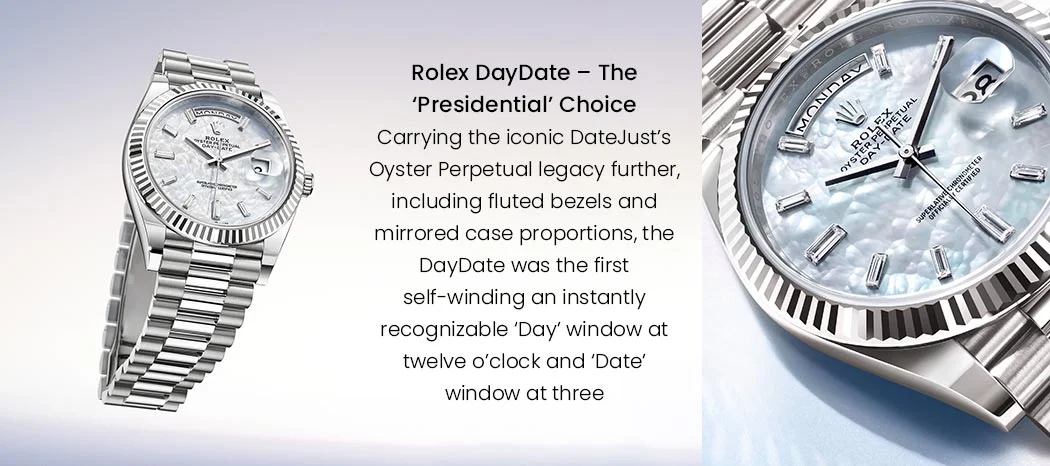
From summiting Mount Everest to diving into Earth’s deepest oceanic trenches and everything in between, Rolex has a proven penchant for planting its flag in the most daring territories known to man. Whether you’re a pilot, astronaut, diver, or racecar driver — Rolex has a watch for you, even if you’re a US President. If we scroll through the archives, Rolex has endured a long association with those who have, over time, guided the world’s destiny. Introduced in 1956, the Rolex Day-Date has been historically revered as the “presidential” Rolex, worn famously by numerous US Presidents.
“Dates and Days are essential.” – Hans Wilsdorf

Carrying the iconic DateJust’s Oyster Perpetual legacy further, including the Day-Date was the first self-winding watch with an instantly recognizable ‘Day’ window at twelve o’clock and ‘Date’ window at three. Both change simultaneously at midnight. Another signature feat of the Rolex Day-Date was its three-link “President” bracelet — seemingly melding the elegance of the Oyster and Jubilee bracelets. With larger, heavier, and more semi-circular links, mimicking the Jubilee bracelet, it features the Oyster’s three-piece design. Over the last seven decades, the Rolex Day-Date has embraced various references and movement upgrades, mainly refining the day and date-setting techniques.
Key Differences: Two Icons, Two Legacies
The Rolex DateJust and Day-Date represent pinnacles of Rolex’s craftsmanship, each embracing hallmarks that cater to unique facets of luxury.
- The DateJust, with a plethora of material options ranging from Oystersteel to two-tone gold, is distinguished by its signature Cyclops ‘Date’ display and self-winding chronometer movement, making it an ideal blend of versatility, simplistic elegance and utility – an icon of everyday luxury.
- The Day-Date, exclusive to precious metals like yellow, white or everrose gold and platinum, exudes sheer prestige and unmatched opulence. Featuring a full ‘Day’ and ‘Date’ display at twelve and three o’clock, respectively, and distinguished by a three-link, semi-circular ‘President’ bracelet, the Day-Date offers an exalted quotient of power and triumph with its craftsmanship.
- The President bracelet is emblematic of the Day-Date, while the DateJust offers options of Jubilee (five-piece link bracelet), Oyster (three-piece flat links) and President (three-piece semi-circular links).
- Both models also offer fluted bezels, a slew of dial colours/materials like mother-of-pearl, onyx, and sunray finishes, along with multi-linguistic display options, catering to enthusiasts across the globe.
- When it comes to sizing options, the Rolex DateJust is available in multiple sizes, ranging from 31 millimetres to 41 millimetres (men’s and women’s collections). On the other hand, the Day-Date offers 36-millimetre and 40-millimetre options.
Embodying Hans Wilsdorf’s spirit of innovation, artistry, and distinction when he first started Rolex in 1905, the DateJust and Day-Date reflect the maison’s dedication to enduring craftsmanship and technical brilliance.


Recent Posts
Recent Comments
Archives