
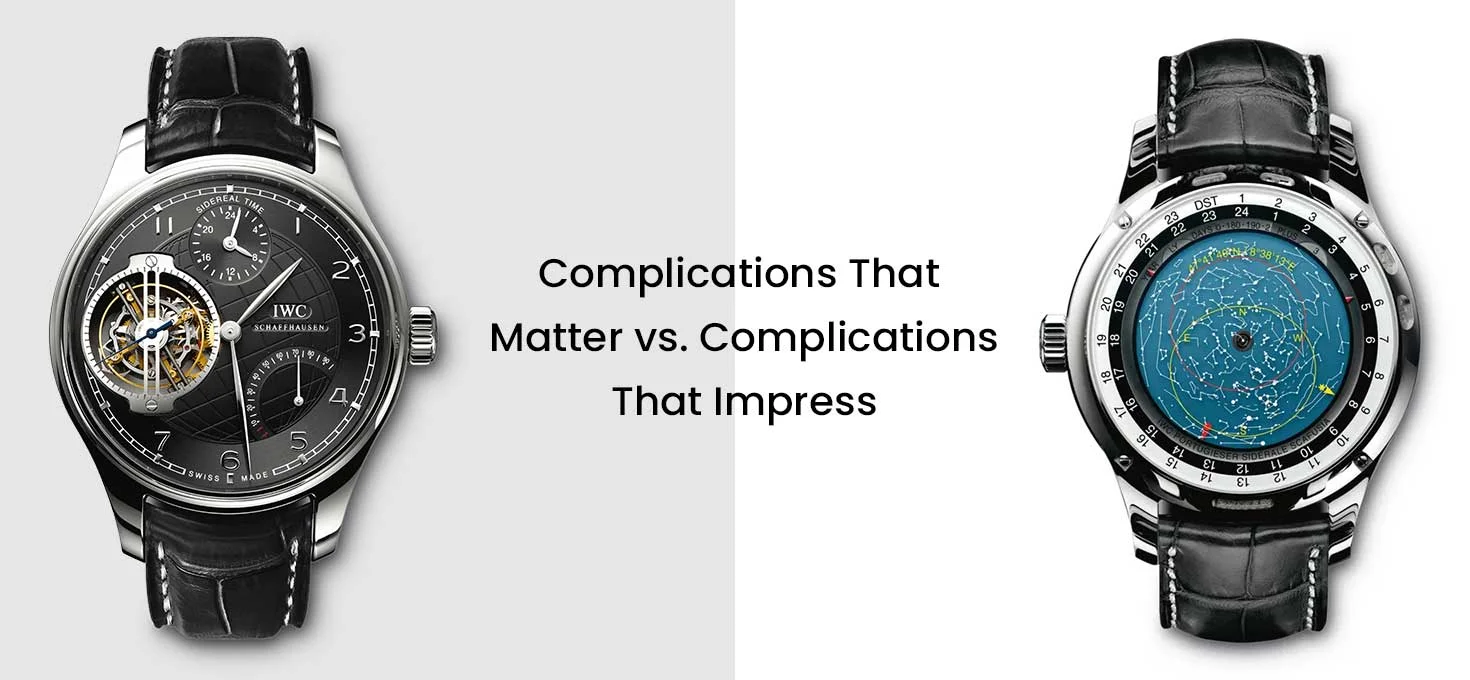
A practical guide to extras that matter, or don’t – chronographs, GMT, dual time, power reserve, perpetual calendar, moonphase, etc.
The watch is a fantastic piece of science and history all rolled into a tiny bundle that occupies a few mm of real estate on one end of our arm. The amount of physics that thing packs into a small space is pure joy for the nerdy mind to explore. It requires calculation, precision, and meticulous alignment and juxtaposition to achieve, one that, even with the right guidance and tools, would still be beyond most of us to achieve. If you have ever attended one of those classes where they let you dismantle a watch movement and then put it back together again, you probably know just how clumsy it makes one feel trying to get those screws to sit in the right place and tighten them perfectly.
In such light, manually-wound or automatic, a watch is a complication. Even a quartz movement, or actually, especially a quartz movement, because it requires even more mind-numbing tech (and other complex machines) to put together. But when a watch collector mentions ‘complications’, none of us mistake it for thinking that they are referring to a ‘simple’ wristwatch.
What is a Complication
To define a complication, in one short phrase, well, it’s complicated. That’s it, I took on this topic and committed to writing an entire piece around it just so that I could crack that (poor) joke. That done, and with no applause still in sound range, I’ll see myself out, or humbly move on.
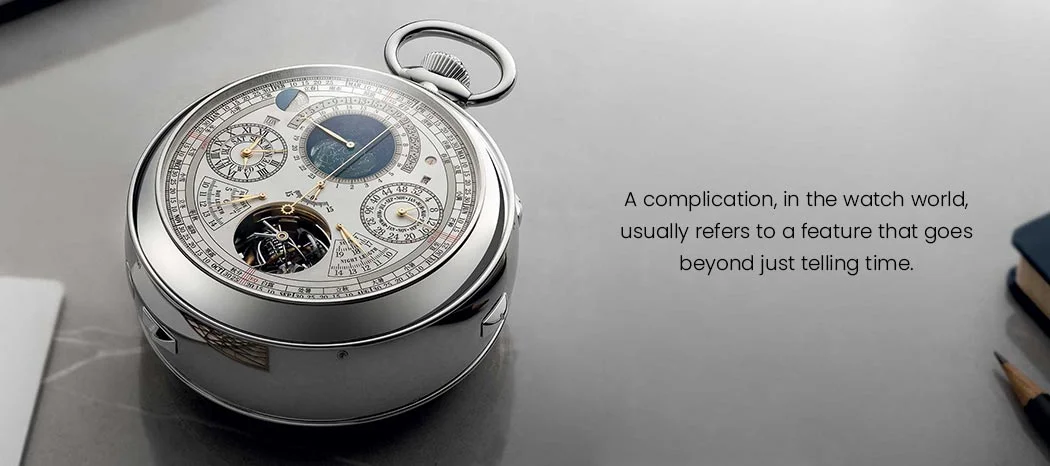
A complication, in the watch world, usually refers to a feature that goes beyond just telling time. For the Gen Z and Alpha readers, this notion is based on the very primordial principle that a watch was invented to keep and tell the time. Not count steps or beep notifications, which may seem to be the more immediate need and usage today. So anything that a watchmaker managed to squeeze into the small frame was considered a complication because, let’s face it, it couldn’t have been easy to pack in anything else that could
- Draw power from the existing setup
- Function reliably within the framework of the watch
- Not be adversely affected (and nor adversely affect) the mechanism of the watch.
In such a scenario, when a watch was able to display the day, as an early complication, it would have been quite the breakthrough moment in early watch design. Gradually, as the prowess of both makers and designers grew, more such ‘complications’ found their way into watches.
Who Needs Complications

In the beginning, one wore a watch to tell the time. But, over time, people from different walks of life may have started inquiring about other possibilities, especially when they would have seen day and seconds being incorporated into these contraptions. Knowing the phases of the moon could be useful to someone who was often at sea. A chronograph would have been extremely futile for someone who was timing cars on a track, or was about to launch an operation where harmony of timing was crucial for its success. A secondary time zone, GMT, power reserve, a calendar that accounts for leap years (aka perpetual calendar), all would have been the pressing needs of the respective hours at various points in our history. This is possibly how most developments would have been initiated; watchmakers would have competed at honing these add-ons, and this race would have effectively helped establish many brands and their prowess in different aspects of watchmaking.
Seen from a distant third-party point of view in history, these don’t seem like complications at all – they were just the pressing requirements of the times. Imagine buying a smart watch today that doesn’t have 24-hour HR monitoring, or, worse encore, doesn’t support Bluetooth connections with your phone! The madness of exigence would have been the same back then.
Who Wants Complications, Today?
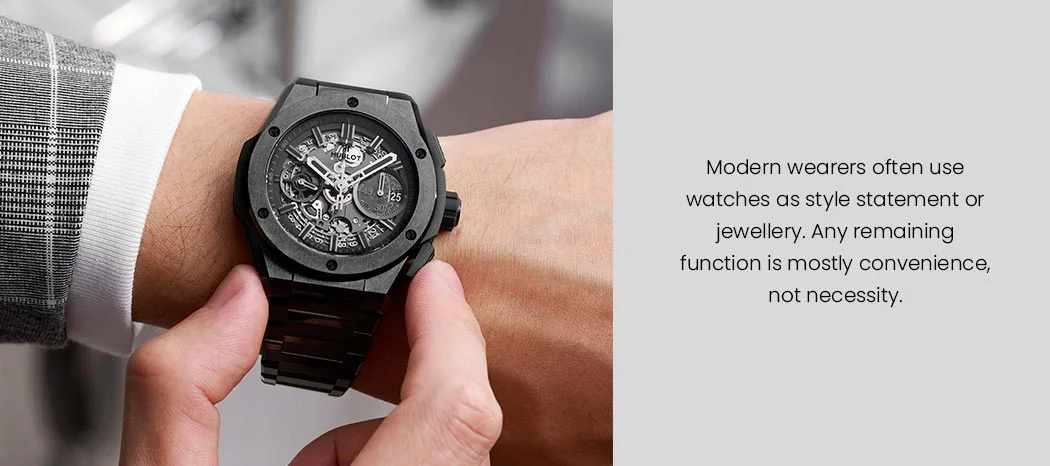
What we strap on to our wrists is as objectively important as our pancreas, or a tailbone. We have no immediate or pressing need nor use of it. We can tell time, barometric pressure, temperature of the GPS coordinates of where we stand, and we can also accurately read all this data for some other place thousands of miles away, just with a simple glance at our mobile phones. Why then, pray, do we wear watches? To me, it’s the same reason I wear ear studs, or a gold chain – mostly vanity. It’s jewellery but a lot less understated and elegant than the other two. It also has some historical significance, not to forget an often-unquantifiable emotional value, all of which earn it a worthy spot on my human frame. A phone feels much more dispensable and ephemeral by comparison. So, one could argue, that subjective quotient aside, the one thing I certainly don’t need my watch for necessarily is to tell time and therefore, by extension, I also don’t need a complication on my watch at all.
To an extent I’d be inclined to concede but, I do feel that reading off my watch is a lot easier than having to whip out my phone every time I need to know what the time is. Therefore, one can argue there is still some functional value to a watch. That said, what else do we need a watch for, or rather, who are the people or which are the professions (or fields) which will still appreciate some complications to continue as they always have.
Flex or Fluff
For a minute let’s let the word ‘flex’ mean something useful and hence worth flaunting, else it spoils my alliteration above. Fluff, by contrast, is stuff that is worthless. Facetious, almost. Voila! Another ‘F’ word for the series.
Now this is largely subjective territory so if you happen to be working on the NASCAR circuit or insist on navigating the sea ways by the night sky, then please excuse this list below. But, even at the risk of miffing you, I’d still tell you that you really need to upgrade your tools.
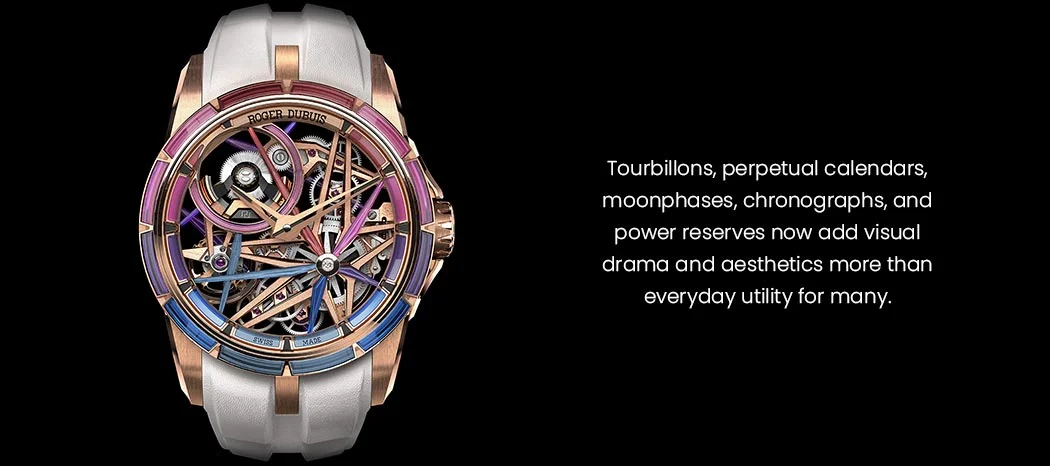
Complications which are purely for sake of complicating:
- Tourbillon: I’ll be the first to admit that fewer things look prettier than a flying tourbillon on your wrist, but, at the price it commands, the hours of skilled labour it requires, and the general fragility of it all, it fulfils no functional purpose anymore. It was designed as a movement to negate the effect of gravity on a watch movement. Today, we have found many ways to mitigate that problem without needing such an elaborate setup. But if you really want to bring a nuclear-ready B2 stealth bomber to a bow and arrow fight, well then the tourbillon is the perfect calibre to arm yourself with.
- Perpetual Calendars: These are the kind that adjust for leap years. There are others which you need to (re-)set annually. Either way, I doubt you’ll miss a meeting or worse yet, your anniversary, and conveniently be able to blame your watch for not accounting for 29th of February. In fact, if you own a perpetual calendar and let the power reserve go to zero, you will perpetually be in the pain of having to set it back to the right time, era and dimension. Many watches require you to follow near-cultic tantric rituals before you can resume usage.
- Moonphase: Another one of those things that will get you a, “Oh, good for you” kinda’ remark at the next convention. Enjoy it if you have it, even if it shows the wrong phase of the moon. Don’t brag about it socially, unless you are a werewolf.
- Equation of Time: There are only two types of people who know what the Equation of Time really means and one of them was the Late Stephen Hawking. The other, well, it’s not you. So, yeah, completely unnecessary. And before you object, in which parallel universe does your version need to keep tabs on the clock time versus the solar time. Ps. The difference is between 22-29 seconds a day, and I doubt anybody here is that fastidious to notice the difference.
- Chronograph: A split-second decision is never one. Read that again. This is why you won’t miss a chronograph in your daily life but aesthetically, you will never be complete without one. And if life is so on-the-edge, then you need more fancy equipment, the kind which comes with laser wire cutters and night goggles as standard issue gear. And also, thank you for your service.
- Power Reserve: This one is like an 11th finger – it doesn’t matter if you have it; whether you use it or don’t, you will never feel at a loss without it. If you wear the watch daily, the indicator will always be at full, and if you have a steady weekly rotation, chances are most watches would need to be recalibrated when you slip them on the next time.
Complications that can stand the test of time may include:
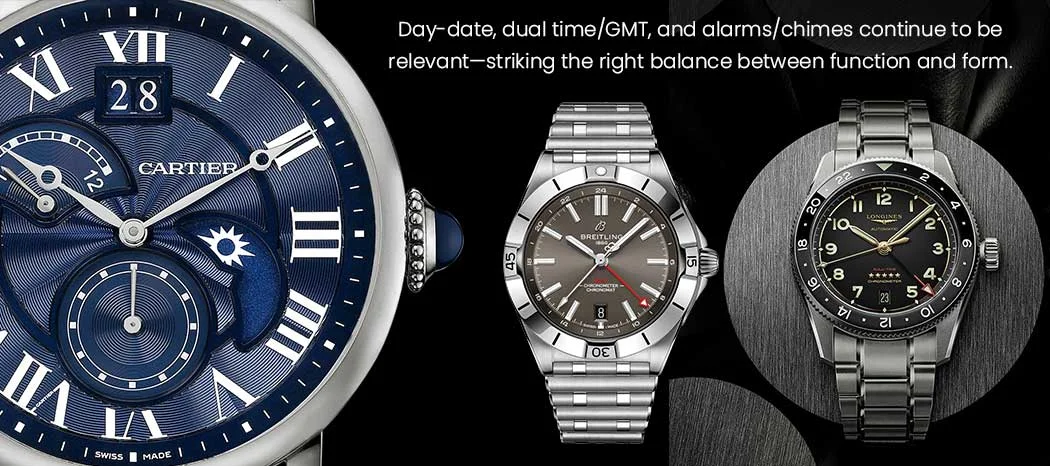
- Day-date function. It is always a civilised day-timepiece that can inform you of the day and date apart from the time. Micro-seconds with a hacking seconds function is the accompanying generally acceptable even if not entirely needed functionality.
- Dual Time/GMT: This you can still have some fun with. Being in NYC and knowing whether it’s okay to call up the folks in India is a polite thing to know at the flick of a wrist, especially when it takes precisely even fewer muscles to place a call and wake up someone at an ungodly hour.
- Alarm/Chime: A rarity, and hence, a precious one, but still has covet value, not just for the fanciness of it, but actual quotidian applicability. It’s the right kind of fancy – one with function while also having form.
Complications Over
So there you have it. To complicate or to not complicate, that is your decision. Choose as wisely as your existing collection, your bank balance, and your life partner allows you to.


Recent Posts
Recent Comments
Archives