
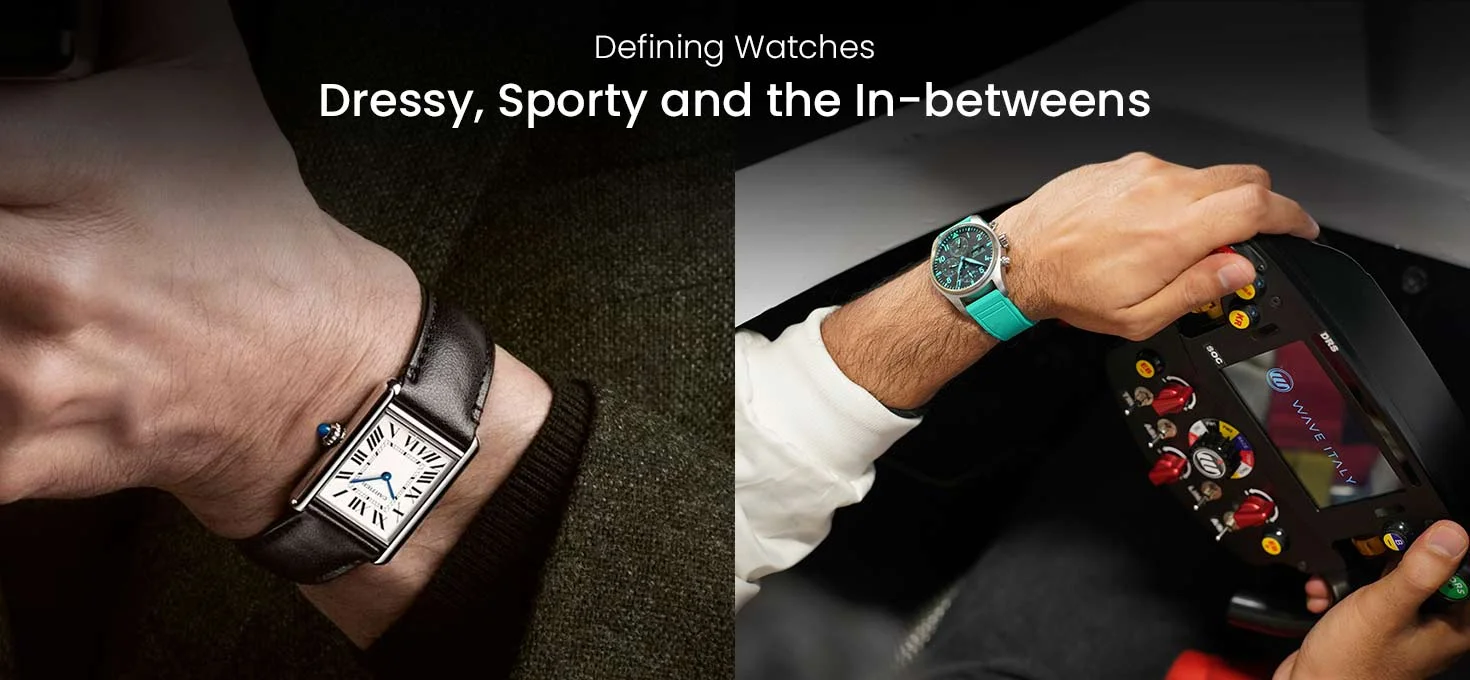
o much is written about watches – defining them, dissecting them, classifying them – that the idea of demystification becomes a rabbit hole in itself. We have defined so precisely and so minutely that it almost feels that there is almost nothing more that can be left to be said about watches in general. And yet, the complications and questions that surround the purchase of a timepiece remain ever-present and daunting. In a way, our bid to simplify has only led to more segregation, and what was supposed to have stood simplified now feels like a task akin to a nightmare, like ordering wine on the first date, or worse encore, on the hundredth one.
The Art of Defining
Whenever I go for a formal wine tasting, my sommelier senses kick in, describing a wine with an array of words – robust, silky, luscious… My wife, on the other hand, quite off-handedly gives me a simple, “Yummy”, or, “Meh”, and walks away, either with the said wine in glass or in search of something else.
And that is the case with watch aficionados, or, I shudder to use the term, connoisseurs. They get so deep into the details of the movement, the placement, the material and the finish, that they, to borrow and slightly twist the phrase, miss the watch for the cogs and gears. The joy of a new acquisition, or even of picking one from your collection for an evening, should be a lot more palpable, direct, and immediate. Let’s try and address that.
The Categories that Matter
Very rudimentarily, watches can be classified into a few broad categories. These are not too different from the categories which we used while defining the 3-, 5-, and 7- watch collections. They stay. Mostly because they are universally recognized and accepted, and, although not down to a mathematical equation, still have certain guiding and defining principles which allow for few exceptions. This gives them enough gravitas to be considered a rule. These categories can have some overlaps but even then, they stay true to both the definitions. Well, almost.
The categories are:
- Dress/Minimalist watch
- Sports watch
- Tool Watches which include Field, Diver, Pilot and Chronograph
- GMT/Dual Time/Travel Watch
As I said, you can already see watches that boldly transgress categories here but let’s quickly look at what makes up each category and how or why they are useful to you in your rotation.
Dress Watch
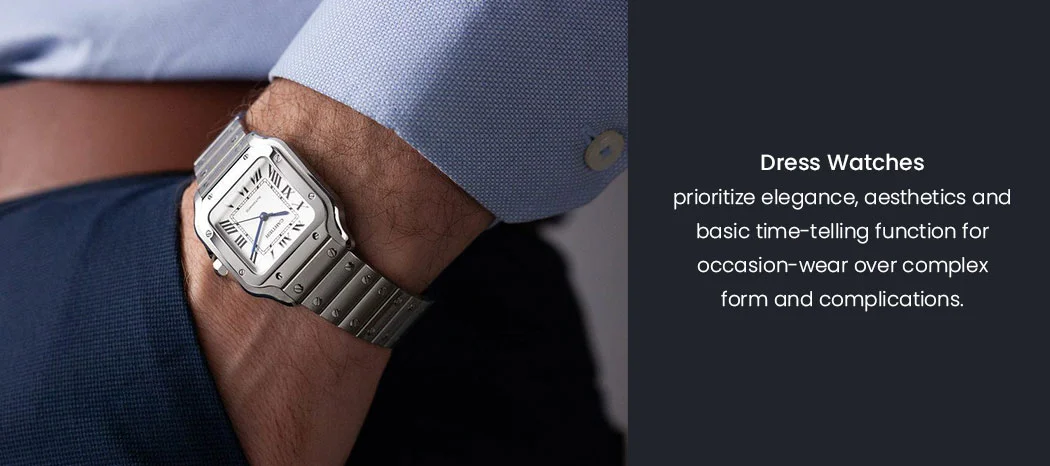
A dress watch, as the name suggests, dresses things up. So, by definition, it goes best when one is dressing up to the nines, ‘The Fully Monty’, as the phrase was originally intended to be used, (instead of the 180 that the movie did on it). A dress watch is for occasions that won’t be taxing physically barring the elbow exercise one gets from handling a social glass of wine. So, it doesn’t need major protection from magnetic fields, or extra shock-absorption as standard; instead, the makers can focus all their energy on one and only one thing – aesthetics. Pretty is primary with a dress watch, whether it be minimalist or baroque, big or small, mechanical or automatic, what people will notice most about dress watches is the level of detail in the design and decoration. Intricate patterns, delicate applications, flamboyant flairs and restraint, and a deft balance between these opposites. Through it all, it keeps time and tells it in the most memorable way possible. That, is a dress watch.
Complications are not a necessity for dress watches; they mostly come out in the evening when the day is about to come to a close so no need to be checking on dates or time zones.
Ideally, the wearer should do a fit check before strapping this on. The mood should be formal, mostly, with a few flourishes for personal statement, and the watch can be one of those. Dressing up doesn’t always mean black tie, as long as it isn’t work overalls or gym gear, as long as they won’t turn you away from your evening reservation for not respecting the unspoken code of civil conduct, one surmises that you are dressed right.
Sports Watch

Almost in diametric contrast, this category of watches sits strong and robust in build at the other end of that spectrum. This is the one you get on when you don’t know what your day will throw at you. Rock-climbing, a spot of tennis, window shopping, driving, golf, movies…the sports watch is for life as it happens. You can even wear it in the evening but that’s where the boys get separated from the gentlemen. A sports watch is made to withstand shocks, falls, and jerks and is usually made of material that won’t scratch or ding easily. And even if it does, a quick polish process can return it to its (near-)former sheen. They often incorporate other functions like a rotating bezel, or a chrono-function (told you the categories overlap) but, at its most basic, a sports watch is a watch that can take a rough and tumble and still keep ticking. It also looks more masculine than other styles.
Tool Watches
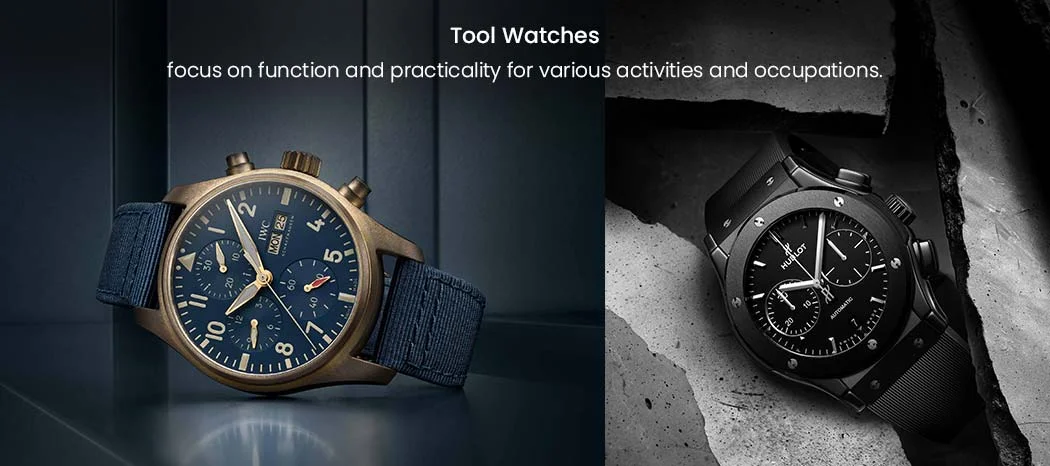
A tool watch is a broad category (again) which includes a few.
Field Watch: These mostly refers to watches that are meant for outdoorsy expeditions. As such, they incorporate features which improve or enhance its performance in those conditions. Some of these include:
- A comfortable size to balance ergonomics and legibility.
- Bold fonts for dial readability.
- Strong build to withstand temperature and environmental extremities.
- Anti-glare coatings on the glass/crystal.
- Matte finish
- Strong lume to allow low light reading.
- Fabric, leather, or other strap materials which are most suited to the environment they will be used in.
- A simple time display with little by way of distraction, maybe a compass at best.
The idea of a field watch is to aid the wearer who are often out in nature exploring, observing, taking readings, making notes, conducting experiments the ‘old fashioned’ way. They can find themselves in the desert, in snow-covered lands, in sultry tropical forests or dry grasslands, and a good field watch is one of their most important tools for such sorties.
Which begs the question, can these be worn in a boardroom? Well, just like someone wearing a diver watch won’t be going SCUBA anytime after the meeting, or flying a two-seater just because they have a pilot’s watch on, wearing a field watch in a corporate setting isn’t inexcusable. But, given their otherwise simple form and design, one might be abhorred for a host of other (stylistic) reasons. But, just like the tribe who swears by their Timberlands no matter the setting, there is a case to be made for those who like to keep their field watch handy at all times.
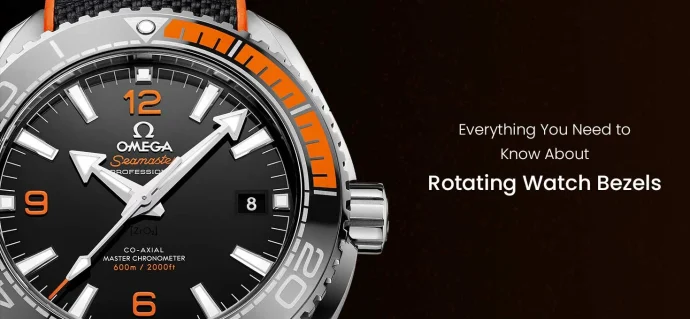
Diver: As the name suggests, these are for diving under and they help ensure that you don’t overstay your aquatic welcome. It is a safety feature that cannot be compromised even in the slightest so a good diver watch can still be a useful tool. As a certified rescue diver, I can certify that even today, I may have a dive computer on my wrist as the primary device but on my other wrist is a reliable old diver watch as a nearly-infallible backup. The one-way rotating bezel ensures that you can never stay underwater longer than planned and that is why it doesn’t move in the reverse direction.
Pilot: Closer to the field watch in look and form, the only different might be that (A) they use much larger dials for improved legibility and (B) may have a few other features like a compass or a chronograph. They can even have a dual time zone capability because a pilot can really use one of those.
Chronograph: This is the watch that everyone wants to buy but nobody knows why. A chronograph with a split second function sounds nifty, but I’m yet to find someone who can give me a real-world use for it. Even for those racing cars or drifting them on streets, I doubt anybody ever just stands there timing them as if readying the posse for a heist in the style of ‘The Italian job’. And if you are thinking of using it as a timer for boiled eggs, I don’t know whether to feel bad for you, or the eggs.
But it is a darned pretty feature, and not in the way a dress watch it is pretty. It is attractive like an excavator is attractive – loud and unapologetic, almost archaic yet recognisably classic, in all its grungy and clunky glory. Even the most refined ones still effuse that brutish charm. Get one because you like something to look busy on your wrist, a complication of gears and sub-dials that immediately lends gravitas to your arm, increasing the immediate value of the boy-toy without really adding much by way of worthiness. I know I sound disdainful but there are a few on my list too.
good chronograph can keep time precisely to the millisecond, but I doubt even commandos still rely on these today, given how much even more precise and legible digital displays are. So get one as if an extension to your sporty watch set, no more. One day, when you are finally invited to the F1 track for a spin in a supercar, I think at least the watch part of your wardrobe for that event will already be sorted.
GMT/Dual Time/Travel Watch
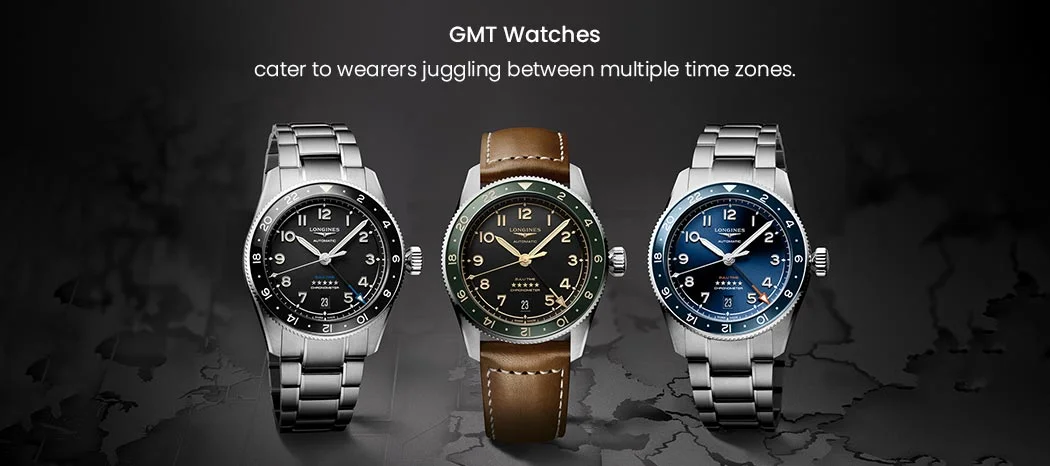
From all vanity and absolutely no utility we now come to a piece that does a better job of balancing the two. Telling the time across time zones is a value-add when you have international work calls to make. While traveling, this can be of even more value. The watch style is still usually sporty (okay, sometimes it can be dressy too) but in general, it’s the function and not the form that defines the watch here. Can you wear one to the local sports centre? -Sure, because it is always a good time to know what time it is in London.
Now that you know how to classify a watch, the real question is, should one bother to? If trying to decide what to wear in the morning, perhaps. On holidays, not at all. If adding a new one to the collection, possibly, yes. But when trying to justify said purchase to your accountant (or your wife), then most certainly and utterly definitely yes.

Recent Posts
Recent Comments
Archives