
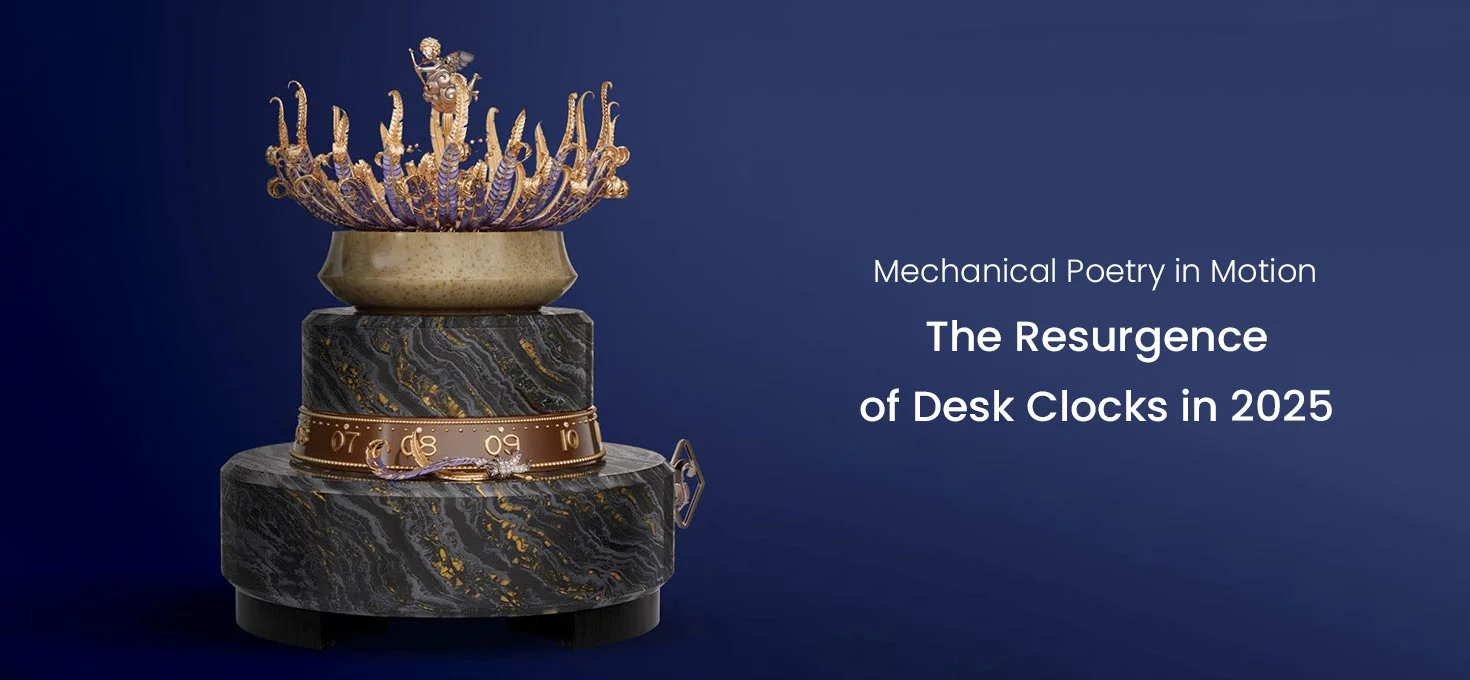
Watches & Wonders 2025 leaned heavily into nostalgia, as maisons explored their roots and reinterpreted classics as future icons.
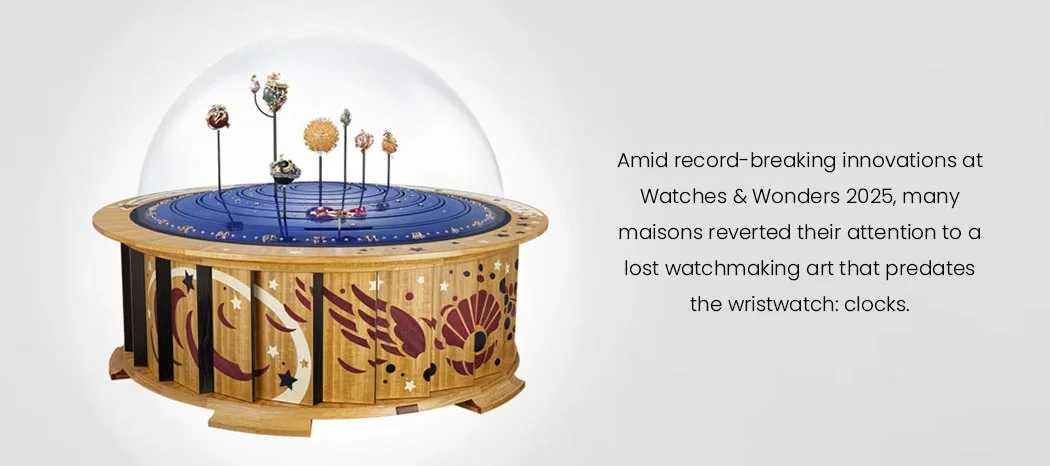
Amid the record-breaking innovations and jeweled elegance, maisons reverted their attention to a lost watchmaking art that even predates the wristwatch: clocks.
Enthusiasts today consider swinging pendulums, kinetic art, and mechanical chimes as things of the past. Interestingly, at W&W25, maisons like Patek Philippe, Panerai, Van Cleef & Arpels, and more ushered in a fresh generation of clocks and automations. Exulting their horological excellence as mechanical sculptures, they’re currently one of watchmaking’s most talked-about avenues. We’re looking back at the history of desk clocks and 2025’s most evocative creations.
A Change of ‘Times’
The true origins of timekeeping date back to the dawn of civilization, where ancient Egyptian and Babylonian sundials traced the sun’s path to indicate the time of day. Gazing skyward, our ancestors also materialized the chaos of the cosmos into intricate astronomical charts. As civilization’s insatiable curiosity for horlogerie endured through generations, its primitive tools turned to innovative mechanisms.
In the 14th century, mechanical clocks were invented in Europe, which employed weights and gears to keep time. Due to their size, these clocks were exclusively used in church towers and monasteries. As technology advanced in the 17th century, these mechanisms were miniaturized for homes. In 1657, Dutch mathematician Christian Huggins invented the pendulum clock, which soon transformed timekeepers into artistic home decor. With the demand for portability and creative customization, these devices shrank further into desk clocks.
Patek Philippe Complicated Desk Clock
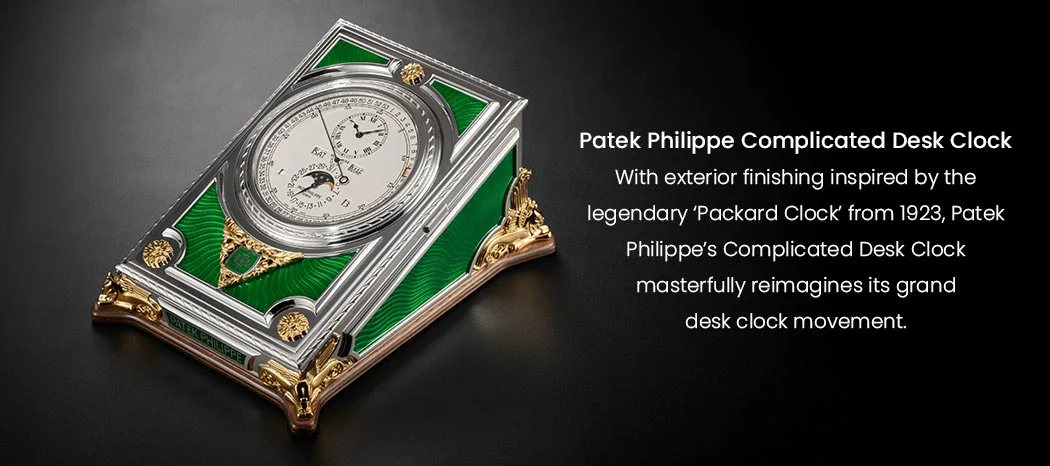
With exterior finishing inspired by the legendary ‘Packard Clock’ from 1923, Patek Philippe’s Complicated Desk Clock masterfully reimagines its grand desk clock movement. Measuring 164.6 millimeters long, 125 millimeters wide, and 76 millimeters tall, its sterling silver case is opulently adorned by braided trim work around the edges, gilt silver winged lions on its corners, and gilt flowers atop the lid. The most striking feat of this century-old desk clock is its jewel-like green Grand Feu flinqué enamel that boasts an ornate wavy guilloché. The casing’s exterior comprises polished and finely grained American walnut wood.
Mechanically, this horological behemoth (Ref. 27000M-001) focuses on endurance and accuracy. As a result of seven years of R&D and comprising 912 parts, its manually wound calibre delivers an astonishing 31-day power reserve. Furthermore, it maintains a razor-sharp precision rate of +/- 1 second per 24 hours. Featuring nine patent innovations, including a stop-seconds mechanism and energy-efficiency systems that reduce wear of perpetual calendar components, it indicates day, date, week, month, leap year, moonphase, day/night, and jumping seconds.
Chanel Diamond Astroclock

Chanel’s Diamond Astroclock is more of a jeweled celestial sculpture than a clock, requiring eight months of craftsmanship and assembly. Encased in a glass sphere, hours are elegantly indicated by a diamond-studded comet that orbits the rotating planet while minutes are marked by the constellation of Leo (also enriched in diamonds). Underneath this planet is a discrete white gold sphere that’s encrusted with 66 brilliant-cut diamonds, serving as a reminder of the passage of time.
At the feet of this celestial timekeeper, prowls Gabrielle Chanel’s most emblematic motifs: a lion. Ferociously majestic, this apex predator is masterfully carved in white gold, adorned with 5,037 brilliant-cut diamonds, and rests its paw on a polished obsidian sphere. Its intricate manual-wound calibre was developed in collaboration with renowned Swiss clockmaker L’Epée 1839, which delivers an eight-day power reserve. As part of Chanel’s Lion of Mademoiselle collection, the Diamonds Astroclock is limited to just five pieces.
Panerai Jupiterium
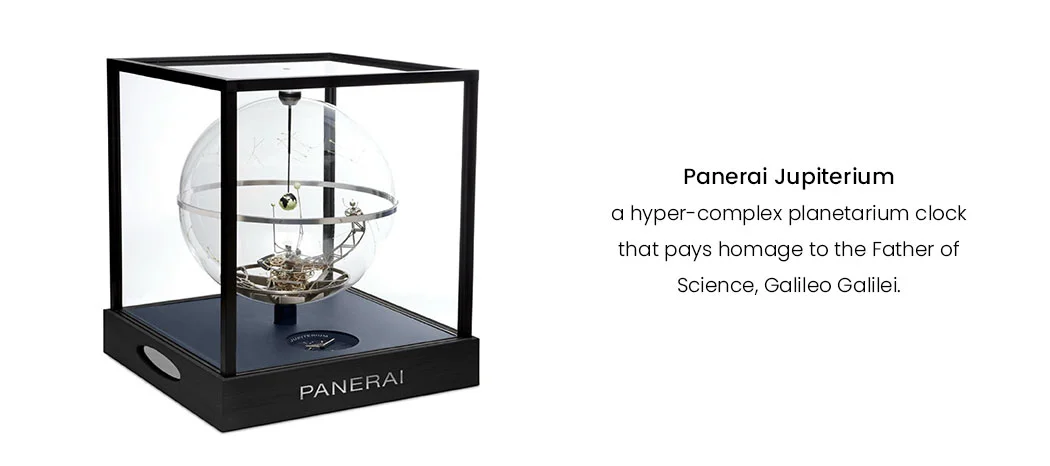
Panerai’s heart sails with the seas, but at W&W 2025, the Italian watchmaker’s creativity leaped beyond nautical horizons and into the cosmos. The Panerai Jupiterium is a hyper-complex planetarium clock that pays homage to the Father of Science, Galileo Galilei. As this 1610 discovery of Jupiter’s four moons challenged the age-old belief of an Earth-centered universe, the Jupiterium offers a God’s-eye-view of our solar system. With Earth at the centre, it illustrates the location of the sun, moon, Jupiter, and its four ‘Medicean’ moons. Comprising a total of 1,640 components, all components are supported by titanium arms.
Furthermore, the Jupiterium features a rotating glass sphere that completes a full circle every 23 hours, 56 minutes, and 4.09 seconds. Upon this glass sphere, the 12 zodiac constellations are depicted, featuring Super-LumiNova® treatment. The Jupiterium also features a retrograde moon. At its base rests Panerai’s signature sandwich dial and all the works. It boasts an AM/PM indicator and a power reserve indicator.
Trilobe le Temps Retrouvé
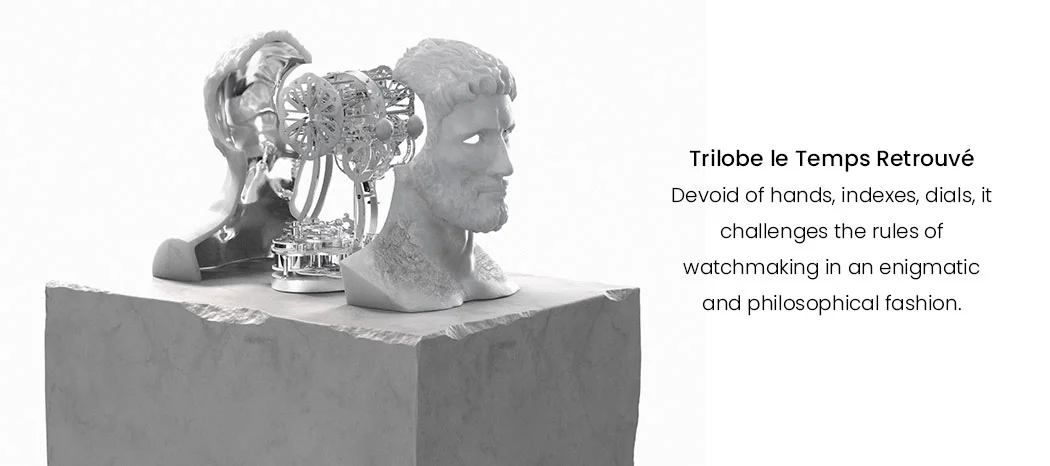
Four years of development, 2,050 components, and 3000 hours of handwork later, Trilobe presented the Le Temps Retrouvé at W&W25. Devoid of hands, indexes, dials, it challenges the rules of watchmaking in an enigmatic and philosophical fashion. Blending horology and sculpture, a visual artist from Paris’s Stephane Gerald Atelier, intends for observers to slow down time and take a moment to reflect. The internal complexity is developed by Manufacture Masur in Sainte-Croix, Switzerland. The rosettes placed on the temple indicate hours while each petal graciously unfolds every hour, marking the passage of time. Minutes are read by subtle movement of the eyes, while seconds are indicated by the sculpture’s breath.
Breath? Yes. Crafted out of ceramic marble and lined internally with palladium, this sculpture boasts an integrated perfume diffusing mechanism — each unique fragrance is developed via personal consultation with a Parisian perfumer, adding another layer to its sensory and immersive experience.
Van Cleef & Arpels Naissance de l’Amour Automaton
For over a century, Van Cleef & Arpels has captured our most exuberant imaginations with precious jewels and hypnotic automations. At W&W25, they’ve embraced this tradition with the Naissance de l’Amour, which is graced by the mythical Cupid. Measuring 30 centimeters tall.
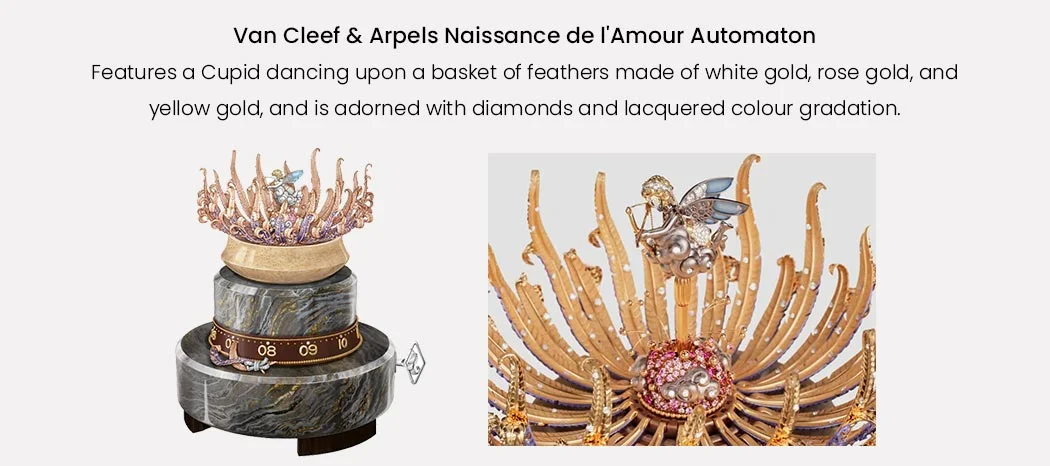
the Cupid dances upon a basket of feathers made of white gold, rose gold, and yellow gold, and is adorned with diamonds and lacquered colour gradation. When the carillon chimes, the Cupid rises and flutters his plique-à-jour enamel wings before hiding away. Designed in partnership with François Junod’s studio in Sainte-Croix, Switzerland, the manual-wound mechanism enables the Cupid to rest atop a rose gold Greek column and a composition of clouds in white gold, diamonds, and pink sapphires in a trio of shades. Beneath this rests a petrified palmwood bowl that holds the feathers in place. Towards the base, a rotating ring indicates time using two lacquered diamond-adorned feathers.


Recent Posts
Recent Comments
Archives