

Hublot, headquartered in Nyon, on Lake Geneva, has proudly embraced their savoir-faire of fusing material innovation with mechanical mastery. And it all began with one man: Carlo Crocco.
Through the ‘70s, Crocco was employed at ‘Binda’, his uncle’s renowned jewelry and watch business in Milan, Italy, until he decided to pursue his watchmaking dreams. With a deep passion for authenticity and a departure from traditional horology, he migrated to Switzerland and created the ‘MDM’ watch company. With ties to the French Riviera, Monaco’s yachts and nautical scenery influenced Crocco’s tastes. This likely led to a company rebranding to the French word “oblò” (Hublot), translating to a ship’s “porthole”, which also inspired the case design of Hublot’s first watch.
Legacy of Disruption
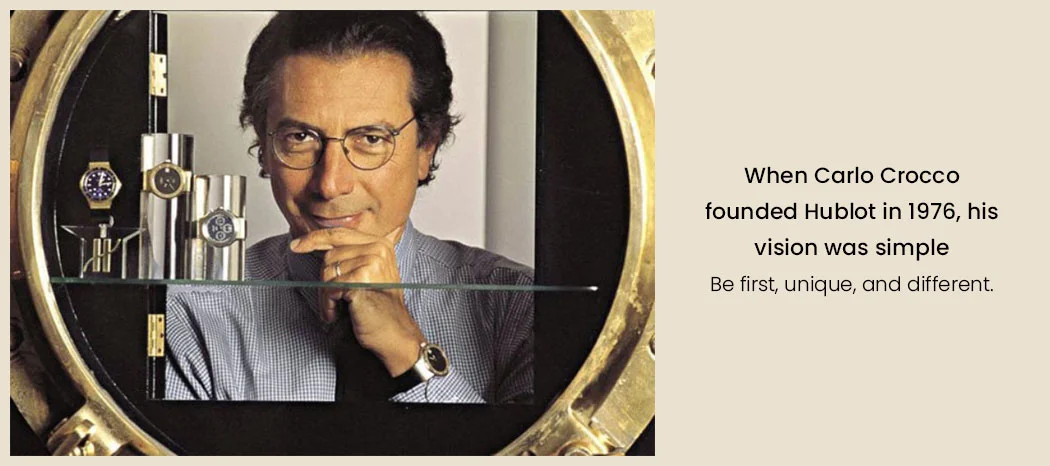
When Carlo Crocco founded Hublot in 1976, his vision was simple: Be first, unique, and different. Combining Italian flair with Swiss craftsmanship, he strived to defy tradition yet remain visually timeless — while, of course, encapsulating the glitz and glamour of the ‘80s.
At the 1980 Basel Watch Fair, Hublot and Crocco presented their first creation, boldly combining a yellow gold case and natural rubber strap. While the case’s design was inspired by a ship’s porthole, the rubber strap was the result of three years of intensive R&D. Crocco created a specialty rubber that wouldn’t crack, tear, or stain — capable of withstanding the elements while providing sheer comfort. Furthermore, Hublot considered the natural properties of rubber and developed specialized, odor-resistant straps. With their inaugural launch itself, Hublot was established as an industry disruptor unafraid to take risks, challenge traditional norms, and push the envelope of material and mechanical innovation. Forty years later, this legacy continues.
Biver & the Big Bang
Entering the 21st century, Hublot found new direction with industry veteran Jean-Claude Biver taking the helm as CEO in 2004. With decades of experience and industry reverence, Biver overhauled Hublot’s marketing and revitalized its reputation as an experimentalist. The next year, Biver unveiled Hublot’s new flagship collection, the ‘Big Bang’. Within a year, Hublot’s sales rose 300% while the Big Bang won Best Design at the GPHG, shaking up the watchmaking world. Ushering in a new era with Hublot’s ‘Art of Fusion’ spirit, the 2025 Big Bang Original combined steel, gold, titanium, ceramic, carbon fiber, Kevlar, and rubber.
Master of the ‘Art of Fusion’
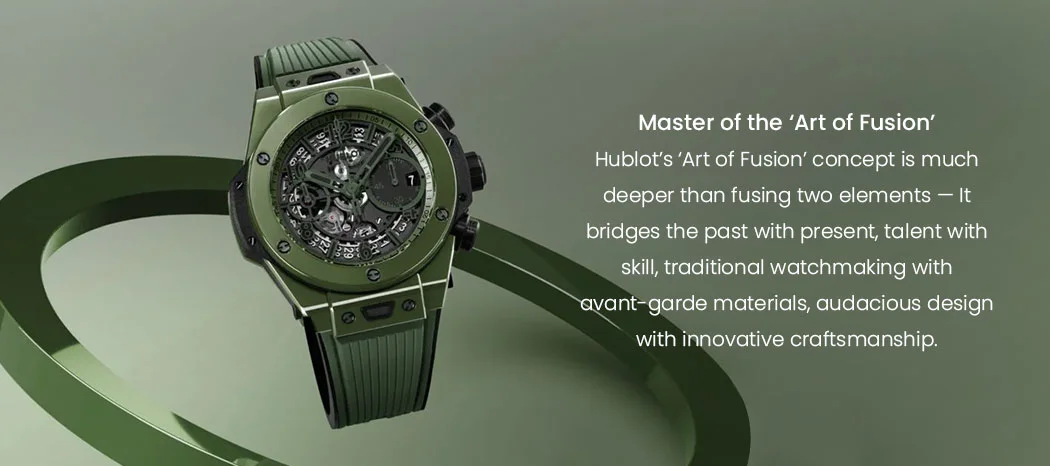
Hublot’s ‘Art of Fusion’ concept is much deeper than fusing two elements — It bridges the past with present, talent with skill, traditional watchmaking with avant-garde materials, audacious design with innovative craftsmanship. Simply put, Hublot is where materials meet mechanisms. Focusing on the latter, the ‘Art of Fusion’ is expressed as a perfect symbiosis between mechanical functionality, architecture, and design. This manifests in several unique ‘in-house’ marvels and feats, including the Meca-10’s unparalleled power reserve, MP-11 calibres, and the revolutionary motor approach with 11 MP-05 barrels and a 50-day power reserve.
All this is brought to life at Hublot’s Manufacture. Under one roof, watchmakers, physicists, chemists, and engineers work in perfect synergy to endlessly push the technical and aesthetic boundaries of watchmaking, shaping its tomorrow.
Defying Norms Through Time
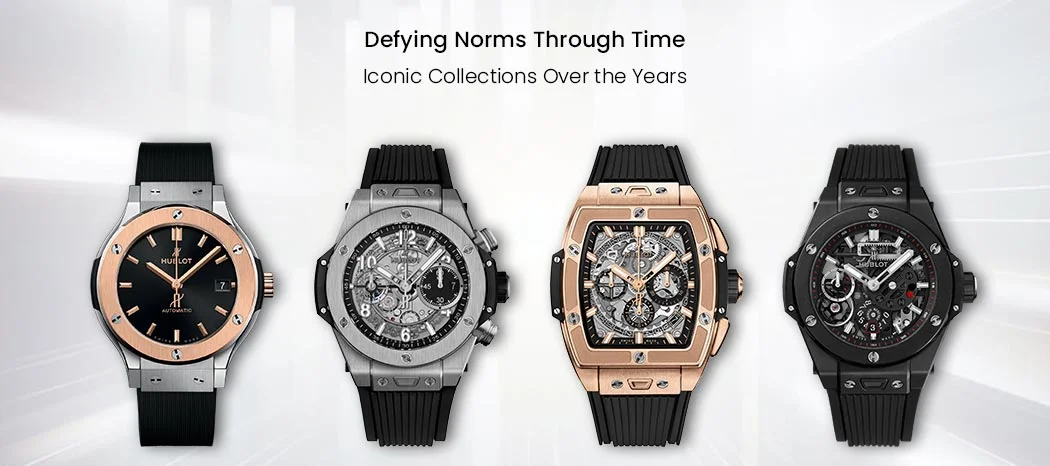
- Classic Fusion: Introduced at Baselworld 2008 as a modern reinterpretation of Hublot’s first designs from the 1980s.
- Big Bang Unico: In 2010, Hublot unveiled their first in-house manufactured movement, the Big Bang Unico.
- Spirit of Big Bang: Presented at Baselworld 2014, Hublot reimagined the Big Bang in a barrel shape case with signature ‘H’ shaped screws, retaining the icon’s identifying codes.
- Big Bang MECA-10: Breaking rules with a building-style rack system inspired by children’s ‘Meccano’ toy sets, the Big Bang MECA-10 redefined watch construction in 2016.
Timekeeper of Champions, Artists, and Icons
Hublot’s passion for choosing audacious paths and breaking rules is shared by a diverse portfolio of ambassadors and partnerships across sports, art, and lifestyle. These include sports icons like Usain Bolt, Novak Djokovic, and Kylian Mbappé, and globally renowned artists like Takashi Murakami, Daniel Arsham, and Sang Bleu.
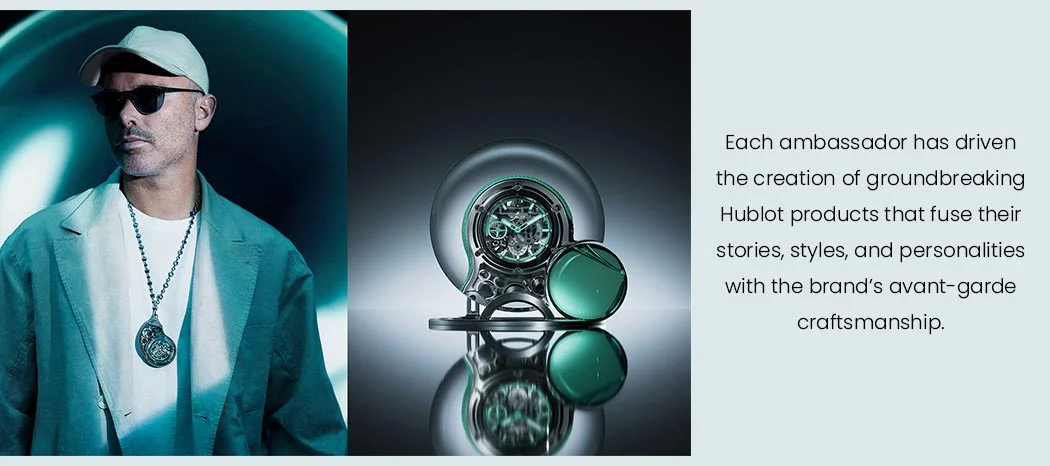
Each ambassador has driven the creation of groundbreaking Hublot products that fuse their stories, styles, and personalities with the brand’s avant-garde craftsmanship.
Furthermore, Hublot has also collaborated with luxury maisons like Berluti, Ferrari, and Arturo Fuente, and organizations like FIFA and UEFA to create cross-cultural icons.
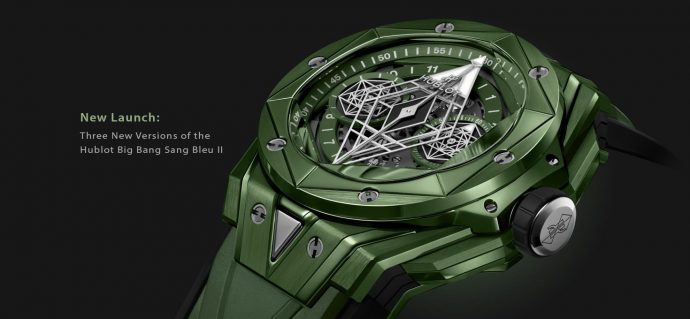
The Arsham Droplet, MP-05 LaFerrari, MP-15 Takashi Murakami Tourbillon Sapphire Rainbow, and Sang Bleu’s reworked Big Bang and Spirit of Big Bang collections are prominent examples of Hublot’s collaborative wonders.
Experimentalism in Hublot’s DNA
Today, material experimentalism remains Hublot’s prime avenue, as it was in 1980. Hublot introduced ‘Magic Gold’ in 2011 as the industry’s first scratch-proof 18-carat gold alloy. Soon, their ‘Art of Fusion’ concept further experimented with elements like titanium, carbon fiber, and platinum. Currently, sapphire and ceramic are Hublot’s magnum opus. From developing a litany of ceramic shades and the world’s first multicolored ‘Magic Ceramic’ case, to a kaleidoscope of sapphire case hues, including Green Saxem and Neon Saxem, Hublot’s legacy of innovation and experimentalism lives on.

Recent Posts
Recent Comments
Archives