
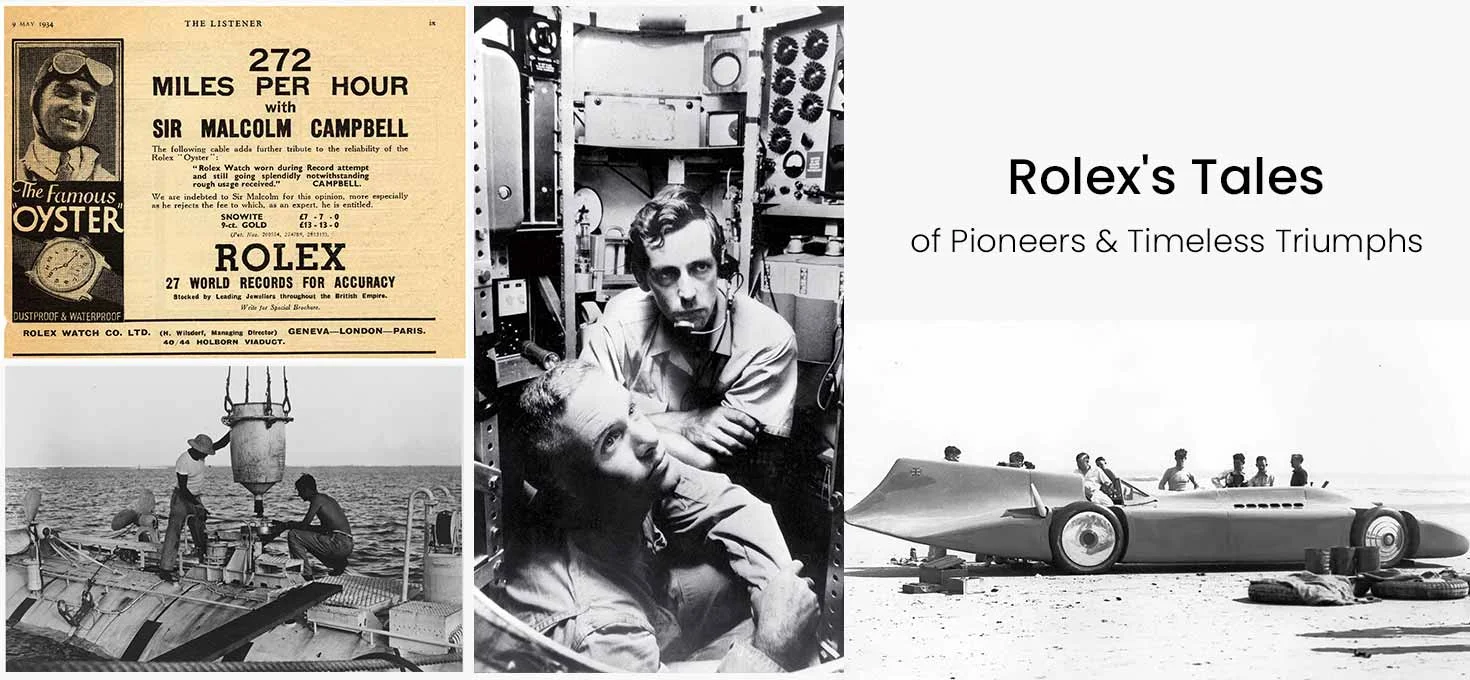
Founder Hans Wilsdorf’s visionary spirit shaped the original wristwatch in the early 1900s, spawning Rolex’s helix arc of elegance, innovation, and reliability. This undying quest for excellence first came to life with 1926’s legendary ‘Oyster’ case — Rolex’s first waterproof wristwatch featuring a hermetically sealed case. In the decades that followed, the Oyster case became intimately associated with human achievement, accompanying explorers, scientists, adventurers, athletes, and artists as they left their mark on history.
From Earth’s highest peak to its deepest abyss, Rolex has accompanied pioneers in planting their flag in the world’s most harrowing circumstances with sheer confidence. Here’s a list of extraordinary individuals and their tales of triumph with Rolex.
Mercedes Gleitze Crossing the English Channel (1927)
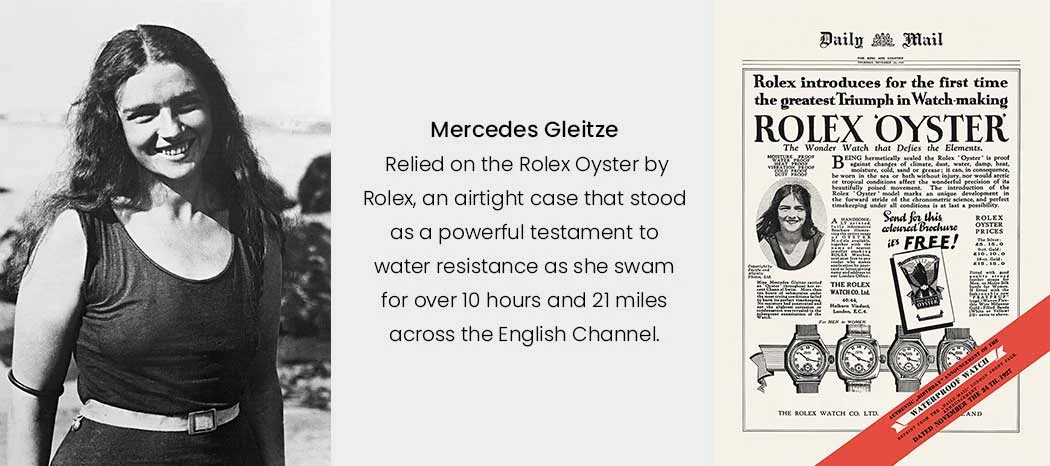
The first of a long line of record-breaking pioneers is Mercedes Gleitze, the first British woman to swim the English Channel. Wearing an airtight horological fortress on her wrist, the Rolex Oyster case, the 26-year-old swam for over 10 hours and 21 miles as a testament to Rolex’s water-resistance capabilities and resilient craftsmanship. This cross-channel accomplishment received high acclaim, showcasing the timepiece’s unique qualities in action, returning in perfect working condition. Celebrating this historic feat and proclaiming the success of his waterproof watch, Sir Hans Wilsdorf took out a full-length, front-page advertisement in London’s Daily Mail newspaper.
Sir Malcolm Campbell’s Triumphs of Speed (1935)
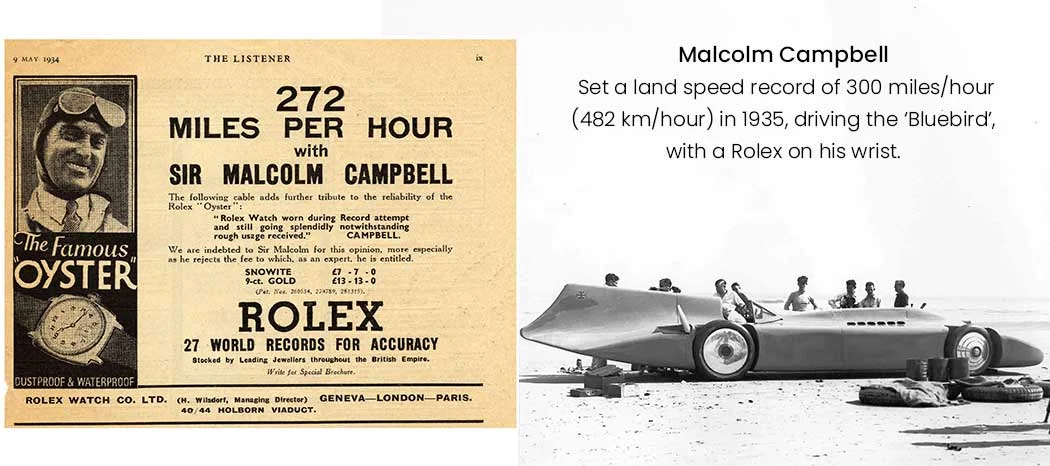
This tale predates the legendary Cosmograph Daytona by three decades, and Rolex simply produced ‘Rolex Chronographs’ with an Oyster case to cater to a world obsessed with motorsports. United by an eternal quest for speed and adrenaline, Sir Malcolm Campbell was one of the world’s fastest drivers, setting nine world speed records between 1924 and 1935 (five at Daytona Beach, Florida).
Considering the era, road conditions were still quite gravelly and unsuitable for new-age sports cars. However, Utah’s Bonneville Salt Flats offered a fairly decent stretch of asphalt-like, flat land, allowing British motoring legend Sir Malcolm Campbell to set a land speed world record of 300 miles/hour (482 km/hour) behind the wheel of his ‘Bluebird’ in September 1935. He wore a Rolex while setting this record.
Sir Edmund Hillary & Tensing Norgay’s Heights of Excellence (1953)
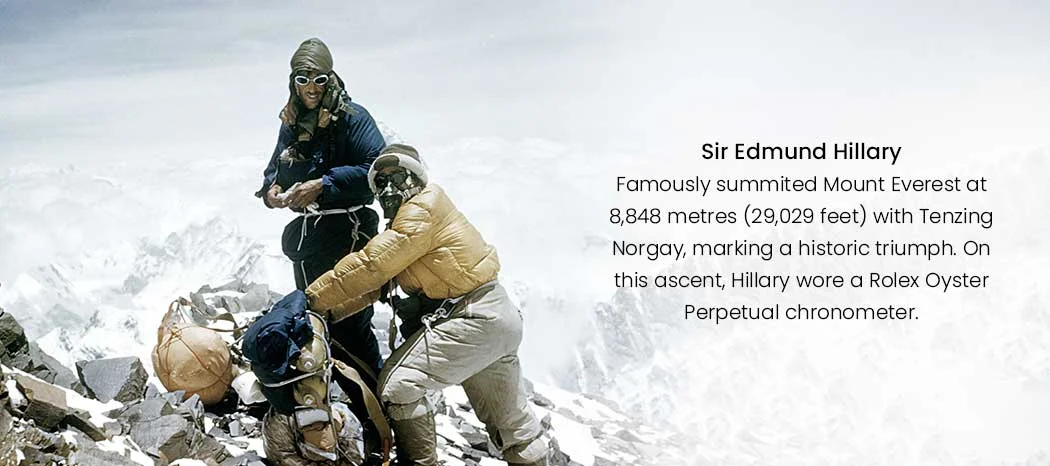
The year 1953 was epochal for Rolex. Alongside the Submariner and Turn-O-Graph (which would evolve into the GMT-Master series), Rolex also debuted one of its first-ever professional models, the Explorer. In May, under Colonel John Hunt’s expedition, British explorer Sir Edmund Hillary and Nepalese mountaineer Tensing Norgay famously summited the world’s highest peak, Mt. Everest, at an altitude of 8,848 metres (29,029 feet). During this historic ascension, Sir Hillary was equipped with an Oyster Perpetual chronometer. Born for high-altitude Himalayan climbing and a purist professional’s watch, the Explorer was a fuss-free tactical tool.
Jacques Piccard & U.S. Navy Lieutenant Don Walsh’s Challenge of Greatness (1960)
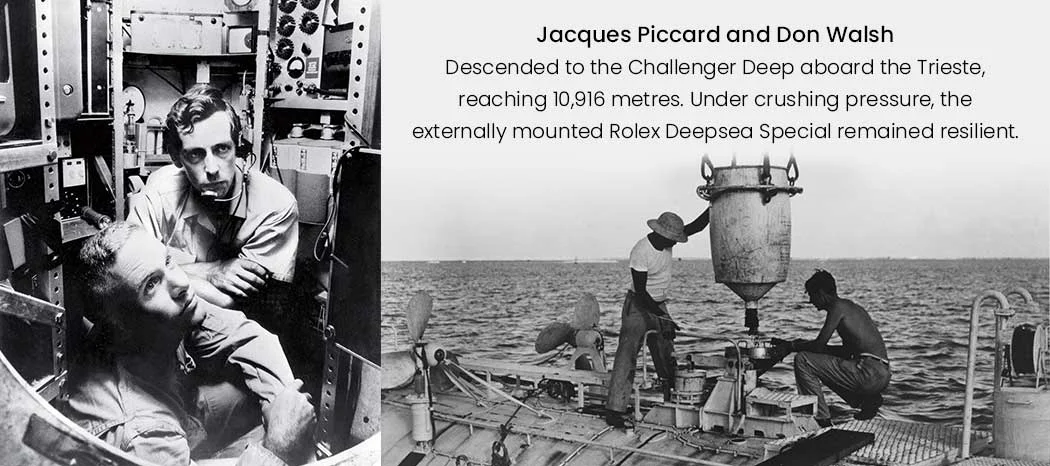
Continuing the Submariner’s spirit, Rolex’s passion for deep-sea exploration took them to a place on Earth unexplored by humans. In 1960, Swiss oceanographer Jacques Piccard and U.S. Navy Lieutenant Don Walsh took command of the ‘Trieste’, a U.S. Navy bathyscaphe engineered to explore the Challenger Deep — Earth’s deepest known point, 320 kilometres South-West of Guam, in the Mariana Trench. At a staggering depth of 10,916 metres (35,813 feet), the pressure was enough to crush steel like paper. Yet, strapped to the vessel’s exterior was a Rolex Deepsea Special. While the vessel’s Plexiglas exterior window cracked under pressure, the Rolex Deepsea remained resilient. Developed between 1953 and 1960, the Deepsea Special featured a bubble-shaped crystal, a reinforced caseback, and Rolex’s iconic Oyster case construction — built to withstand the inconceivable.
Paul Newman’s Race to Eternity (1960s)
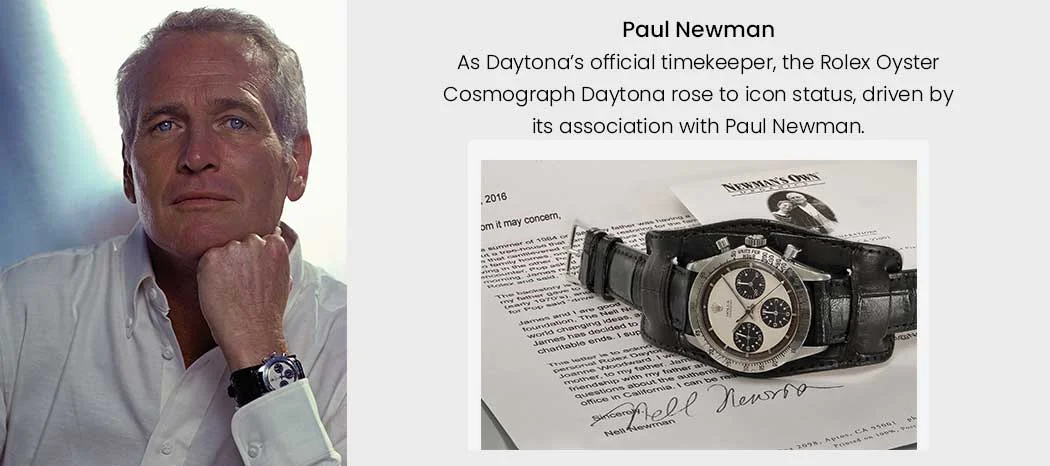
By the speedy 1960s, Rolex’s Oyster Cosmograph Daytona was gloriously building upon its three-decade-plus legacy of racing precision, while also serving as official timekeeper of the Daytona International Speedway. What pushed the Rolex Oyster Cosmograph Daytona into pole position was its association with racetrack and cinema legend, Paul Newman. Featuring a signature white dial with black counters, this model featured rounder index numerals and a unique layout. In case you’re wondering, a Paul Newman Daytona sold for $17.8 million in 2017.
James Cameron’s Dive into the Deep (2012)
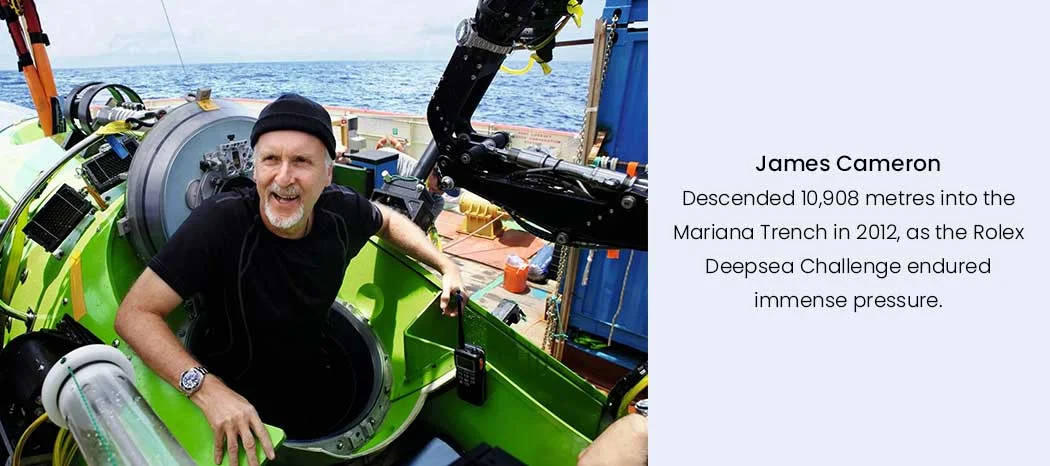
Nearly half a century since the US Navy’s bathyscaphe, Trieste’s record-setting voyage 11 kilometres into the abyss darkness of the Mariana Trench, famous Hollywood filmmaker James Cameron dared to revisit its trajectory in 2012. This time, Cameron was equipped with a specially designed experimental Rolex: the Deepsea Challenge. Just like it did in 1960, the timepiece withstood a theoretical pressure of 15,000 metres and 17 tonnes on its crystal as it dove 10,908 metres (35,787 feet) into the Mariana Trench. Cased out of RLX titanium — a grade 5 titanium alloy and equipped with a Rolex-patented helium escape valve, Ringlock system, and Chromalight display dial.


Recent Posts
Recent Comments
Archives