
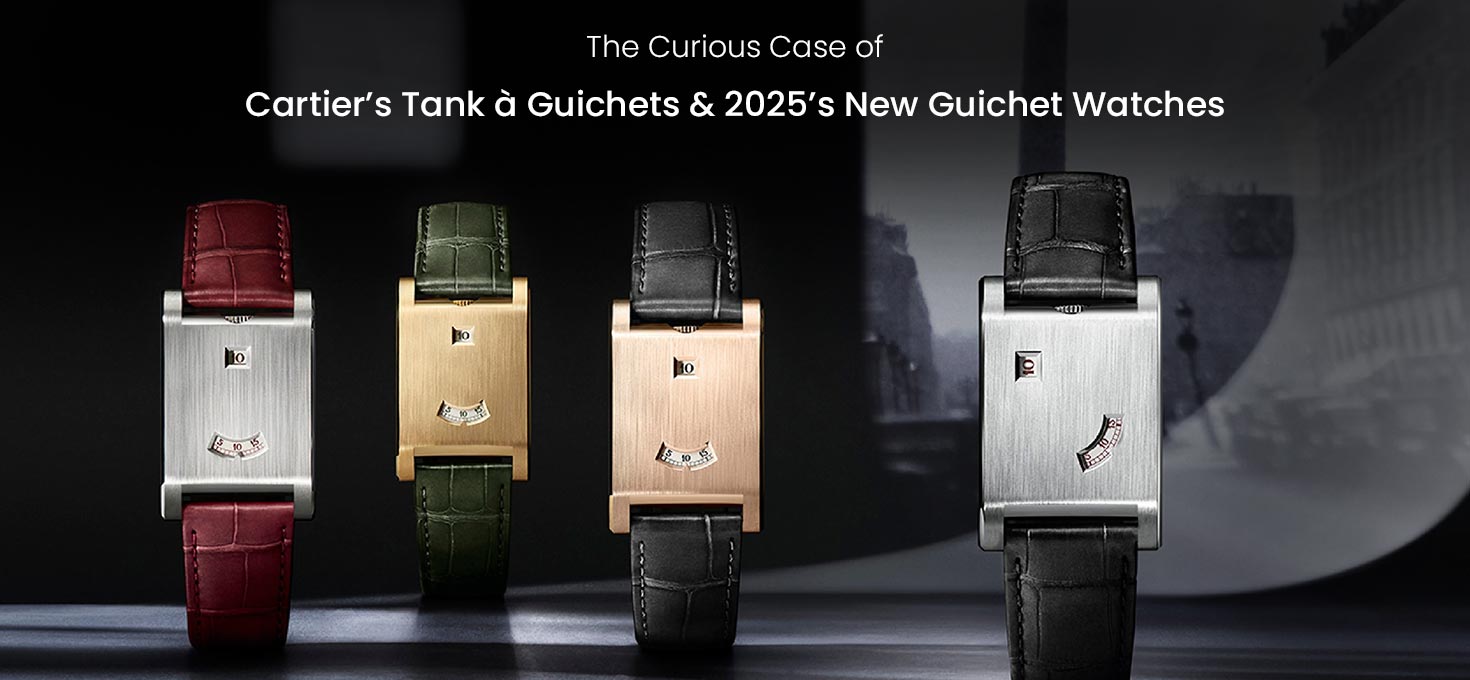
Amidst the roars of hyper-complications and bold designs at Watches & Wonders 2025, a quiet, minimalist silhouette made an unmissable statement. With palpable admiration from enthusiasts and retro timepiece collectors, ‘Guichet’ watches represent the epitome of 17th-century minimalist timekeeping, once glamourized in the 1920s.
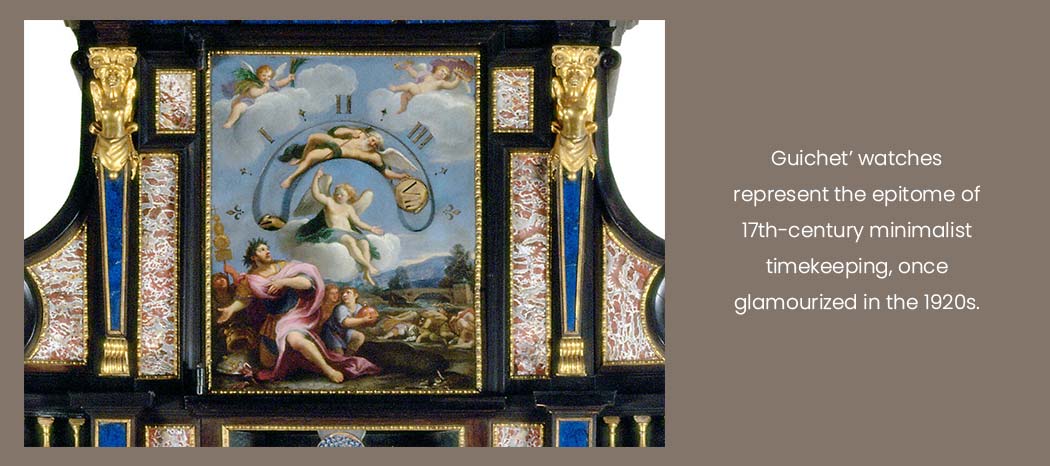
Characterised by the absence of a dial and instead employing a duet of jumping hours and minutes (apertures), this obscure accent of timekeeping makes a comeback nearly a century since its heyday.
In January 2025, Louis Vuitton paid homage to the bygone era of ‘montres à guichet’ (watches with apertures/windows) with the Tambour Convergence — following which, maisons including Cartier, Louis Vuitton, Bremont, Urwerk, and Jaeger-LeCoultre turned Watches & Wonders 2025 into an absolute Guichet watch fiesta.
‘Windows’ into the Past
Upon the dial of contemporary Guichet timepieces, rests a window to the past — to an era defined by avant-garde tastes, Art Deco geometrics, and an audacious spirit of breaking tradition. However, the true origins of Guichet timepieces predate even the Art Deco era by nearly three centuries.
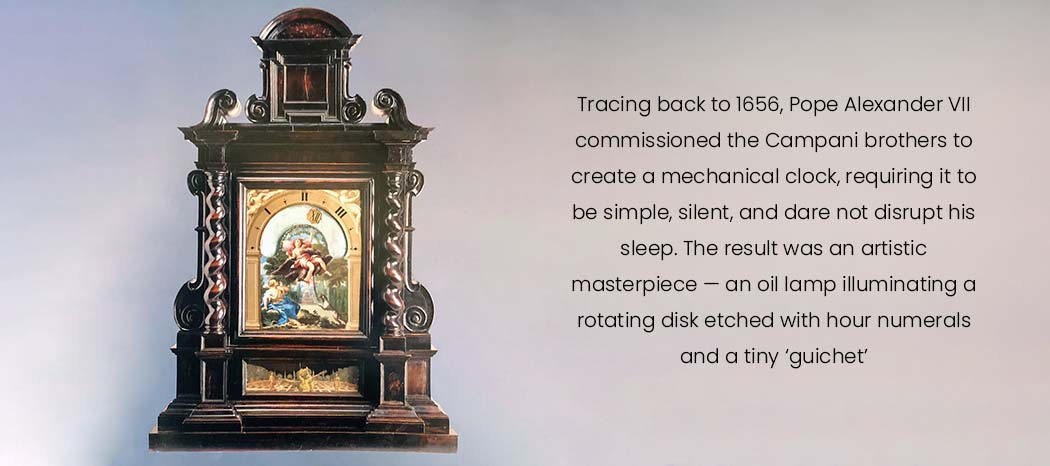
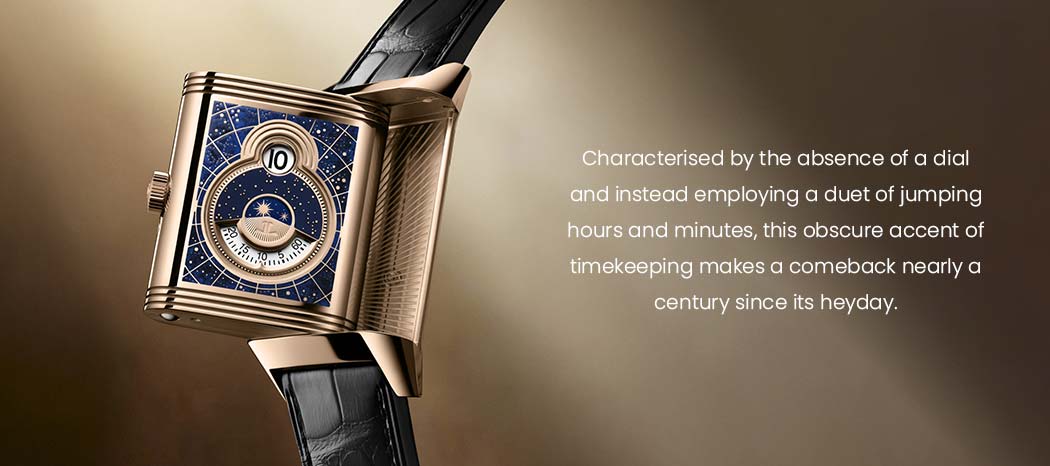
Tracing back to 1656, Pope Alexander VII commissioned the Campani brothers to create a mechanical clock, requiring it to be simple, silent, and dare not disrupt his sleep. The result was an artistic masterpiece — an oil lamp illuminating a rotating disk etched with hour numerals and a tiny ‘guichet’ (French for window), capable of telling time even in the dark. Legend has it that the Campani brothers appointed artists Carlo Maratta and Filippo Lauri to adorn the clock with motifs of flowers, foliage, angels, and other religious imagery.
As the centuries that followed artistically stripped these creations, they mechanically innovated and evolved into ‘jump hour’ watches. Innovated by French watchmaker Antoine Blondeau circa 1830 for King Louis Philippe, it replaced traditional dials, indexes, and hands with rotating disks visible through a tiny ‘guichet’.
By the 20th century, this style of time-telling was given an ‘Art Deco’ twist by Audemars Piguet in 1921, followed by Breguet’s 1927 ‘digital display perpetual calendar’ and Cartier’s iconic Tank à Guichets in 1928, creating one of the most emblematic and unconventional horological icons to exist.
Cartier’s Tank with ‘Windows’’
Cartier’s legacy is built upon its shapes of time. One of the French watchmaker’s most pivotal silhouettes is the Tank, created in 1917 as the ‘Tank Normale’, inspired by Renault military tanks used in World War I. Soon, the Tank began to experiment while its rectangular case and lateral brancards remained central to its design, expressed in the form of the Tank Cintrée, Tank Chinoise, Tank Louis Cartier, Tank Basculante, Tank Asymétrique, Tank Américaine, and Tank Française.
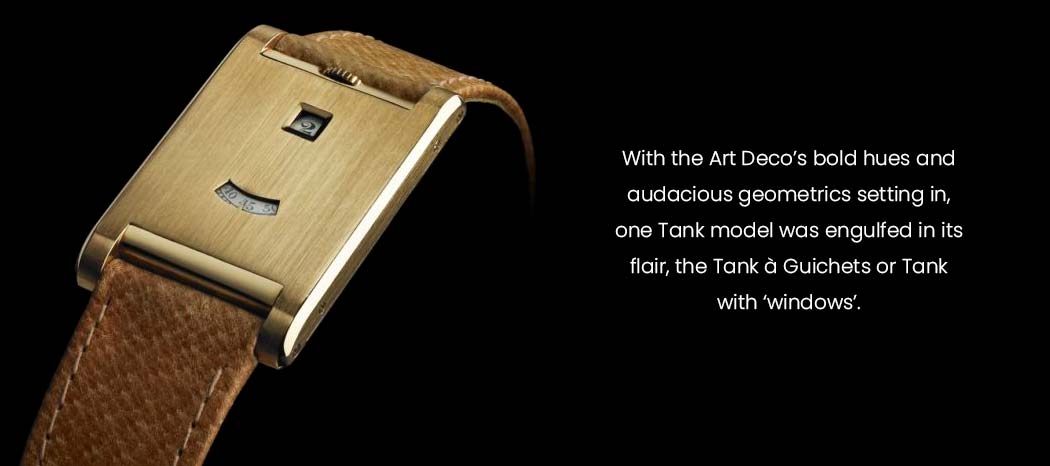
With the Art Deco’s bold hues and audacious geometrics setting in, one Tank model was engulfed in its flair, the Tank à Guichets or Tank with ‘windows’. In 1928, the Tank à Guichets perfectly embodied the spirit of Art Deco with a brutalist, fuss-free dial. Futurist and unlike any previous Tank model, the dial was replaced by a streamlined, brushed gold case with two tiny apertures: a jumping hour display and a minute track, and a crown positioned at 12 o’clock. Celebrating the French maison’s 150th anniversary in 1997, the Tank à Guichets was revived in platinum, and again in 2005 as part of the exquisite CPCP collection (Collection Privée Cartier Paris) in rose gold.
Cartier Tank à Guichets at Watches & Wonders 2025
Cartier’s Privé collection is a curation of the maison’s most mythical and emblematic creations reimagined as contemporary icons. At Watches & Wonders 2025, the Cartier Tank à Guichets joined this pantheon of extraordinaires, reviving the forgotten legacy of the 1928 wonder with four new editions.
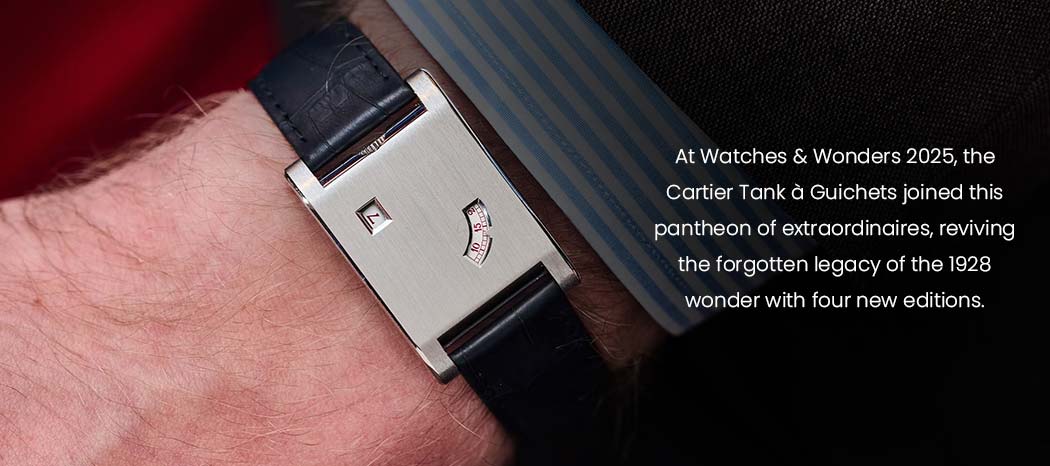
With three models in yellow gold, rose gold, and platinum, boasting the classic Tank à Guichets layout, the fourth platinum limited edition comes with a twist. Measuring 24.8 millimetres in width, 37.6 millimetres in length, and 6 millimetres in height, the brancards are thinner with longer lugs, aiming for a sleeker, refined silhouette. The fourth, platinum limited edition, is even more unusual than the classic Tank à Guichets — the hour aperture is vertically oriented at ten o’clock, while the minute aperture is at four o’clock and arched 90 degrees. The Arabic numerals and minute track are burgundy instead of black. Like a true ‘tank’, its full-body case features a vertically brushed finish pierced by two tiny time apertures: hours and minutes, powered by the calibre 9755 MC. While 2005’s CPCP collection migrated the Tank à Guichets’ crown from twelve to three o’clock, Cartier reverses it to its original position. This quartet of Tank à Guichets is strapped in leather (black, burgundy, green, and dark grey — corresponding to the case model).
Louis Vuitton Tambour Convergence
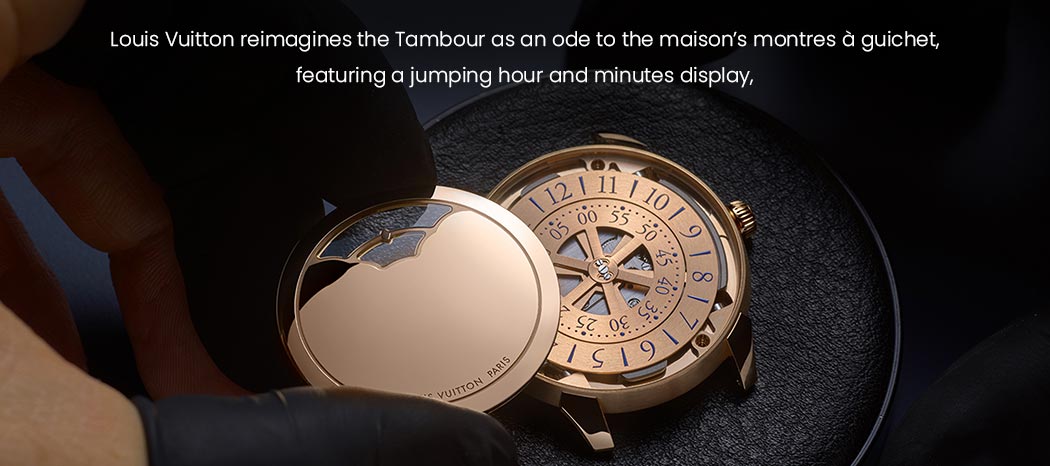
LV’s Tambour Convergence from LVMH Watch Week 2025 first sparked our curiosity about Guichet watches. On a note of contemporary minimalism, LV reimagines the Tambour as an ode to the maison’s montres à guichet, featuring a jumping hour and minutes display, visible through a window at twelve o’clock. Cased in 37 millimeters of 18-carat pink gold, the timepiece is fuss-free and artistically exquisite. Accompanying this, is a dazzling platinum edition enriched with 795 diamonds.
Bremont Terra Nova Jumping Hour Bronze
Bremont’s Terra Nova collection was built for the outdoors. Taking a page out of Cartier’s book, Bremont expands its staple field watch for the first time with two Jumping Hour models. First, sizing at 38 millimetres and cased in cupro-aluminium bronze is designed to age and develop a natural patina (limited to 100 pieces). It features an hour aperture at twelve o’clock, a central seconds display, and a minutes track just below it.
Jaeger-LeCoultre Reverso Tribute Nonantième Ename
Limited to 90 pieces, JLC’s Reverso Tribute Nanotieme ‘Enamel’ is crafted out of 18-carat pink gold, and of course, features two faces. Upon the Guichet side, the timepiece boasts two overlapping circular apertures with windows at twelve and six o’clock. These windows are surrounded by intricate gadroons that mimic the case’s Art Deco geometric flair. This is set against a regal three-quarter plate lacquered in blue, painting the night sky.
Urwerk UR-101 T-Rex
Inspired by the Urwerk’s original UR-101 and 102 models from Baselworld 1997, the ‘T-Rex’ ups the ante with a striking guilloché texture on its bronze case, resembling the scales of the mighty Tyrannosaurus Rex. In classic Urwerk style, the crown is positioned at twelve o’clock while time is indicated via a curved window down South featuring a minute tracker and a separate circular window for hours.

Recent Posts
Recent Comments
Archives