
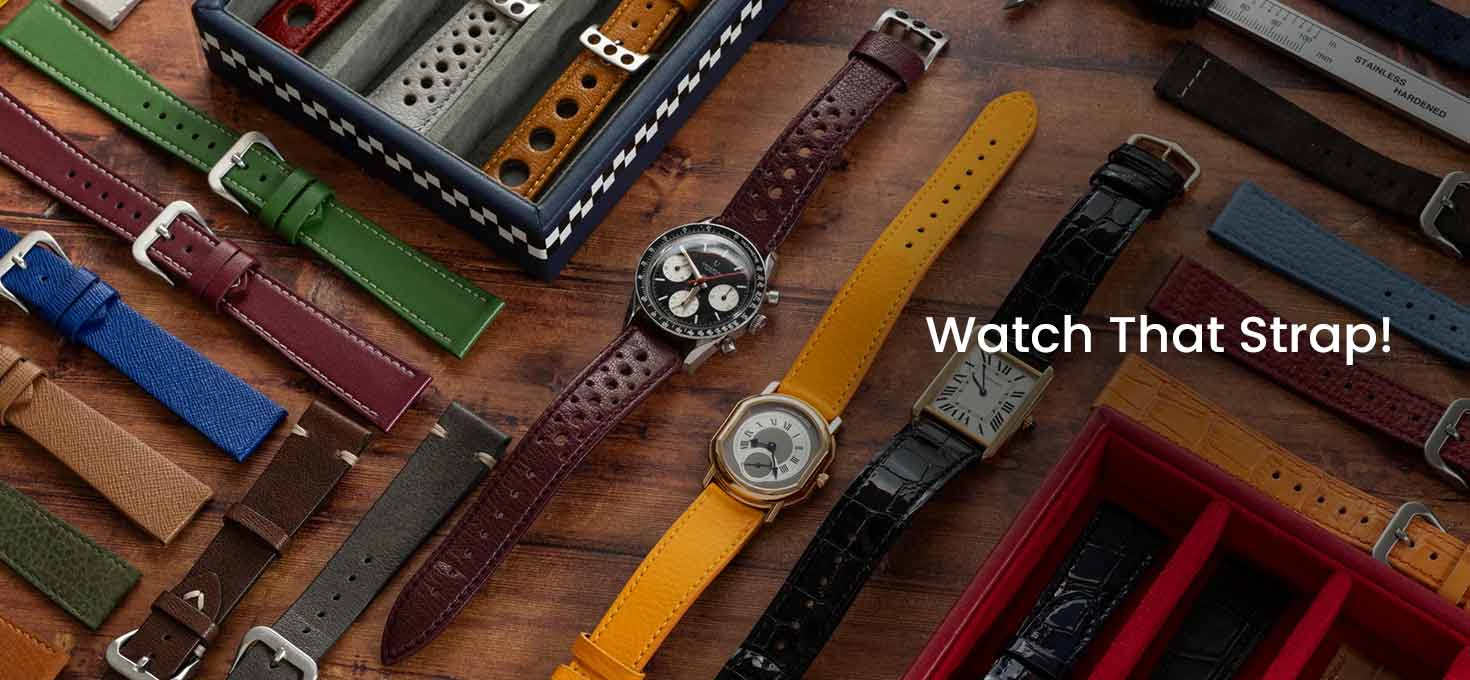
The novelty of a new watch, the smell of fresh leather seats in a new car, there is something about such acquisitions that can get a person, no matter the age, excited. In fact, even more than the coming-into-possession stage, it’s the decision-making and hunting-down-the-right-one stages which are more exhilarating. In fact, people put all the effort into deciding which watch to covet and eventually acquire – more deliberation perhaps than even when choosing a life partner – but they invest a disproportionately lesser amount of time figuring what strap to adorn said wrist-piece on. So, today, let’s look at the different types of watch straps available and what should one consider when deciding to buy one or to replace an existing one.
A Brief History of Straps
Before we deep dive, how about a quick skim through wristwatches in general. The first watches were not meant to be worn on wrists. It would have been preposterous to even suggest that to a seasoned gentleman a few centuries ago. Oh no, anyone decent and worth their top hat would have carried a pocket watch, a fashionable fob conspicuously slung from a button, gently disappearing into the waistcoat pocket. A watch on full display on an exposed wrist!!!…such ‘lewdness’ was not to be even imagined.
But fast-forward a bit, and Breguet had made a pièce unique (exclusively, circa 1810) for the Queen of Naples, Caroline Murat. But it didn’t really catch on till, nearly a 100 years later, jeweller Henri Cartier made a version for his aviator friend (and millionaire) Alberto Santos-Dumont (circa 1904) who had expressed a desire for a watch which he could refer to while flying his plane. He didn’t wish to inconveniently reach into his pocket to retrieve his watch, a task made extra difficult when seated snug inside the cockpit. Instead, he wanted to see it while his hands were still on the controls. With a few modifications (and many more to follow in the following years) Monsieur Cartier made it possible, and shortly thereafter, the first commercial wristwatches for men had arrived. The strap, while it was a bracelet made of finely woven gold thread for the Queen, Senhor Santos had his on a leather strap and, going ahead, this is what became the template for men’s wristwatches. By the 1950s, pocket watches had been reduced to a novelty as the more practical wristwatches came to completely dominate the scene.
Strap Options
Now that we know how watch straps became mainstream, this might be a good time to get back to discussing the different types and styles of straps available out there and how to go about selecting one as a secondary option for a loved watch in your collection. Or, it could be a not-so-loved watch but with this metaphorical facelift, it rises in rank in your weekly rotation.
Leather Straps
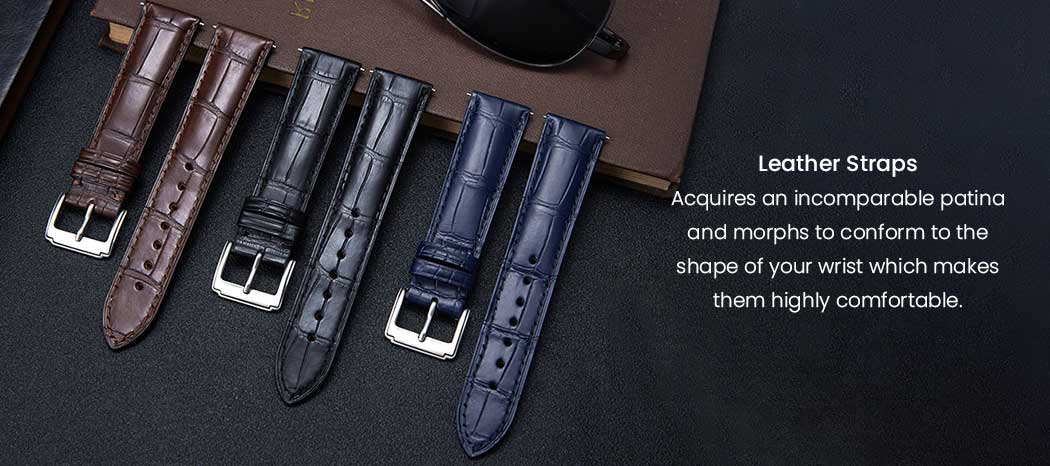
Leather straps come in many types and styles and are generally the lighter, and more classic choice. It is possibly the most natural material available to man for many purposes. True leather may need some breaking in to get them sitting right, but it weathers with time and acquires an incomparable patina and morphs to conform to the shape of your wrist which makes them highly comfortable. They can be dyed, cut into shapes and the more complex ones can also incorporate patterns and weaves. So, a strap that can shift shapes, colours, and textures and is light – what’s the downside? A few, actually. It doesn’t fare well in hot climes as sweat is not good for leather, damaging it while also imparting a vile stink to it. Leather needs to be cared for, conditioned regularly, and in spite of it all, it may not be as durable as, say, a metal strap.
Metal Straps
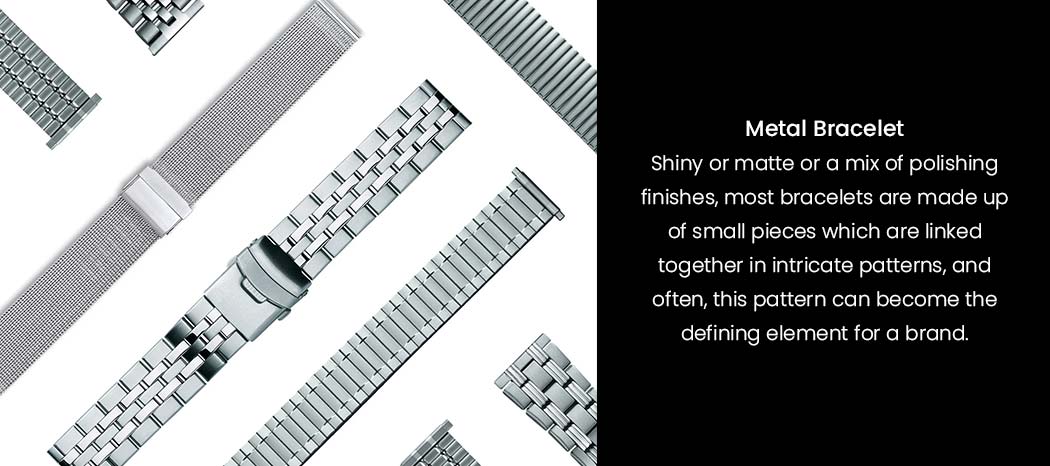
Nice segue into the other most popular option for straps – metal bracelets. When one says metal, they generally refer to steel but the term can also apply to titanium or precious metals like gold and platinum. Shiny or matte or a mix of polishing finishes, most bracelets are made up of small pieces which are linked together in intricate patterns, and often, this pattern can become the defining element for a brand i.e., you can identify the watch brand simply from the bracelet. They add some weight and heft to a watch (which is desirable when dealing with watches that measure or wear big i.e. have an exaggerated lug-to-lug length), they look quite sporty, and most metals can certainly take a bashing given their natural resistance to elements like heat and moisture.
But some people do not like all that bulk which a metal strap can bring as it can make an otherwise slender watch feel chunky. And some designs have been infamously known to epilate men involuntarily through the day, leading to a kind of a pain which is excruciating yet not one that will garner you any sympathy if shared with others. Also, even though they are generally considered easy to clean, some metal straps may require a professional touch as cleaning between the tiny links is not a task easily accomplished at home. But if they do get scratched, most can be repolished to return them to their near-original sheen.
Rubber & Silicon Straps
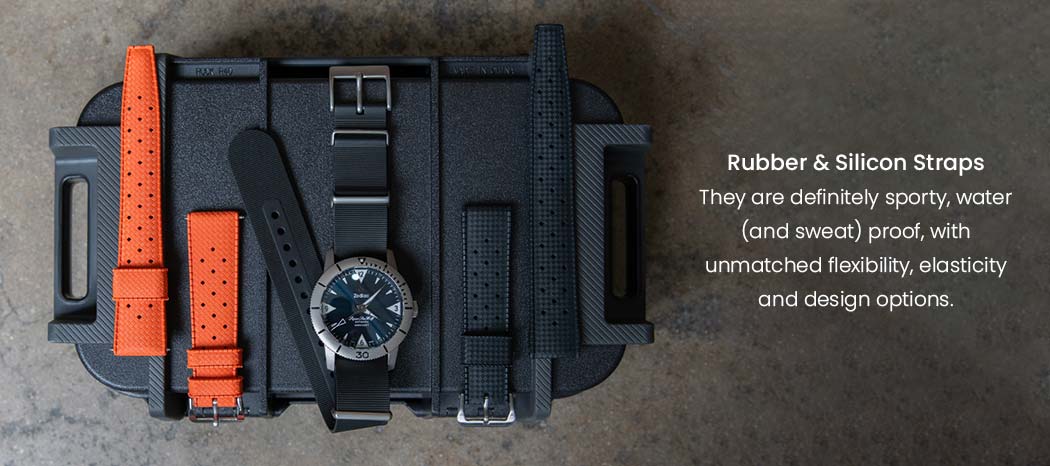
In the 1980s a luxury brand went and stuck a rubber strap on a high-end watch and made the world sit up and notice, and comment. In spite of all the initial negative press, the idea stuck – steel watches had faced a similar trial-by-public only a decade earlier and had come out unscathed – and today, some of the top watches come with a rubber (or silicon) strap as an option. They are definitely sporty, water (and sweat) proof, with unmatched flexibility, elasticity and design options. They can come in the possibly the most diverse range of colours and designs. They are possibly the top choice for watches geared for sporty engagements – from racing to diving, grappling to rappelling, triathlons to tennis. But this very attribute makes them slightly less suited for more formal settings. Rubber can harden over time and silicon too can lose some of its elasticity. All these reasons are probably why these are often included as an optional strap in the box rather than the sole choice.
Fabric, Canvass, NATO, Zulu and Exotic Straps
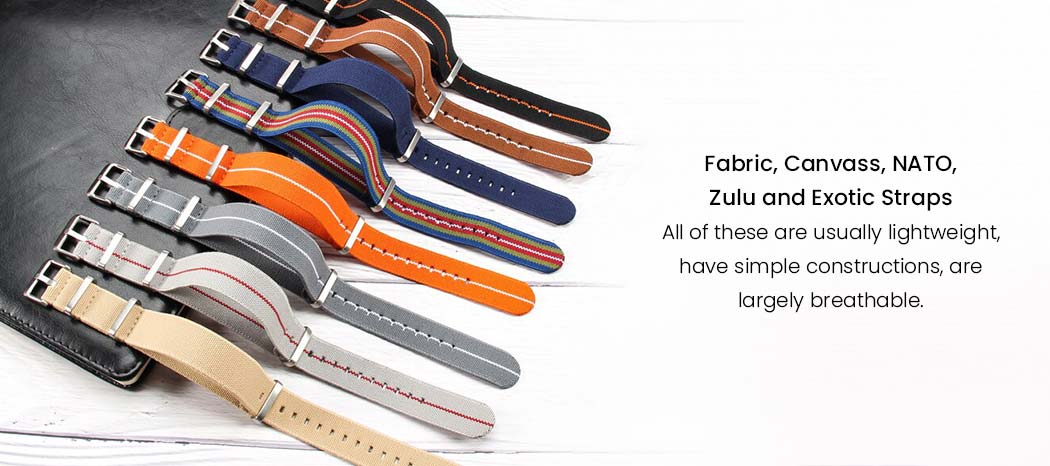
Clubbing these together as these make up the large chunk of usage-specific miscellaneous minority and while they all have certain advantages – all of these are usually lightweight, have simple constructions, are largely breathable. NATO and Zulu have the added advantage of being extra secure while also being easy to change on the fly. But they can all absorb sweat and stink, can fade or even fray over time and quicker if exposed frequently to water, and NATO and Zulu do add some extra bulk on the wrist right under the watch. They are mostly seen on field watches and divers so basically around sand and water, aka, nature. This makes them almost entirely unsuitable for anything even remotely slightly formal or dressy.
As for exotic straps, from ceramic to carbon-fibre, or hybrids, they are only limited by the designers’ imaginations. But their parts can also be limited which means, years down, if you need one repaired, it might be tough to find the spares. Also, quirk is good for a weekend or once-in-a-while piece, it can’t always become your primary staple.
Choosing the Right One
There is no one right strap and maybe that’s a great thing. It is what keeps that initial euphoria that you felt while acquiring the timepiece somewhat alive and going. Many an enthusiast will spend hours combing online communities and channels trying to figure which other strap they can slap on onto their pieces and make them feel entirely new and novel without having to break the bank. It’s a quick fix, a little cheeky ploy, and completely excusable since technically, it’s not cheating.
So, while you will always have the original watch strap, keep these factors in mind while trying to acquire a new strap:
- The Usage: Is this strap intended for daily-wear or will it come out for special (formal/social) events only? What kind of weather will this be mostly worn in?
- How often will you change the straps, if often, maybe a quick-release option would be important to consider?
- What personal style statement do you wish to convey – do you want to dress down a very formal piece or are you on the market for something that makes your sporty number more versatile?
All these considerations are useful to help you decide your secondary strap options. The good thing is, no matter however wrong you get it, it will never be a very big investment and it won’t mar the original look of your watch. As with tattoos, once you have switched straps on your wrist-piece, there is no limiting how many times and in how many styles you keep acquiring more.
Recent Posts
Recent Comments
Archives