

With the scent of kerosene in the air and the runway draped in a shimmery mirage, the aircraft pilot responds to tower control, “Roger that”, as he cautiously completes his pre-flight checklist.
Every flight to the skies challenges the bond between aviator and aircraft. After all, when you’re flying at Mach speeds, 35,000 feet high above ground, man and machine maneuver as one. And in these critical moments, the aviator’s fate rests on the precision and efficiency of aircraft tech. From the cockpit’s button-flooded dashboard and wire-mazed electrical bay to the outer body’s agile ailerons and rudder fins, each aircraft component works in perfect harmony, enabling aviators to jet through the clouds and gloriously soar to the skies.
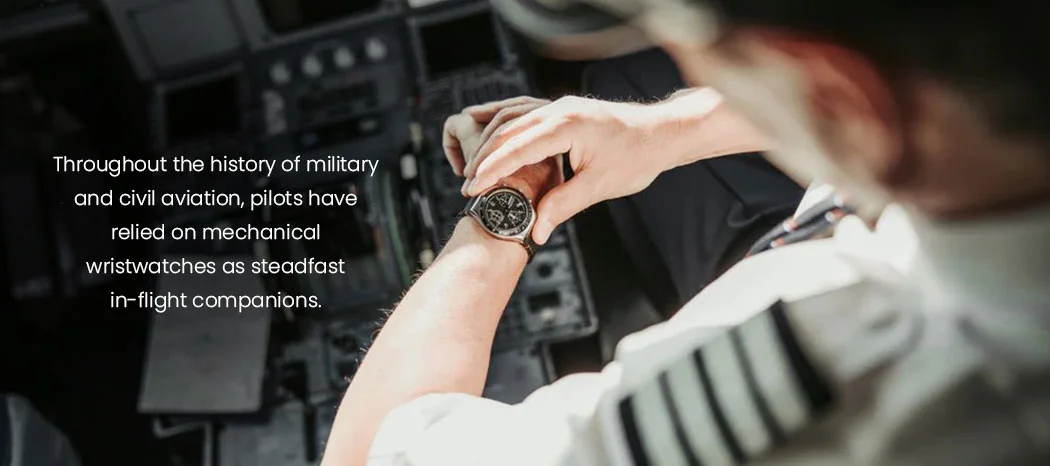
Throughout the history of military and civil aviation, pilots have relied on mechanical wristwatches as steadfast in-flight companions. Designated to serve as reliable and precise timekeepers in the skies, “pilot’s watches” boast highly distinct characteristics in form and function. Here are some of the most definitive characteristics of contemporary pilot’s watches.
Onion Crown
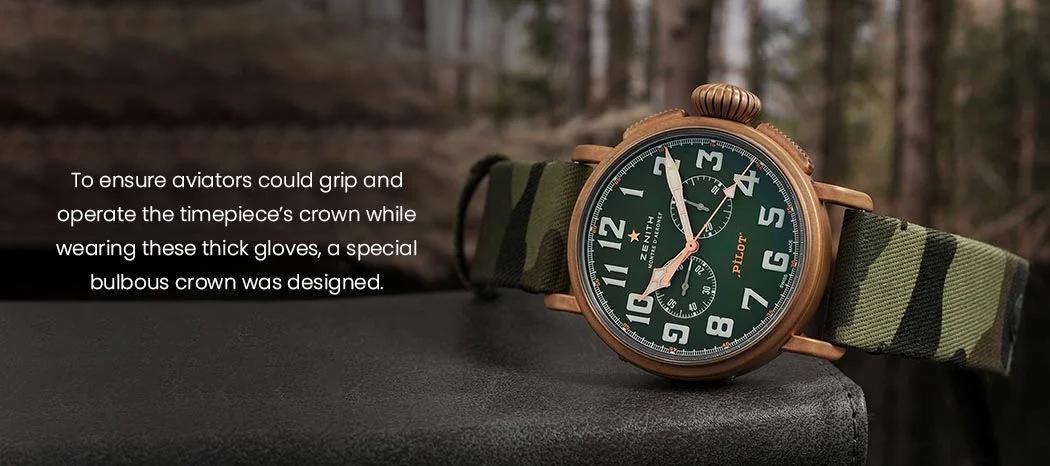
As humanity explored the skies during the first half of the 20th century, their aircraft cockpits weren’t equipped with comfy climate control features. Hence, pilots were exposed to intensely freezing temperatures and wore heavy gloves to keep warm. To ensure aviators could grip and operate the timepiece’s crown while wearing these thick gloves, a special bulbous crown was designed. While contemporarily referred to as “Big Crown”, their traditional names were diamond (conical) or onion (round-headed) crowns. Recognized for its oversized build, these crowns also boast riveted finishing to ensure a precise grip even today.
Here are two recent excellent examples of onion/conical crowns. First, Breitling’s Top Time B01 Ford Mustang, which sports a motorsport-inspired green dial and large diamond crown surrounded by chronograph pushers. Second, IWC’s Big Pilot’s Watch Perpetual Calendar, which is equipped with the mighty calibre 52616, boasts perpetual calendar functionality and a 168-hour power reserve. The signature polished conical crown contrasts with its matte-finished 46.2-millimeter stainless-steel case.
Flyback Chronograph
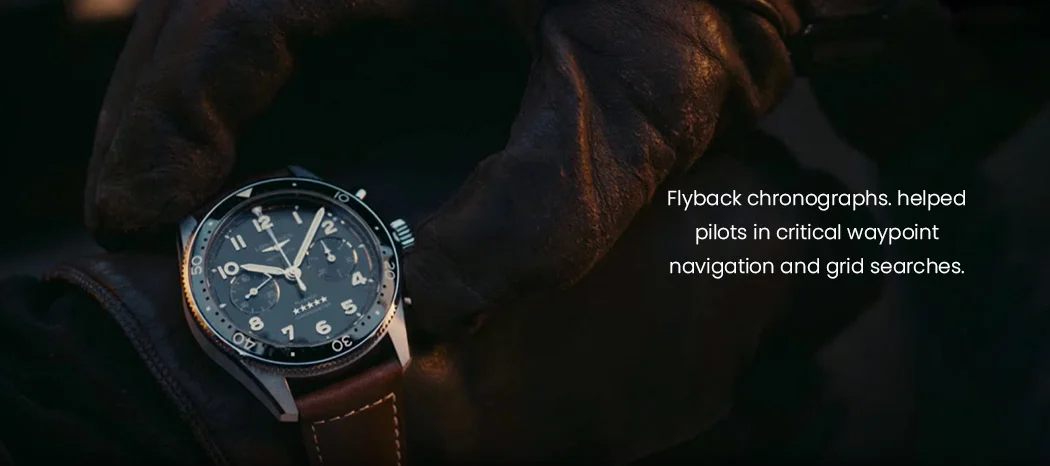
In the air, every second counts — while navigating through tight air spaces, veteran aviators were required to track several elapsed flight times, often consecutively. Traditional chronographs employed a standard start-stop-reset-start sequence, which necessitated four pusher operations. The solution? Flyback chronographs. “Retour-en-vol”, the French for “return in flight” or “on the fly”, its chronograph mechanism could reset to zero and instant restart with a single click. This feat helped pilots in critical waypoint navigation and grid searches.
Today, flyback chronographs are staple features of pilot’s watches, operated by either single or dual pushers. One of our favorite examples of flyback chronographs is the Longines Spirit Flyback, which channels the maison’s century-long aviation heritage. Cased in 42-millimeter stainless steel with a bi-directional ceramic bezel, its sunray black dial features a central flyback chronograph seconds hand with a minutes register at three and small seconds at nine o’clock. Inside, the automatic calibre L791 boasts a 68-hour power reserve.
Orientation Triangle
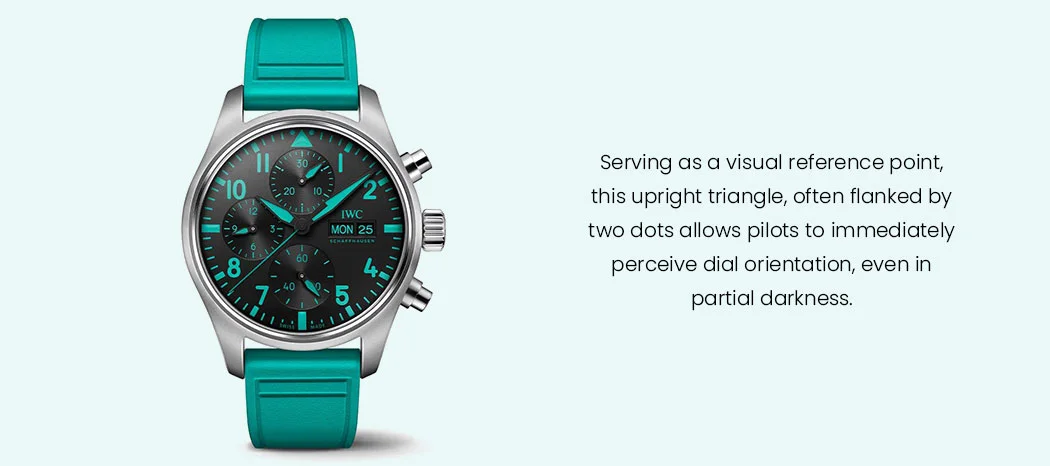
When battling turbulent weather, 30,000 feet above ground in a dimly lit cabin, it’s important to track how long you’ve been in the storm. During these critical moments of timekeeping, legibility was a matter of survival. Aviators preferred timepieces with dials stripped down to their bare essentials and featured high-contrast luminous index markers. Among these index markers at twelve o’clock, was a strikingly distinct orientation triangle. Serving as a visual reference point, this upright triangle, often flanked by two dots (a vestige of German B-Uhr models), allows pilots to immediately perceive dial orientation, even in partial darkness. Be it night flights or low-visibility weather, this luminous triangular marker provided a reliable point of vertical reference, ensuring pilots could read elapsed time or synchronize with flight instruments at a glance.
IWC Schaffhausen is notorious for the use of orientation triangles in its signature pilot’s watch collections. One that catches our eye is the Pilot’s Watch Automatic 36, which features the orientation triangle at twelve and a date window at three o’clock.
Slide Rule Bezel
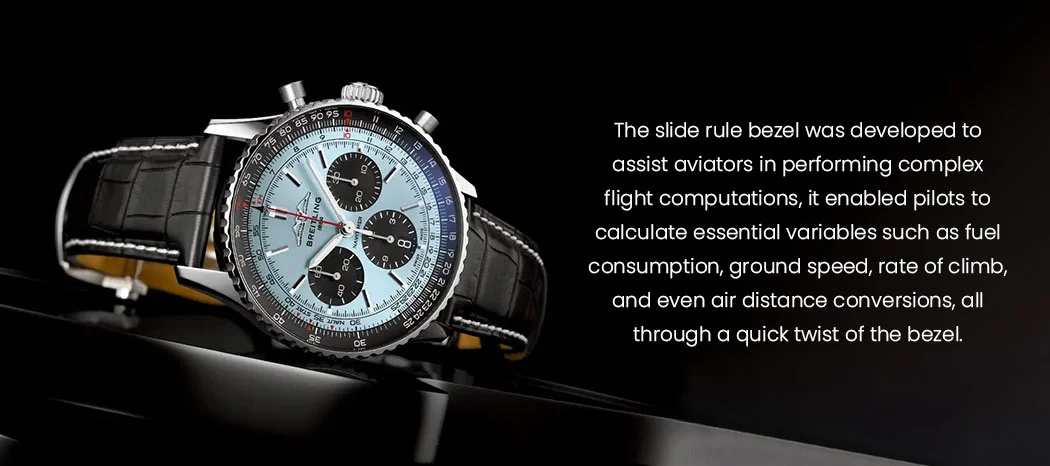
Long before digital avionic systems and touchscreen cockpits became mainstream in aviation, critical flight calculations were performed using timepieces. The slide rule bezel was developed to assist aviators in performing complex flight computations, it enabled pilots to calculate essential variables such as fuel consumption, ground speed, rate of climb, and even air distance conversions, all through a quick twist of the bezel. In operation, the slide rule bezel features two logarithmic scales (one fixed and one rotating), which allow rapid multiplications and divisions, much like an E6B flight computer. Pilots could align values to determine airspeed, fuel burn, or flight time, saving crucial minutes during navigation. While modern flight tech has long since automated such tasks, the slide rule bezel remains a signature hallmark of the golden age of aviation. Today, contemporary Navitimers, such as the Breitling Navitimer B01 Chronograph 46, retain the flattened slide rule and domed crystal, combining mid-century utility with modern refinement.
Arabic Numeral Indexes
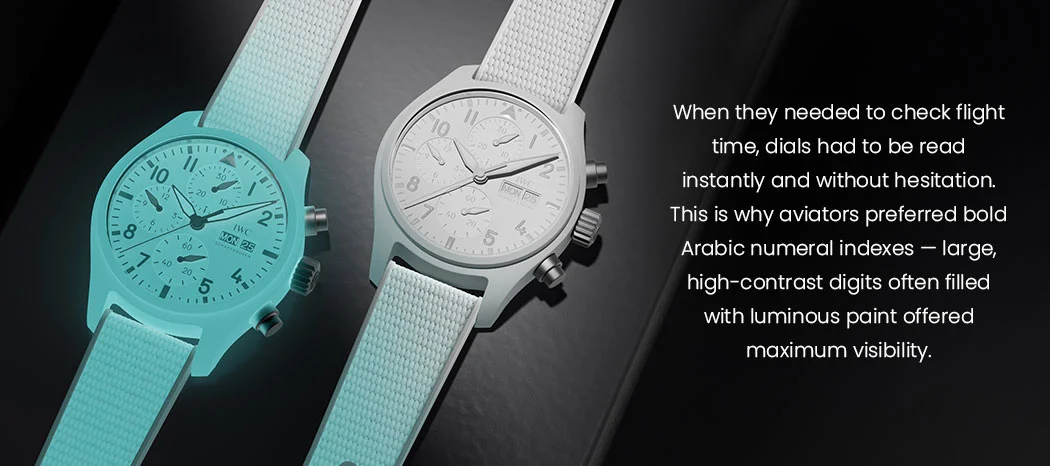
Throughout the age of aviation, the legibility of cockpit instruments has been as critical as exterior visibility. In early aircrafts, cockpits were dimly lit and lacked modern cruise-control systems, meaning pilots could seldom take their eyes off the flight path. When they needed to check flight time, dials had to be read instantly and without hesitation. This is why aviators preferred bold Arabic numeral indexes — large, high-contrast digits often filled with luminous paint offered maximum visibility. Their clarity and universal legibility made them the natural choice over ornate Roman numerals. Celebrating a century of aviation, the Longines Spirit Zulu Time 1925 features these iconic Arabic numerals in true pilot-watch fashion, complemented by a GMT hand and a date window at six o’clock.


Recent Posts
Recent Comments
Archives