
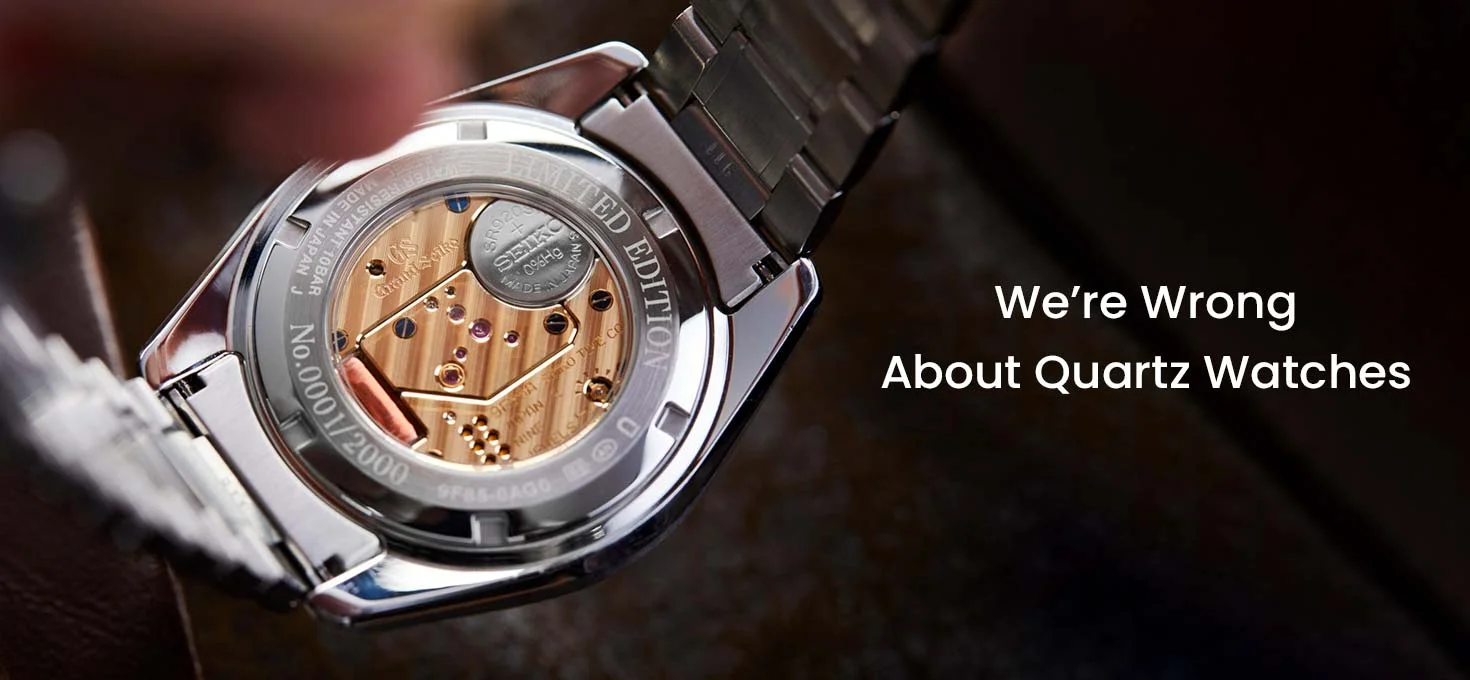
The world would be a strange place without quartz watches. Yet, they’re perceived as the absolute antithesis of luxury horology. Mass-produced, budgeted, and battery-powered, they’re devoid of the mechanical timekeeping’s geared poetry and charm. And while these claims might seem plausible on the surface, quartz watches aren’t necessarily “evil” for being different from mechanical watches. In some respects, they might actually be better. Sure, it doesn’t take a Swiss master-watchmaker six dedicated months and a super-specialized toolkit to build a quartz movement, but they’re proven to be more reliable, accurate, and technologically advanced than their mechanical counterparts. Right since the Quartz Crisis, we’ve been misunderstanding quartz watches. Here’s why.
History of Electronic Timekeeping
Right until World War II, mechanical timekeeping was a staple choice in matters of sports timekeeping, military aviation, and exploration. But comprising a labyrinthine network of gears, springs, and hundreds of tiny, delicate components, mechanical watches had some critical shortcomings. Its fragility boasted no shock resistance, limited power sustenance, and most importantly, unreliable accuracy. The solution? Going high-tech and electric.
In 1957, American watchmaker Hamilton spearheaded the innovation with the Ventura, the world’s first electronic watch. Employing a battery, magnets, and an electronic coil, it also made headlines for its eccentric, neo-futuristic curved case, resembling a bullet. Fellow American watchmaker Bulova joined the race in 1960 with the groundbreakingly innovative Accutron Spaceview 214. The Accutron technology featured a tuning fork and a one-transistor electronic oscillator, moving nearly 150x faster than mechanical balance wheels.
The Quartz Revolution
The tectonic plates of the watch-world shifted on Christmas 1969 with the launch of Japan’s Seiko Quartz Astron. Unlike a mechanical movement, its quartz movement derives power from a battery instead of a wound mainspring. More accurate, energy efficient, and affordable than mechanical counterparts, this tiny battery-powered horological breakthrough sparked the Quartz Crisis, pushing the mightiest of Swiss watchmakers to the brink of bankruptcy. Japan truly embraced the quartz technology. In 1976, Japan’s Citizen Watches introduced the ‘Eco-Drive’ prototype featuring photovoltaic cells on the dial, which used light to power the quartz watch. A single charge was sufficient for a six-month battery life and didn’t require battery replacement.
The Value Proposition of Quartz Watches
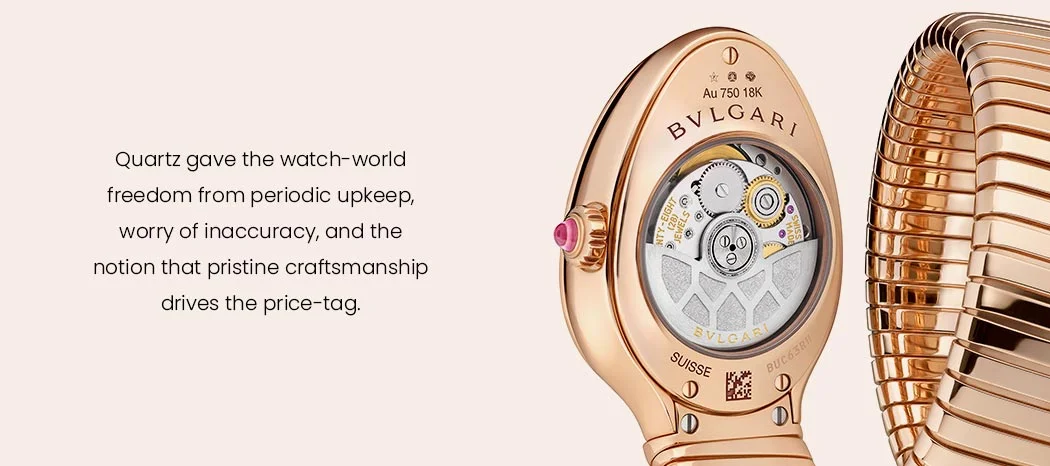
It’s true, unlike their mechanical counterparts, quartz watches aren’t romantic — that’s ironically why they’re valued. Quartz gave the watch-world freedom from periodic upkeep, worry of inaccuracy, and the notion that pristine craftsmanship drives the price-tag. It redefined timekeeping, proving that it can be simplistic, dependable, and accessible. From modest time-only field watches to high-accuracy quartz icons like Grand Seiko’s 9F, quartz watches have served a singular horological purpose of delivering absolute precision with minimal intervention. That’s its true proposition: perfection without ego.
What We Get Wrong About Quartz Watches
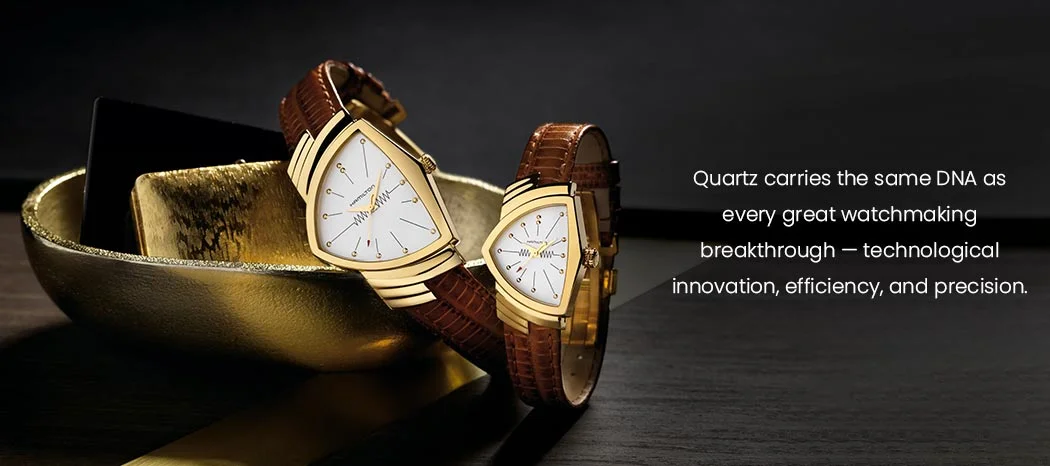
Quartz watches can tell time accurately and consistently for years. Despite delivering fuss-free, woundless, and unwavering precision, we mistake its quiet pulse for soullessness. We often perceive the Quartz Crisis as a villain in horology history, but I believe it saved the watch industry from stagnation. It forced an entire industry to question what truly mattered in a timepiece: was it complexity, or was it accuracy? Glorifying gear over goal, the industry almost mistook mechanical complexity as a sole value metric. Quartz shattered that illusion. The irony is, quartz carries the same DNA as every great watchmaking breakthrough — technological innovation, efficiency, and precision.
Quartz in the Big League
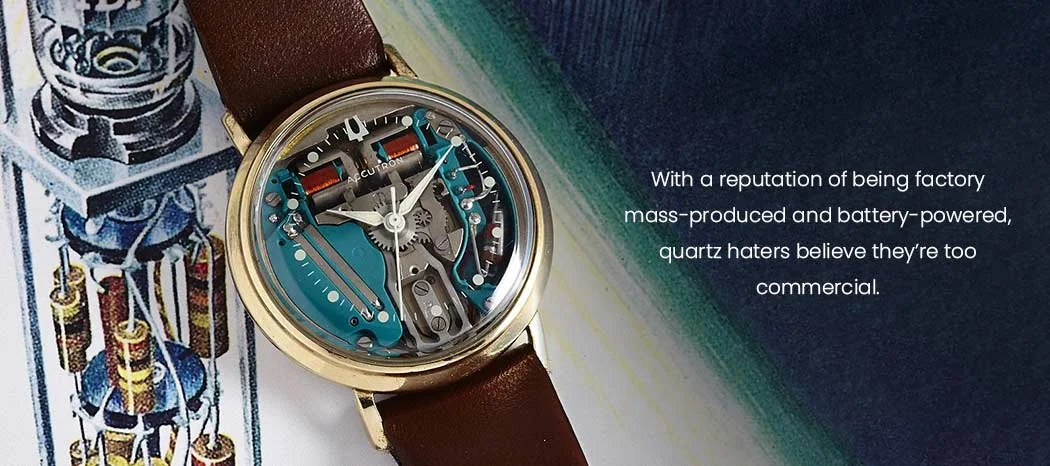
One of the biggest ‘icks’ associated with quartz watches is that they’re cheap. With a reputation of being factory mass-produced and battery-powered, quartz haters believe they’re too commercial for lacking specialization in dexterity or customization. But what if I told you maisons like Patek Philippe, Vacheron Constantin, and F. P. Journe employ quartz movements in their most prestigious collections to date?
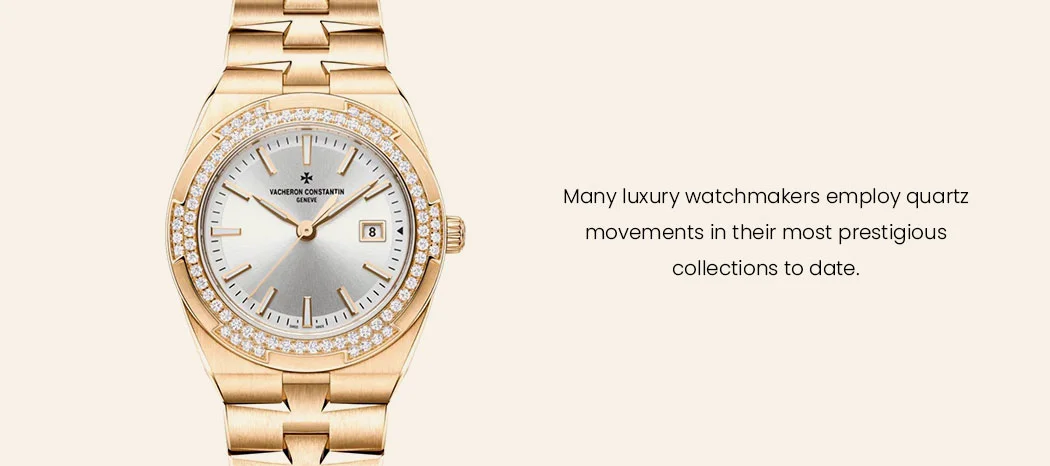
Patek Philippe’s Twenty~4 (Ref. 4910/1200A-011) is proof that quartz can be luxurious and efficient. Channeling the prestige of the maison’s legendary calibres and craftsmanship, its E15 quartz movement guarantees precision while boasting a gem-set bezel of 36 diamonds. The mighty F. P. Journe pushes the boundaries of quartz tech further with its Élégante 40 mm Titane. The calibre 1210 uses a motion detector to enter a “sleep mode” when not worn, extending battery life up to 18 years. Another spectacular example would be Vacheron Constantin’s Overseas 1225V/200R-H031, which not only features an 18-carat pink gold case with 78 brilliant-cut diamonds but also a potent quartz movement.
Quartz Watches at Kapoor Watch Co.
At Kapoor Watch Co., quartz watches have always embraced timekeeping’s spirit of functionality, precision, and contemporary elegance.
Amongst a vast catalogue of quartz wonders, we’ve handpicked this TAG Heuer Formula 1. Encased in 38 millimeters of stainless steel, and features a striking white dial with red accents, embodying the dynamic spirit of motorsport. Powered by the Calibre TH50-00 Solargraph quartz movement, it harnesses solar energy, ensuring longevity with a 15-year battery life.
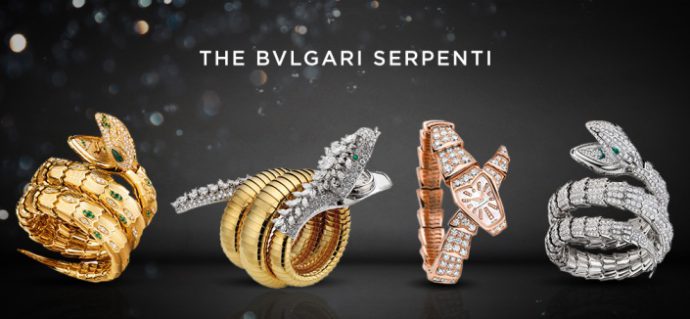
On a note of timeless elegance, this Bvlgari Serpenti Tubogas boasts an exquisite fusion of Roman mythology, fine jewelry, and watchmaking. With a harmonious blend of stainless steel and 18-carat rose gold for its bracelet, its diamond-studded bezel is complemented by a cabochon-cut rubellite crown. Underneath its guilloché soleil silver opaline dial rests a quartz movement.
As one of the earliest wristwatches ever created, this Cartier Santos Dumont Large stands as a monumental achievement not only in the watch-world but also in humankind’s history. This model, featuring a 31.4-millimeter pink gold case and signature blue sword bands on its dial, is powered by a quartz movement.


Recent Posts
Recent Comments
Archives