
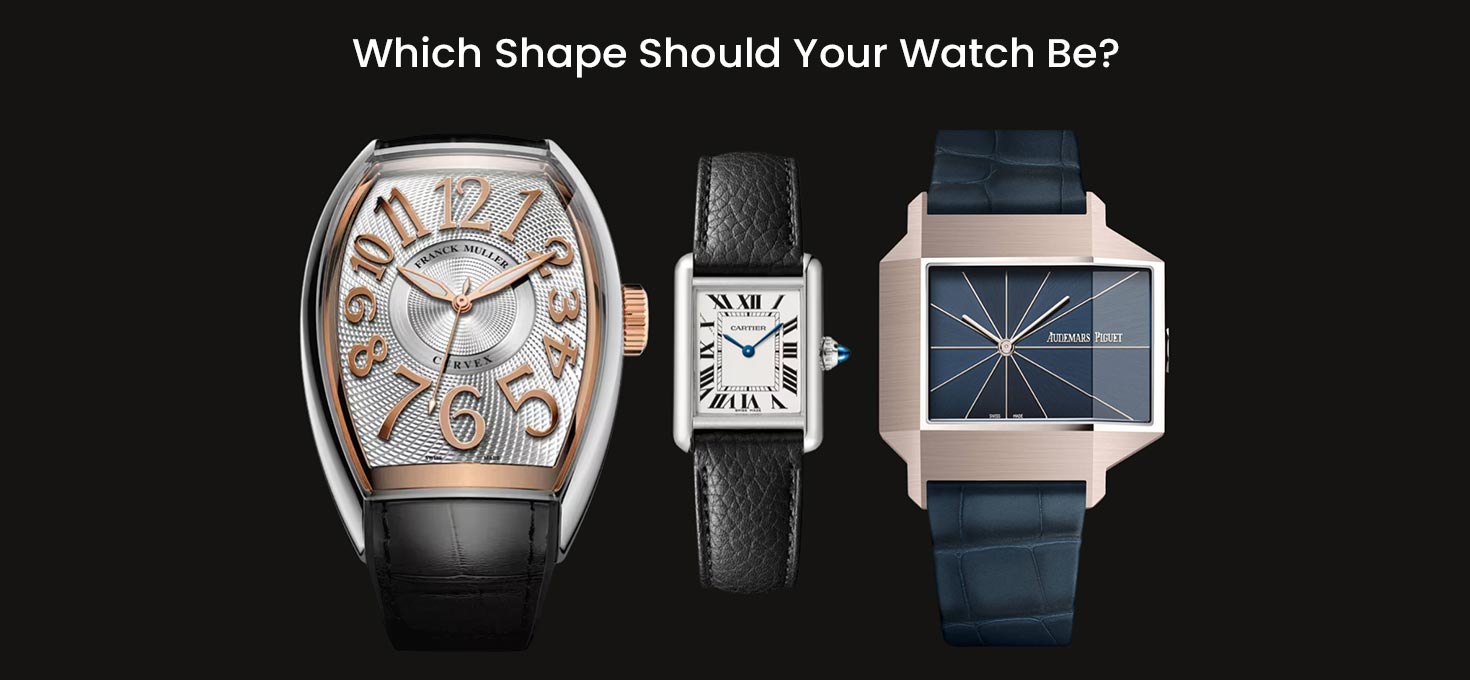
The first shapes that we learn are the circle, the square and the triangle. These primary forms are almost embedded in our early cognitive learning, so much so that we can recognise them in all formats, even when concealed in negative spaces. And finding them possibly makes us feel a sense of comfort, a calm that can only be derived from the recognition of a form that we know for as long as we have known the world around us. At least that’s what I tell my doctor as to why I can’t refuse a pizza which is a circular pie that comes in a square box and is eaten by the triangle. He still refuses to agree that it justifies me falling off my diet plan so regularly.
But even before we learn to draw a line, we learn to identify these elementary shapes, and it does explain why so many quotidian objects rely on these shapes for their form. Wrist watches come in possibly all three of these shapes, but then there are also rectangular, barrel/tonneau-shaped, oval, octagonal (very popular), decagonal, and dodecagonal ones. And then there are watches which don’t have a conventional form, like, say, a double-ellipse. And some blend shapes like squares and circles into the same form! But more on that later. So, in a world so full of fanciful forms, which one should one vie for, and how is one to decide which will look good on their wrist. It is a function of not just the watch form but also its thickness, how the lugs and strap wrap around your wrist, and, most pertinently, the size of your wrist. Let’s take these and analyse them before deciding some way of ascertaining just how to choose the right shape and size for our next piece.
The Ergonomics of Shapes
Every shape has its own unique set of advantages, as also disadvantages. A square-shaped dinner table is more efficient than a round one if the dining space is a constraint. But a round plate is more aesthetically pleasing at presenting dishes than, say, a triangular one. Triangles work fabulously as skylights, as do squares, but circles, well, they just don’t; they are better as portholes on a ship or submarine as they distribute pressure better. I could go on. The point being that the shapes deployed in any field all have a lot of research and usage-based experience taken into consideration before they become the industry standard. Simply exchanging them sometimes just doesn’t work, or sit right.
Watches and Shapes
To extrapolate that previous idea onto the world of wrist watches has many implications. It isn’t as intuitively simple to tell time on non-conventional shapes which explains why triangle wristwatches are rarely popular. But round ones, oval ones, even square ones, there are many takers for those shapes. Popularity means that those shapes are also commercially more viable and this then implies that more people involved in the design segment of the process make and create ideas and concepts to fit into those existing ‘popular’ paradigms. It’s a bit of a chicken-and-egg situation; because people design round movements, more watchmakers set them inside round cases and because round cases are popular, all new design tends to focus on elements that suit a round format for a watch. Similarly for square shapes. But once you get into the tonneau and octagonal shapes, it’s slim pickings. And you really don’t want a watch which uses an ‘adapted’ movement from another shape, which can literally become a case of a round peg in a square hole!
When the big boys of the industry make movements, cases, bezels and hands en masse, they focus on the economies of scale. So certain shapes rule roost. For smaller independent brands, these lines can confine their creativity to some extent, requiring them to think (and draw, and design) within these existing boundaries. What it means is that it is very unlikely that someone who is crowdfunding their first watch project will go and have it amoeba-shaped. They will play with the usual shapes and structures, trying instead to add their creative flair to the dial colours/textures, the shape of the hands, maybe even decorate the case and bezel, pretty up the crown and slap on a fancy strap, but it would still follow a very safe and generic design pattern. The minute you see a watch that is a squ-ircle or some similarly zany shape, you know it will cost, well, differently, simply because the makers would had to customise a lot of parts to make it fit (and feel) right.
How Do I Choose
One might, at this stage, be inclined to believe that buying a watch is akin to buying a Ford Model T in its heyday when the choice of colour was merely an illusion of choice, no matter what you wanted, you only got black. But, with watches, and in spite of the limited shapes I have just recounted here, it’s not that limiting. Sure, one will most likely be looking at buying a round one in all probability, perhaps a square or rectangle one, and there may be a smattering of a few other shapes to consider. But in each shape, one may even be able to have a few sizing options to fit different wrist sizes. Already that can amount to a lot of choice. Add to this the options of colours of finishes, options of material (steel to precious metals, ceramic to carbon) and strap choices and chances that two people end up choosing exactly the same watch start diminishing.
But, here’s the thing – don’t worry about the watch being unique. Never choose a watch simply because it seems like a rare piece. Instead, see what looks good on your wrist, sits comfortably so much so that you don’t feel like you are wearing one through the course of your day, and, most importantly, doesn’t feel disproportionate on your wrist. At the risk of oversharing, I have dainty wrists. I’ll pause while you snicker. Done? Good. My wrist circumference measures in at just a little over 6.5 inches which is quite average. But, the flat upper surface of my wrist is not as wide which means I can’t wear a watch with a major lug-to-lug measurement. It’s this latter which matters even more than the diameter (or side length in case of a square or rectangle) watch. Lugs are the bits which jut out (most often) like dog ears from the watch case and it is to this that the straps attach. In the case of integrated bracelets this is better hidden (or, integrated) but the measurement is still valid. Sometimes a watch with a small case can have over-exaggerated lugs thereby making the watch ‘wear big’ and conversely, a watch may have neatly tucked in lugs to reduce the overall wrist-print of the watch. In light of this, the case size matters slightly lesser than the lug-to-lug measurement.
For me, based on this knowledge, and an idea of how big my wrist is, (it’s not), I know that round watches over 37mm struggle to sit flush on my wrist. With reduced lugs, I can size up to 40mm but anything bigger tends to hang over my wrist on either side creating a little space on the inside at the two ends where it should have ideally tapered inwards to wrap around my wrist. With other shapes, this carries over and I have to work with smaller squares and even smaller rectangles to accommodate them comfortably and snugly on my wrist. The minute the shapes get more, well, creative, I really have to try it on and see how it wears. Chances are that the circle is the largest size I can usually sport and from there, I have to size down with most other shapes. One factor, which can sometimes allow me to size up a bit, is if the watch is extremely thin. Anything that comes in at under 9mm allows me an extra few millimetres on the lug-to-lug distance but even then, I may max out at 42mm. But the thicker a watch gets, I need to size down to have it sit right on my wrist else it just feels like an unsightly blob sticking out at the business end of my arm.
If your takeaway from all this are still my petite wrists, well, then, what can I say.
So, Conclusion
As a super precise mathematician once said, “It depends.” There is no one right answer for shape or size. It varies from wrist to wrist, preference to preference. If there ever was an equation to evaluating the best watch shape, it would still have a few variables which need to be factored in based on the wearer’s personality and quotidian usage requirements. All shapes can be worn by day or evening so don’t worry about any protocol disruption. A good time piece should feel like a limb, an extension of your body itself, and not like some foreign body dangling off one end of it. Find one that sits snug, feels right and conveys time (with a sense of immense pride) every time your flick your wrist. That’s about all the boxes a good watch should, pun intended, tick.
“Which Shape Should Your Watch Be?”
The first shapes that we learn are the circle, the square and the triangle. These primary forms are almost embedded in our early cognitive learning, so much so that we can recognise them in all formats, even when concealed in negative spaces. And finding them possibly makes us feel a sense of comfort, a calm that can only be derived from the recognition of a form that we know for as long as we have known the world around us.
At least that’s what I tell my doctor as to why I can’t refuse a pizza which is a circular pie that comes in a square box and is eaten by the triangle. He still refuses to agree that it justifies me falling off my diet plan so regularly.
But even before we learn to draw a line, we learn to identify these elementary shapes, and it does explain why so many quotidian objects rely on these shapes for their form. Wrist watches come in possibly all three of these shapes, but then there are also rectangular, barrel/tonneau-shaped, oval, octagonal (very popular), decagonal, and dodecagonal ones. And then there are watches which don’t have a conventional form, like, say, a double-ellipse. And some blend shapes like squares and circles into the same form! But more on that later.
So, in a world so full of fanciful forms, which one should one vie for, and how is one to decide which will look good on their wrist. It is a function of not just the watch form but also its thickness, how the lugs and strap wrap around your wrist, and, most pertinently, the size of your wrist. Let’s take these and analyse them before deciding some way of ascertaining just how to choose the right shape and size for our next piece.
The Ergonomics of Shapes
Every shape has its own unique set of advantages, as well as disadvantages. A square-shaped dinner table is more efficient than a round one if the dining space is a constraint. But a round plate is more aesthetically pleasing at presenting dishes than, say, a triangular one. Triangles work fabulously as skylights, as do squares, but circles, well, they just don’t; they are better as portholes on a ship or submarine as they distribute pressure better. I could go on.
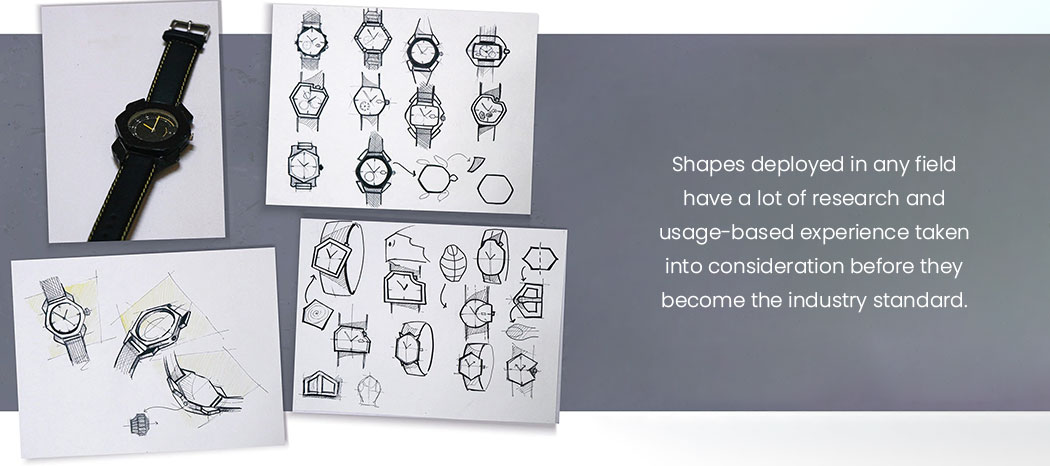
The point being that the shapes deployed in any field all have a lot of research and usage-based experience taken into consideration before they become the industry standard. Simply exchanging them sometimes just doesn’t work or sit right.
Watches and Shapes
To extrapolate that previous idea onto the world of wrist watches has many implications. It isn’t as intuitively simple to tell time on non-conventional shapes which explains why triangle wristwatches are rarely popular. But round ones, oval ones, even square ones, there are many takers for those shapes. Popularity means that those shapes are also commercially more viable and this then implies that more people involved in the design segment of the process make and create ideas and concepts to fit into those existing ‘popular’ paradigms. It’s a bit of a chicken-and-egg situation; because people design round movements, more watchmakers set them inside round cases and because round cases are popular, all new design tends to focus on elements that suit a round format for a watch. Similarly for square shapes. But once you get into the tonneau and octagonal shapes, it’s slim pickings. And you really don’t want a watch which uses an ‘adapted’ movement from another shape, which can literally become a case of a round peg in a square hole!
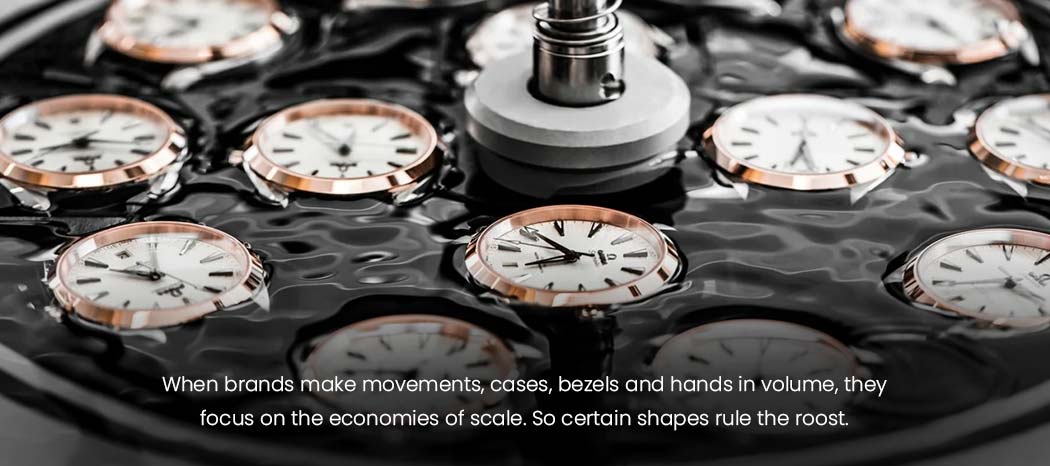
When the big boys of the industry make movements, cases, bezels and hands en masse, they focus on the economies of scale. So certain shapes rule the roost. For smaller independent brands, these lines can confine their creativity to some extent, requiring them to think (and draw, and design) within these existing boundaries. What it means is that it is very unlikely that someone who is crowdfunding their first watch project will go and have it amoeba-shaped. They will play with the usual shapes and structures, trying instead to add their creative flair to the dial colours/textures, the shape of the hands, maybe even decorate the case and bezel, pretty up the crown and slap on a fancy strap, but it would still follow a very safe and generic design pattern. The minute you see a watch that is a squ-ircle or some similarly zany shape, you know it will cost, well, differently, simply because the makers would had to customise a lot of parts to make it fit (and feel) right.
How Do I Choose
One might, at this stage, be inclined to believe that buying a watch is akin to buying a Ford Model T in its heyday when the choice of colour was merely an illusion of choice, no matter what you wanted, you only got black. But, with watches, and in spite of the limited shapes I have just recounted here, it’s not that limiting. Sure, one will most likely be looking at buying a round one in all probability, perhaps a square or rectangle one, and there may be a smattering of a few other shapes to consider. But in each shape, one may even be able to have a few sizing options to fit different wrist sizes. Already that can amount to a lot of choice. Add to this the options of colours of finishes, options of material (steel to precious metals, ceramic to carbon) and strap choices and chances that two people end up choosing exactly the same watch start diminishing.
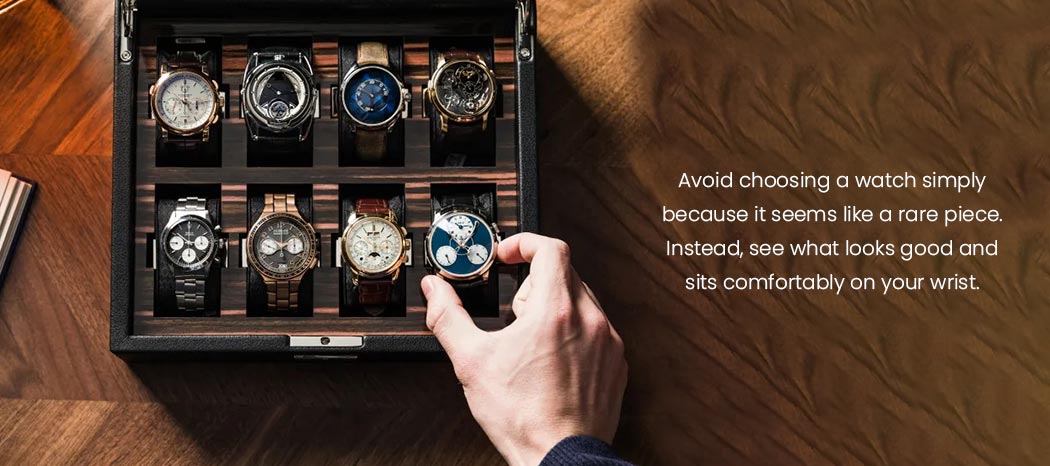
But, here’s the thing – don’t worry about the watch being unique. Never choose a watch simply because it seems like a rare piece. Instead, see what looks good on your wrist, sits comfortably so much so that you don’t feel like you are wearing one through the course of your day, and, most importantly, doesn’t feel disproportionate on your wrist. At the risk of oversharing, I have dainty wrists. I’ll pause while you snicker. Done? Good. My wrist circumference measures in at just a little over 6.5 inches which is quite average. But, the flat upper surface of my wrist is not as wide which means I can’t wear a watch with a major lug-to-lug measurement. It’s this latter which matters even more than the diameter (or side length in case of a square or rectangle) watch. Lugs are the bits which jut out (most often) like dog ears from the watch case and it is to this that the straps attach. In the case of integrated bracelets this is better hidden (or, integrated) but the measurement is still valid.
Sometimes a watch with a small case can have over-exaggerated lugs thereby making the watch ‘wear big’ and conversely, a watch may have neatly tucked in lugs to reduce the overall wrist-print of the watch. In light of this, the case size matters slightly lesser than the lug-to-lug measurement. For me, based on this knowledge, and an idea of how big my wrist is, (it’s not), I know that round watches over 37mm struggle to sit flush on my wrist. With reduced lugs, I can size up to 40mm but anything bigger tends to hang over my wrist on either side creating a little space on the inside at the two ends where it should have ideally tapered inwards to wrap around my wrist. With other shapes, this carries over and I have to work with smaller squares and even smaller rectangles to accommodate them comfortably and snugly on my wrist. The minute the shapes get more, well, creative, I really have to try it on and see how it wears. Chances are that the circle is the largest size I can usually sport and from there, I have to size down with most other shapes. One factor, which can sometimes allow me to size up a bit, is if the watch is extremely thin. Anything that comes in at under 9mm allows me an extra few millimetres on the lug-to-lug distance but even then, I may max out at 42mm. But the thicker a watch gets, I need to size down to have it sit right on my wrist else it just feels like an unsightly blob sticking out at the business end of my arm.
If your takeaway from all this are still my petite wrists, well, then, what can I say.
Watch Shapes and Wearer Type
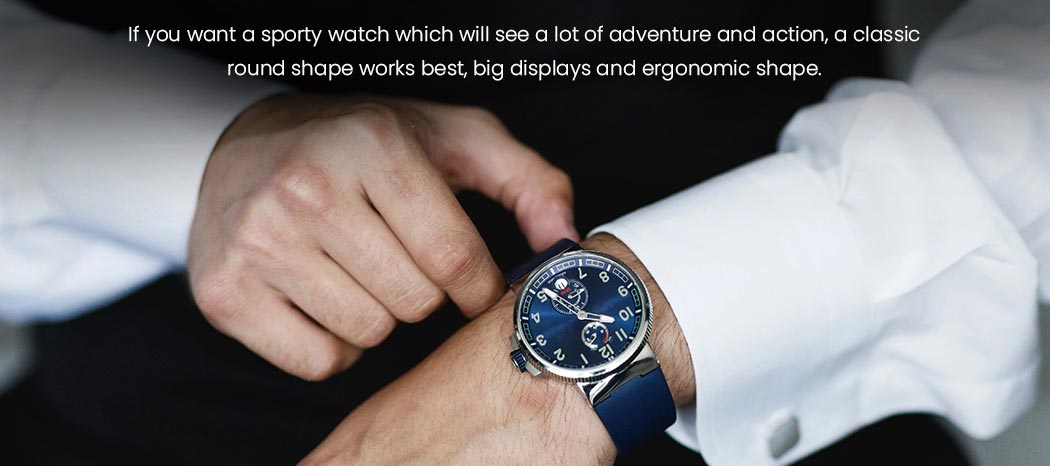
If there was ever a typecast that can hold true, this might just be one of those. If you want a sporty watch which will see a lot of adventure and action, a classic round shape works best, big displays and ergonomic shape.
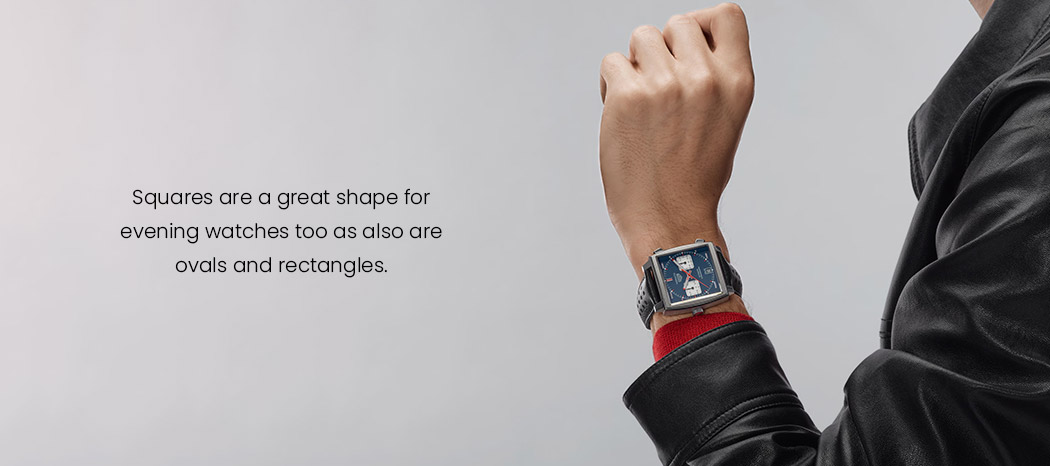
Reserve the angular ones and tonneau/barrel shapes for the urban crawlers who frequent more board rooms than the outback. Squares are a great shape for evening watches too as also are ovals and rectangles.
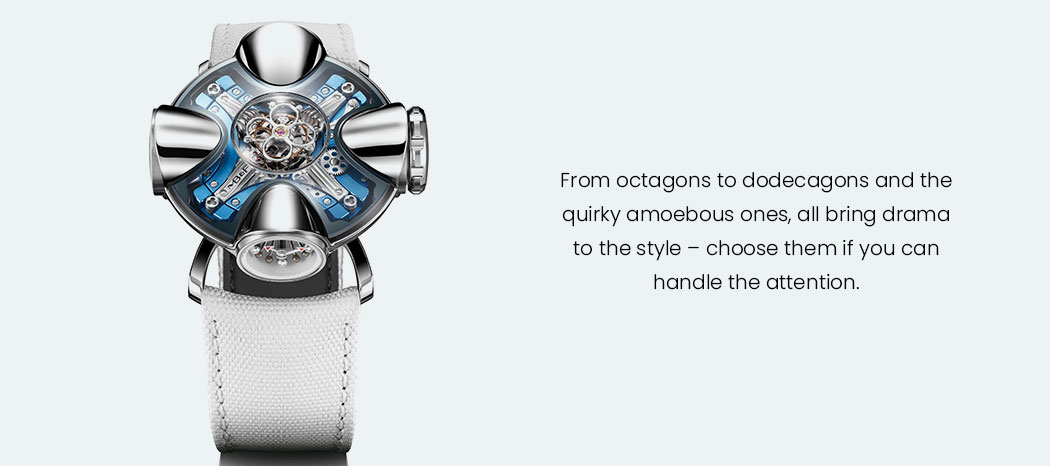
Which leaves us with anything that has more than 4 sides, from octagons all the way up to dodecagons and the quirky amoebous ones; well, they bring drama – to the wearer as also the situation – choose them if you can handle the attention.
So, Conclusion
As a super precise mathematician once said, “It depends.” There is no one right answer for shape or size. It varies from wrist to wrist, preference to preference. If there ever was an equation to evaluating the best watch shape, it would still have a few variables which need to be factored in based on the wearer’s personality and quotidian usage requirements. All shapes can be worn by day or evening so don’t worry about any protocol disruption.
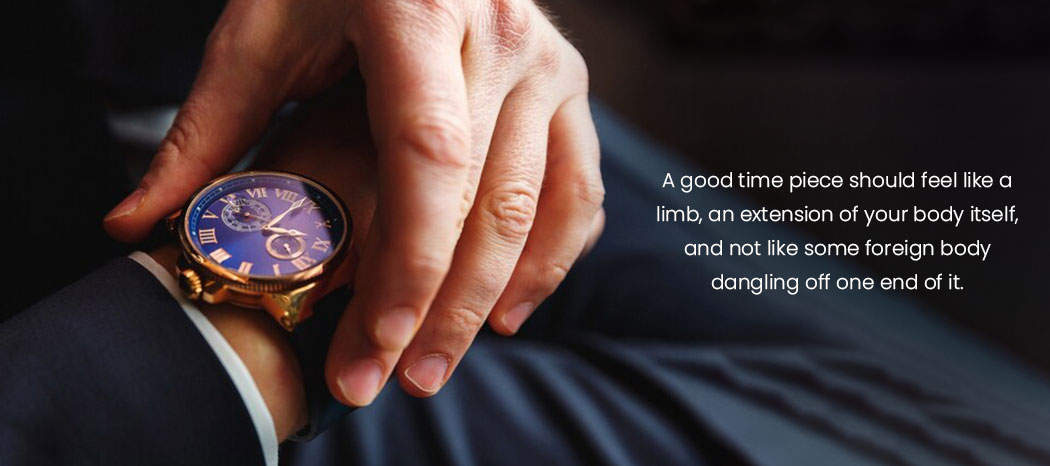
A good time piece should feel like a limb, an extension of your body itself, and not like some foreign body dangling off one end of it. Find one that sits snug, feels right and conveys time (with a sense of immense pride) every time your flick your wrist. That’s about all the boxes a good watch should, pun intended, tick.
Recent Posts
Recent Comments
Archives