
The Premium of Provenance
The word is ‘provenance’, signifying where a product comes from – its veritable origin – and it leads to many such debates about how to define it for any given product. In the world of luxury, it is even more relevant as provenance can almost translate to pedigree. Because, let’s be honest, and I am speaking particularly about luxury now, one is never as willing to pay the same price for something that is “Made in China” while leather shoes and jackets with a “Made in Italy” mark immediately seems to up the premium quotient. And how many of us, when we have come back from a trip and started unpacking all the costly shopping, only to find a “Made in India” tag on several items, felt gypped instead of a sense of patriotic pride? There’s a reason the words ‘origin’ and ‘original’ share an etymology.
Integrity of Integration
The adult world isn’t entirely black and white, which is why being a child is so much easier, and fun! When the teacher tells us to do our homework, and if yours were the type of parents who insisted on it, you ended up with an essay that was entirely composed by you. It may not have read well, but it was your effort, an effort which, over time, honed your skills as a writer. It taught you to use multiple skills – both mental and physical – to get your thoughts down on paper eloquently. But as adults, there is less pressure to go it all the way alone; oh no, elders much prefer committees and groups for activities. (Or, in today’s times, AI.) That way, there is no one to blame, for one, but more pertinently, it allows different people with specialised skills to contribute to the collective thereby enhancing the overall knowledge bank. That sounds like an unrealistically ideal group but in most cases, we work better when we club resources. If you can draw and I can write, between us we may have a potentially awesome graphic novel. If you can navigate like Moses and I can drive off-road like the ghost rider but on four-wheels, I think the rally world beckons us. However, it does bring up the question, who gets credit for the results achieved in such setups.
Defining In-house
In the timepiece universe, things get even murkier. Making a watch has many steps, from conceptualising and drawing out the initial renders to designing the movement and how it will be placed in the watch case, and finally the straps or bracelet it will be set on. There is no particular mandate on how many have to be done in-house and which ones can (or should) be outsourced. The very decision to decide this itself depends on many elements. But before we look at those, let’s quickly define what exactly does it entail to have an in-house movement.
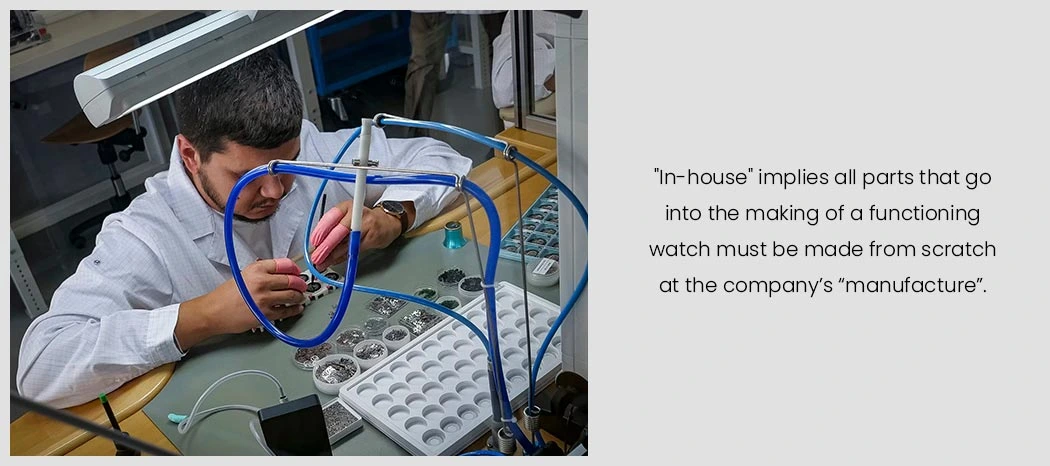
In the purest sense of its usage, the term implies all parts that go into the making of a functioning watch must be made from scratch at the company’s “manufacture” (fancy French-loan word for factory). So they should basically buy steel and other materials in their raw, pure form, and then get down to working with them – drawing, designing, cutting, grinding, polishing, decorating, all of it and anything else that may be needed. Then, they need to assemble it all into a complete working movement.
Still with me? Good, next step, is setting this movement in a case and this case too, you guessed it, has to be designed, shaped, milled, hollowed out, and brought to life by the team at the brand. Finally comes the strap or bracelet and if it’s a bracelet, then there is still much work needed in designing every link and then to bring it all together. That is as close as I can skim to the purest form of the definition of an in-house movement but I am sure someone is already wondering how can that be if they didn’t make the sapphire crystal or mine the rubies themselves. Well, most watch brands don’t tan the leather for their straps nor do they smelt the iron to extract it and then make it into steel either, so, let’s ease up on that a bit.
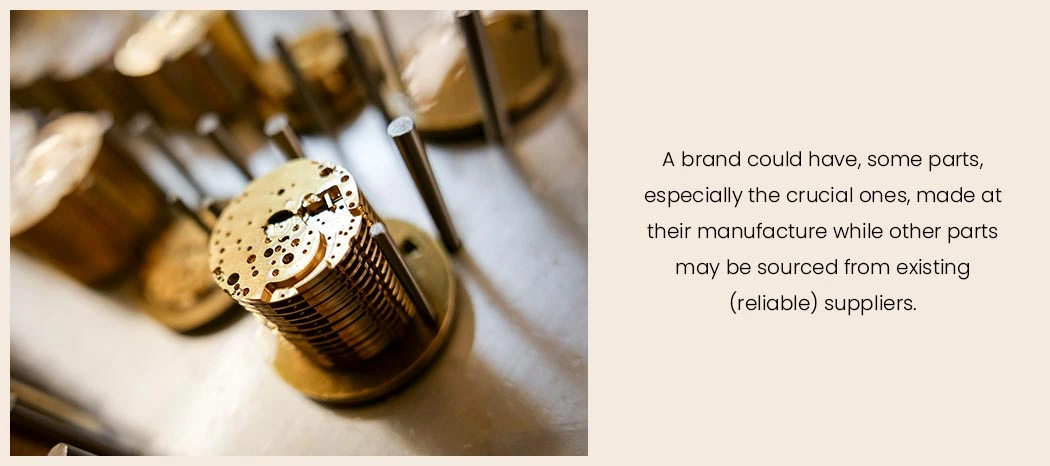
But from this puritanical level of in-house with quite an extreme level of backward integration, we can step down so slightly less stringent levels of in-house definitions too. So, a watch could have a movement which is designed entirely in-house and then, some parts, especially the crucial ones, would be made by them in their manufacture (there’s that word again) while other parts may be sourced from existing (reliable) suppliers.
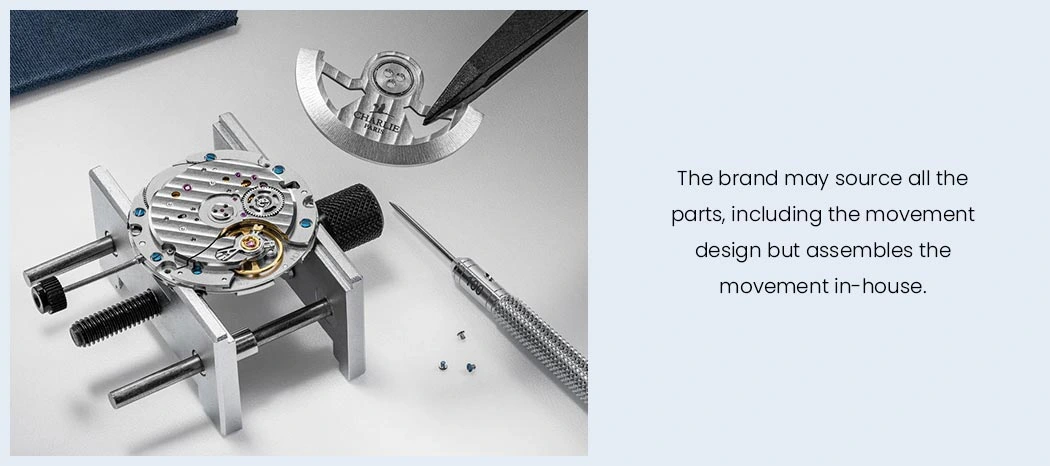
Another step down is when the brand sources all the parts, including the movement design but assembles the movement in-house. And finally, they may everything sourced from a third party but the finishing and assembling of the watch are don’t in-house.
What Moves the Watch World
So, there was a time when I staunchly believed that if a watch didn’t have an in-house movement, it wasn’t worth any wrist time. Thankfully, the years have left me wiser. Not prettier, just wiser. Today, I wear a watch because I like the way it looks. Beyond that, I certainly wish to know what makes it tick and rather than a faulty in-house movement which gains or loses seconds like a fickle partner, I’d much rather they use a completely outsourced movement from a reliable and established brand in the trade.
That said, why would a watch company, one that wants to build its repute and standing wish to outsource a part of its process; well, there are a few reasons, and most are quite logically sound.
- Their expertise lies in designing the watches and maybe the movements itself but not in making the individual parts. Think of it like a brain bank which is better utilized at planning the process rather than executing it, a task which can be easily outsourced in the form of a detailed set of instructions.
- The cost factor can be a big reason; it may not be viable for the brand to produce all parts in-house because it’s too expensive to build (from scratch) the entire setup needed to process the raw materials into the finished goods.
- Another reason, closely linked to the cost factor, is that they may be making extremely limited numbers of pieces for a given model or style and therefore, even if they do have an in-house setup, it may not be viable to deploy to produce small numbers.
- There is also the factor of operational complexity – it is trickly enough to align all the wide range of production processes and supply chains. Trying to have control over every aspect of it could dilute focus on their core competency and could adversely affect design, assembly, finishing or any other innovation-related step in the watchmaking process.
- The resources saved by not trying to control every aspect of manufacturing can then be diverted to extremely meticulous and pernickety levels of quality control at a fraction of the cost. It can position a brand get the absolute top-quality hardware without having to worry about overproduction, quality-related losses and other setbacks.
- This last point can be debated but producing parts isn’t exactly the most profitable part of watchmaking and top established and reputed brands stand to gain much more by focusing on building their brand equity and marketing their craft.
In the world of watches, only a handful of brands produce everything in house. While there be a certain sense of palpable pride in doing so, the composite benefits may not often weight in favour of pursuing this passion. Rolex, Grand Seiko and A. Lange are possibly the only brands one can think of which flex this level of integration in their manufacturing. All other brands, yes, almost all, including that famous ones which you always dream of acquiring, well, all of them outsource some part of the process. So, do you still want to get that watch now that you know? And if you do, then you should also be more accepting of independent watchmakers and microbrands who design their ware but outsource everything else about it. But that is a cliff to scale (or leap off of) another day. In the meantime, admire all that it took to bring together that beauty on your wrist and don’t sweat the logistics of it.



Recent Posts
Recent Comments
Archives