

Date windows have a notorious reputation for migrating across dials. It does so in matters of dial aesthetics, movement design, or even establishing a brand signature (like A. Lange & Söhne’s Lange 1). On the collector’s side of the fence, date windows have the community divided — some love, hate, don’t need, or can’t live without them.
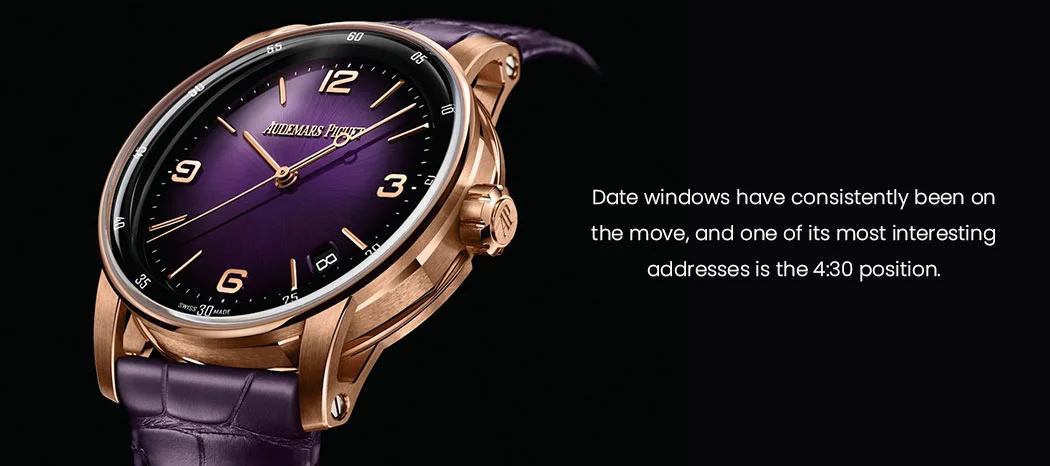
In this affair, date windows have consistently been on the move, and one of its most interesting addresses is the 4:30 position. In comparison to the traditional 3 o’clock date window, the 4:30 date window is arguably eccentrically placed but brilliantly ergonomic. We think it might just be the perfect spot to tell the date. Here’s why.
Why Are Dates Windows Such a Pet Peeve?
The date complication is subject to dial, movement, requirement, but most importantly, taste. It’s a factor that’s completely up to preference — like dial colour, strap/bracelet, whether you like sugar with your coffee, pineapple on your pizza, or summer over winter. It isn’t that deep and is simply a human tendency to turn differences in preferences into debate subjects.
However, watchmakers evidently have a tough crowd to please when it comes to date window placement — there are too many collector preferences, styles, and placements. However, one thing’s for sure: people buy watches because of date windows and for the utility they offer.
Quick History Lesson on Date Windows & How They Work
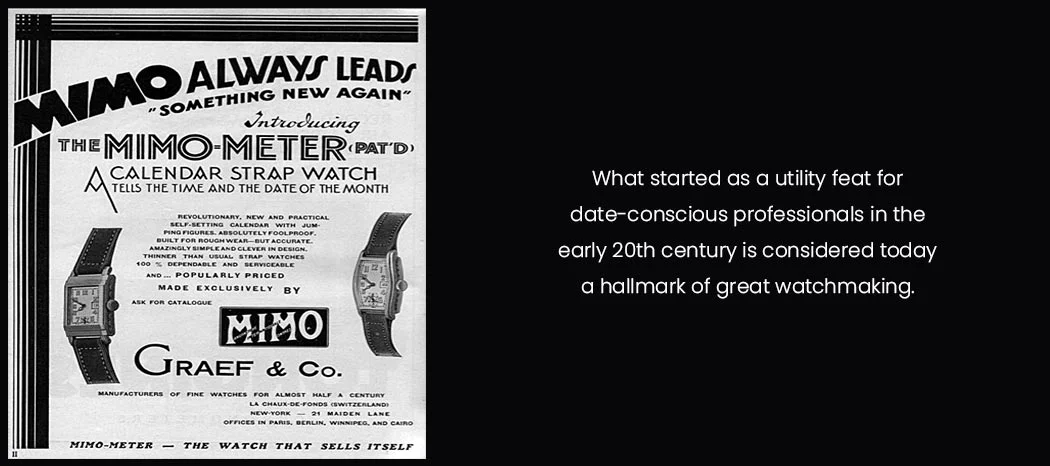
What started as a utility feat for date-conscious professionals in the early 20th century is considered today a hallmark of great watchmaking. Calendar functions were first seen in 19th century pocket watches, until Swiss watchmaker A. Hammerly introduced a wristwatch patent for this complication in 1915. Soon, the Swiss titans created their versions of day/date indicators — the best recorded example remains the 1930 Mimo (Girard Perregaux) Mimo-Meter. Revered as a technological breakthrough at the time, it was reserved only for high-end timepieces.
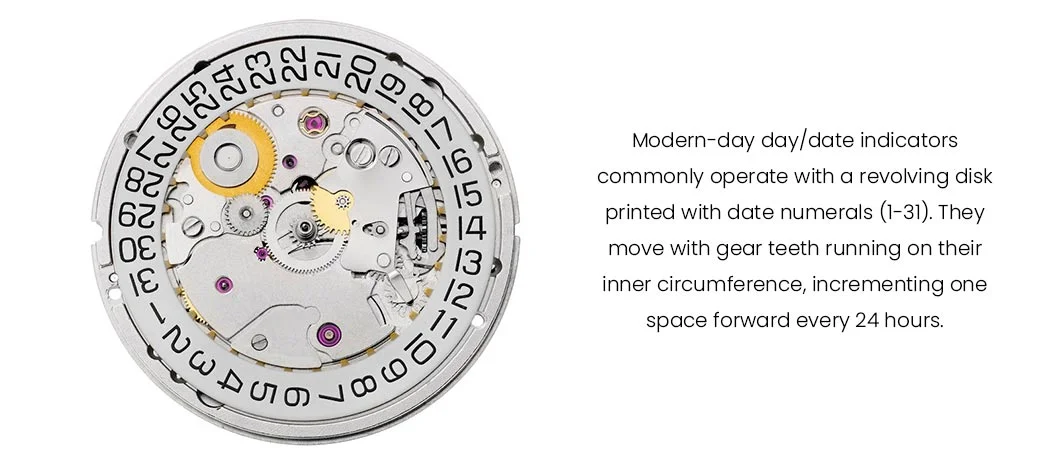
Modern-day day/date indicators commonly operate with a revolving disk printed with date numerals (1-31). They move with gear teeth running on their inner circumference, incrementing one space forward every 24 hours. This complication is usually accompanied by a day indicator and sometimes, a month indicator.
The Case of Symmetry

answer is symmetry. Symmetry, being naturally eye-pleasing, has been a compass for watch design since the age of sundials. Being highly useful in establishing visual structure in complex matters, most watchmakers embrace it, but a few think differently.
Take the Bell & Ross BR 03-94 Multimeter Chronograph’s one o’clock date window, F.P. Journe Octa Lune’s 11:30 date window, or A. Lange & Söhne Lange 1’s two o’clock date window with an off-centered dial. In these timepieces, the deliberate asymmetry adds to their character. Speaking of character, while date windows are almost industry-wide staples with classic three, six, or nine o’clock placement styles, it’s refreshing to see watchmakers break convention and experiment with odd spots to tell the date.
It’s 4:30
In the 1960s, the legendary SEIKO diver SKX007 made quite a splash with its four o’clock crown. Designed for the harshest deep-sea explorations and ergonomic timekeeping while at it, its crown was placed at four o’clock.

Ergonomics is a big deal in watchmaking, especially when it comes to purpose tools. I believe the same principle applies to the 4:30 date window. Imagine yourself typing on a computer keyboard, and you need to glance over to your watch to check the date. If the date window were placed at the traditional three o’clock, you’d need to tilt your head or adjust your hand to read it. To avoid this, the date window would need to be ergonomically angled perpendicular to your line of sight. While some watch enthusiasts argue that the repositioning of the date window to 4:30 is unnecessary, I believe it’s the perfect demonstration of utility-focused and ergonomic watchmaking design.
Leading Models with the 4:30 Date Window
Among modern flagbearers of the 4:30 date window, a few titles stand out for how they organically integrate the complication into their icon’s DNA. The Zenith Chronomaster Sport is a prime example — its high-beat El Primero movement understandably demands a busy dial, but the 4:30 placement neatly tucks the date away, unobtrusive to its tri-color sub-dials.

Breitling’s Navitimer series, a legend in aviation chronographs, similarly uses the 4:30 date to preserve the integrity of its signature slide-rule bezel and its ultra-cluttered cockpit dashboard-like dial. On a more contemporary note, Audemars Piguet’s Code 11.59 embraces the 4:30 aperture across several references.


Recent Posts
Recent Comments
Archives