
Some words always denote luxury.
“Artisanal”, “Handmade”, “Curated”, “Limited Edition”…. So common is their appearance in marketing spiel and invitations, that one comes to view every printed word with a hidden asterisk. Well, they did have value once upon a time but with the reckless proliferation of adjectives that are casually strewn around like party confetti, they all ring hollow and blasé. So, what is a guy to do? How does one make their way through the weeds of wordplay to find the real gems Well, let’s start delving.
Defining Terms
A good point of start would be to understand what those oft-used terms mean. ‘Handmade’, can’t really confuse that one, it should mean made by a human, usually with so many years of experience that it becomes near impossible to tell it apart from a machine. That said, handmade doesn’t necessarily imply that a man sat there and beat the metal sheets all flat (or dimpled). They may have used a machine, but it was still very much human hands working the article. And in the slight chance you think that’s cheating, well, I encourage you to try and guilloche a dial on an engine turning machine and see for yourself just how much dexterity is needed to get an even pattern.
But here are some terms that can be ambiguous. “Craft” or “Artisanal”, at one point they used to mean something: made in a small quantity. But the qualifier ‘small’ is relative. How many pieces can a brand make to be considered a “boutique” brand? Alternatively, is there a number beyond which they can no longer be considered artisanal? Can something be made machine-made but be craft since it was made in small numbers? The answer, sadly, is, inconclusive.
The Watch World Divide
This lack of clarity leads to much heated debate and condescension in watch communities. It is not uncommon to look down on someone who may have a shiny trinket of a timepiece by labelling it “commercial” in a bid to lower their ‘connoisseur’s quotient’? Just because a brand that started small did things right and became popular and consequently was able to expand and produce more of their ware, should that be grounds enough to relegate them and detest them? How does one contrast it with another brand that just can’t manage to find buyers for its pieces and thus is forced to keep production limited to small numbers: are they, then, a commercial failure or a craft success?
The Cost of Success
Success is an elusive partner in the world of products, especially where one needs form and precision. Products like airlines and mobile phones need super high levels of precision of execution but they needn’t be handmade or boutique. Wines and cigars lose out if they are mass-produced and even when made in small batches, minor variations from one lot to another only add to the charm and story of the product. Watches enjoy neither of those advantages. Commercial or craft, I can think of very few other products that need the same passionate dedication and relentless expertise as the world of luxury timepieces. Success, given such tight constraints, can be extremely elusive and a hard-earned accolade. Which is why watch brands innovate very slowly. The progress seems microscopical, evolutionary rather than revolutionary. But any faster and they risk slipping up. Instead, once they find something that works like, well, clockwork, they double down and make it their raison d’etre. Over time, a few brands come to dominate the scene and once that happens, they can command prices that may not seem entirely logical or explicable. When a quasi-monopolised product gets elevated to occult status, logical pricing mechanics are the first thing to go out the window.
Enter Micro Brands
Every microbrand owner/innovator out there was once someone who saw the world of watches and asked a question. They were the proverbial Davids, standing in front of Goliaths, and wondering why things only had to be one way. They asked questions that many sensed but were too afraid to voice, for fear of being called out or being outcast from the hallowed communities. It couldn’t have been easy, to question the wisdom of a world that had been established and evolving for over centuries. Yet, some souls did and this gave us truly small truly boutique brands, who were in the game just to show people that there could be another way to get things done, a way which was tangential, quirkier, and often, cheaper.

But before we laud them as unsung heroes, let’s take a moment to define what exactly is a microbrand. Well, a small setup making watches in extremely limited numbers is a start. But does it have to be bootstrapped? Can it be a super high-end endeavour which only caters to bespoke whims and fanciful desires? The answer, very simply, is this – microbrands is all encompassing and inclusive in these regards.
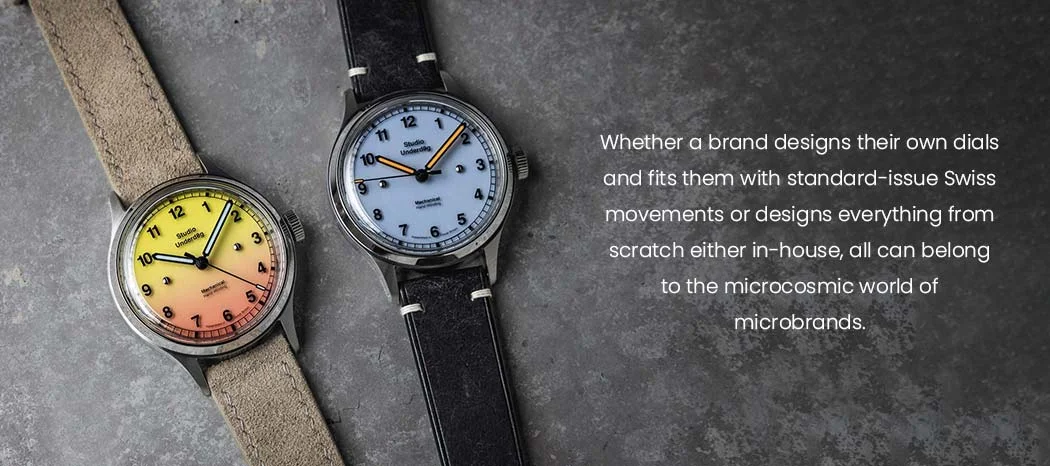
So whether you design your dials and fit them with standard-issue Swiss or Japanese movements (which are usually great at keeping time by the way) or you design the dial but also work on decorating the standard movements to make them more personalised to your brand, or, you make everything from scratch either in-house or have them commissioned, all three can belong to the microcosmic world of microbrands.
The more detail one delves into the more it adds to the cost of production (as smaller quantities of anything are more expensive to produce, whether by hand or by machine) and that is why a microbrand can range from a few hundred dollars.
Which Micro Brand is Right for Me
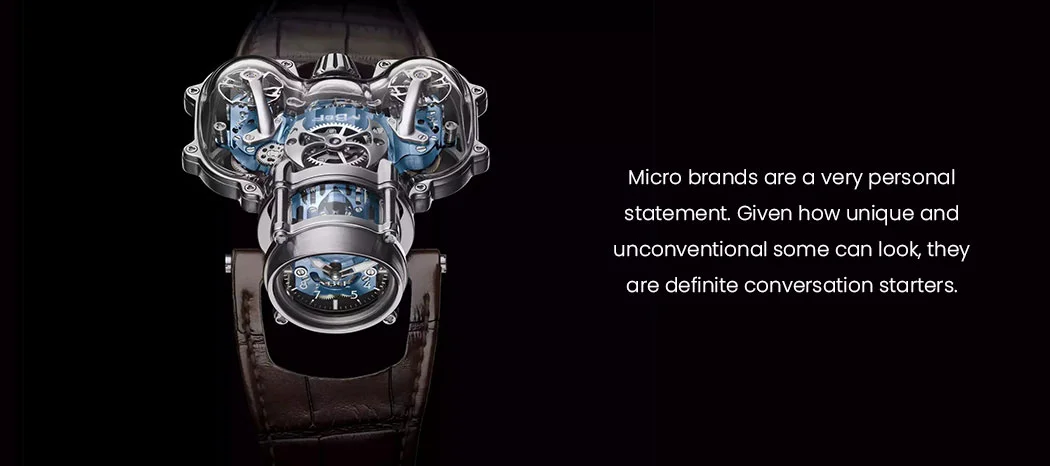
Let me clear the air here – one doesn’t buy a microbrand watch because they can’t afford a popular brand. If anything, a good collection has a healthy mix of both. Also, microbrands are a very personal statement. Go for what you like, what looks good on your wrist. Given how unique and unconventional some can look, they are definite conversation starters so focus on comfort and ease of use over brand value or other social factors.
That said, here are a few that are always on my list of acquisitions and I have positioned in ascending order of spend. So, scroll as far down and deep into this financial rabbit hole as you like.
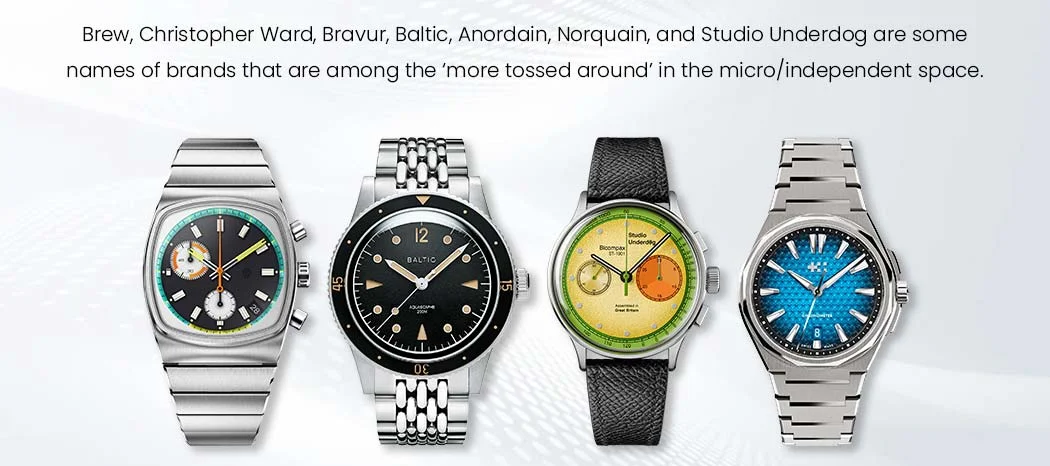
Brew, Christopher Ward, Bravur, Baltic, Anordain, Norquain, and Studio Underdog are some names of brands that are among the ‘more tossed around’ in the micro/independent space. But let’s try and look at a few others; this list, is in no way exhaustive or definitive. It is merely a personal cherry-picked lot, and feel free to apprise me of more brands.
Venezianico: This brother duo, based out of Venice, Italy, have done some innovative work in their short existence. The golden renaissance cross that came to become their logo comes from the clock tower at St. Mark’s Square. One timepiece of particular note was the Redentore Ultrablack which used a special Musou black™ Japanese paint which absorbs 99.4% of light. A reliable Seiko movement with a 5ATM water resistant 40mm stainless steel case on a black leather strap make for an understated yet classy presentation.
Schnelle: Thomas Schnelle honed his skills at/with Chronoswiss before experimenting with and launching his eponymous brand where, apart from the movement and the sapphire crystal, he does it all himself. The case is angular and almost brutalist in design, industrial yet Art Deco, and quite unisex. With it’s U-shaped front glass and an exhibition caseback to display the refurbished vintage movements, this is a watch for the serious chronophiles. At 2-3 watches per month, you know one will need to be a patient client.
Itay Noy: This person is an indie watchmaker with an eye for the unusual. His watches approach time telling in a novel way, one with childish freshness and quirk: ‘Reorder’ has the hours scattered on the dial and the right one lights up on the hour, while ‘Seven-Day Cycle’ use the same reverse highlight technique to showcase days of the week.
Atelier Wen: Singapore has been quite the Asian hub for micro brands (well, also HK), and this unique one showcases a modern take on traditional Chinese design and techniques with (possibly) a French influence. The brand focuses on showcasing the epitome of Chinese manufacturing expertise (diametrically contrasted to the oft-derogatory “Made in China” moniker) with intricately worked dials and to present it in locally-produced parts.
Isotope: English brand with a Swiss imprint, making watches that are creative yet affordable – that about sums up this brand with a distinct design identity. Their Hydrium range is like a grungy yet kindergarten take on a traditional dive watch. Never thought I’d ever use ‘grunge’ and ‘kindergarten’ in the same sentence.
Echo/Neutra: Another Italian add, this brand focuses to design with meditative devotion, the kind that transcends trends and norms. Yet, it remains utile and contemporary without stretching things into that realm of design which can only likened to Balenciaga-esque levels of uselessness. Design here is for beauty and form but does not compromise function.
Toledano and Chan: The most popular Brutalist design purveyor on your wrist will come from this duo, a watch that’s so austere and solitary, it could have had odes written by Edgar Allen Poe and then adapted into film by Tim Burton. It also tells time, in a window that almost seems to face (upto?) you.
Ludovic Ballouard: Upside Down is one of the quirkiest watches that manage to maintain a healthy balance between visual quirk and spur-of-moment legibility. You look down and you can immediately tell the time, unlike many other watches where one has to sweep over and across the dial to read the time. It’s an inconspicuously elegant dress watch, till someone notices the dial, and then it’s the ultimate conversation centrepiece.
Naoya Hida: Another Japanese stalwart for good measure and to wrap this list up for now, one that opens it’s order window ever so rarely that the queues never dry up. Their USP: bringing together skilled craftsmen on the latest microfabrication machines, recreating symbols and motifs from a bygone era, all updated and adapted to work today. Nostalgic yet future-safe.
Hajime Asaoka: No list would be complete without a few worthy Japanese heavyweights of the space. He is credited as Japan’s first (and foremost) independent high-end timepiece maker and he announced this with the first tourbillon from the country back in 2009, handling each and every step, in-house. Kurono is the more affordable brand from his stable as his standard pieces tend to be extremely high-end and always sold out.
Recent Posts
Recent Comments
Archives