

In the world of haute horology, legacies are not written in logos, but in design features so distinctive they transcend seasons, trends and even eras. These are the visual codes, born out of function, heritage or sheer creative audacity, that go on to transform a watch from a timekeeping instrument into a cultural icon. Don’t write them off as embellishments. These cues are shorthand for history, innovation and craftsmanship at the very highest level. These are touchstones, recognisable codes that carry the DNA of their House forward.
From the serpentine grace of Bvlgari to the irreverent playfulness of Franck Muller, each Maison has a hallmark design feature that has come to define its identity. We unpick the codes that have evolved into horological iconography, tracing how these details became visual signatures of luxury watch brands. For collectors, learning these signatures is like mastering a secret language. For brands, they are an unbroken thread connecting past to present, heritage to innovation. Ultimately, these details form the lexicon of modern watchmaking, a grammar of signatures that discerning eyes can read at a glance.
Bvlgari: Serpenti Tubogas Bracelet
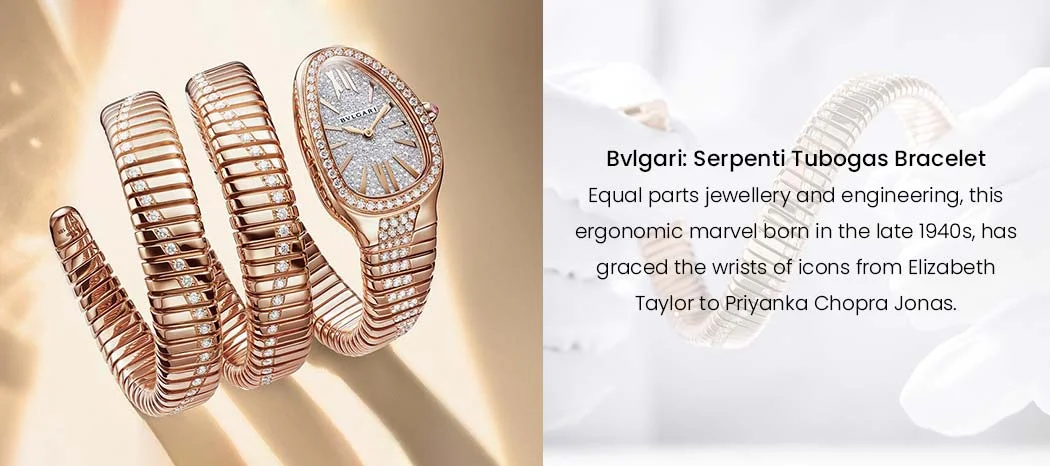
The Serpenti—coiled around the wrist in a fluid embrace—is the Roman Maison’s most hypnotic creation. Its Tubogas bracelet, named after the flexible gas pipes it evokes, is crafted without soldering, relying instead on a complex system of interlocking bands. The result is a sinuous bracelet that slithers with sensual ease, echoing the serpent’s mythic symbolism of rebirth and eternity. Equal parts jewellery and engineering, this ergonomic marvel born in the late 1940s, has graced the wrists of icons from Elizabeth Taylor to Priyanka Chopra Jonas.
Cartier: Railtrack Border
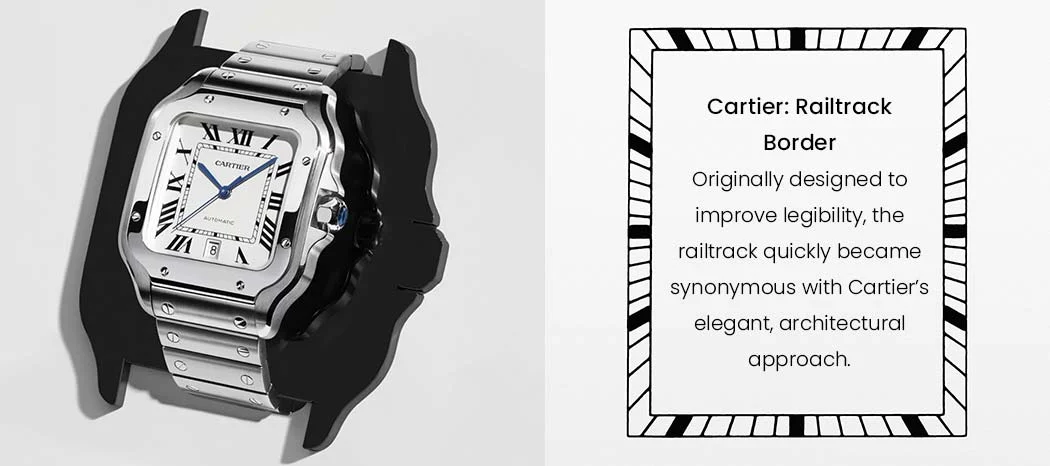
Cartier is often hailed as the jeweller of kings and the king of jewellers, and its horological codes are just as regal. The Maison’s iconic chemin-de-fer or railtrack—a fine inner ring encircling the numerals—has become a defining flourish. Originally designed to improve legibility, the railtrack quickly became synonymous with Cartier’s elegant, architectural approach. Paired with the brand’s sapphire cabochon crowns and elongated Roman numerals, the railtrack is a subtle yet enduring design stroke, instantly identifiable on any Cartier dial.
Chopard: Dancing ‘Happy Diamonds’
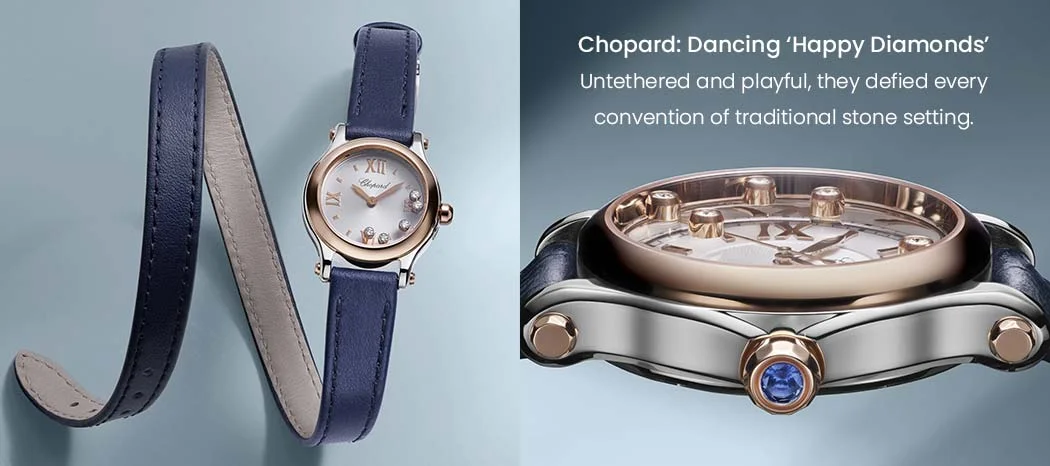
Chopard’s signature spectacle unfolds within the dial itself. Introduced in the 1970s, the Maison’s ‘Happy Diamonds’ revolutionised elegance in motion with freely moving stones set between sapphire crystals. Each diamond pirouettes with every flick of the wrist, turning the dial into a kinetic stage. Untethered and playful, they defied every convention of traditional stone setting. Decades later, the sight of Chopard’s twinkling stones in motion remains one of the most instantly recognisable signatures in fine watchmaking.
Franck Muller: Crazy Hours
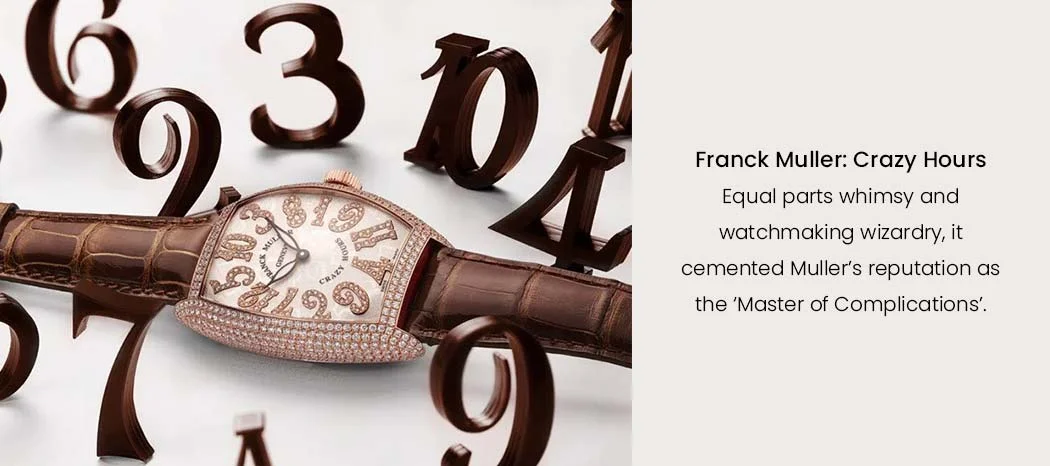
Franck Muller’s ‘Crazy Hours’, introduced in 2003, rewrote the very order of time. Instead of appearing in sequence, the numerals on the dial are scattered across the dial in apparent chaos. Yet with each passing hour, the jumping hand leaps with mechanical precision to the correct numeral. Equal parts whimsy and watchmaking wizardry, it is the kind of audacious invention that cemented Muller’s reputation as the ‘Master of Complications’. It is both a technical marvel and a sly provocation that time, perhaps, is only as linear as we perceive it to be.
Patek Philippe: Horizontal Embossed Dials

When Gérald Genta sketched the Patek Philippe Nautilus in 1976, he envisioned a sports-luxury watch like no other. Its defining feature—the horizontal embossed ridges running across the dial—gave texture, depth and a distinct maritime identity. The grooved lines catch and refract light with quiet brilliance, epitomising Patek Philippe’s discreet elegance. Paired with its porthole-inspired case and integrated bracelet, the Nautilus transcended its athletic origins to become one of the most coveted timepieces in the world.
Panerai: Protected Crown Guard
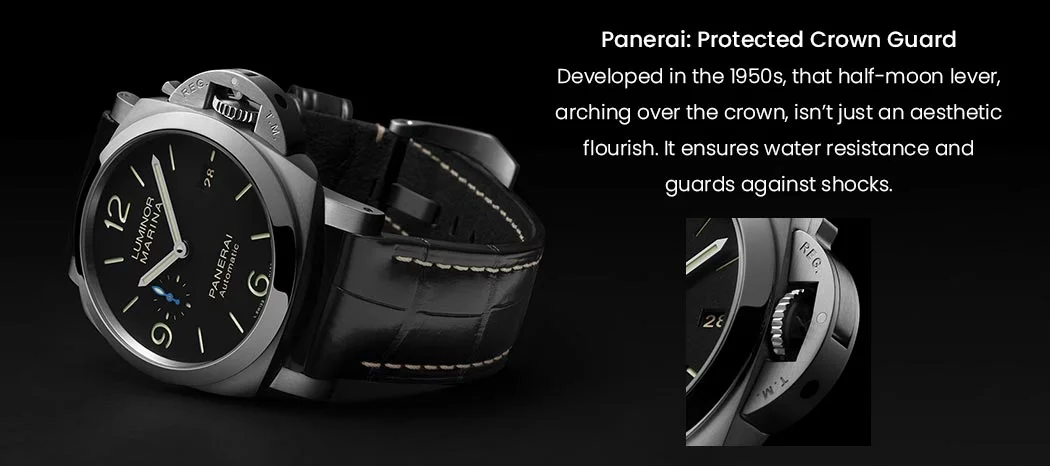
With its roots in the Italian navy, Panerai has given watchmaking one of its most distinctive silhouettes: the protected crown guard. Developed in the 1950s, that half-moon lever, arching over the crown, isn’t just an aesthetic flourish. It ensures water resistance and guards against shocks. Today, it is instantly recognisable as a piece of military hardware transformed into a design language. Rugged, masculine and authentic, the crown guard stands as the ultimate emblem of Panerai’s utilitarian roots.
Roger Dubuis: Star-shaped Skeleton Bridges
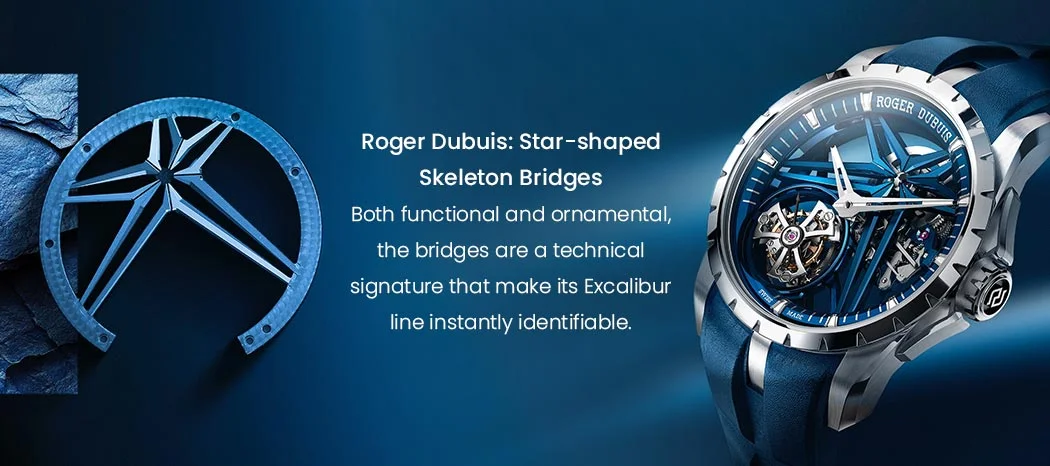
Art meets engineering in Roger Dubuis’s audacious skeletonised movements. Its star-shaped bridges radiate across the calibre like architectural scaffolding, elevating each piece into a work of art where mechanics and aesthetics collide. Both functional and ornamental, the bridges are a technical signature that make its Excalibur line instantly identifiable. They speak to Roger Dubuis’s philosophy of horology—performance art and technical mastery presented through the lens of avant-garde design.
Omega: Constellation Claws
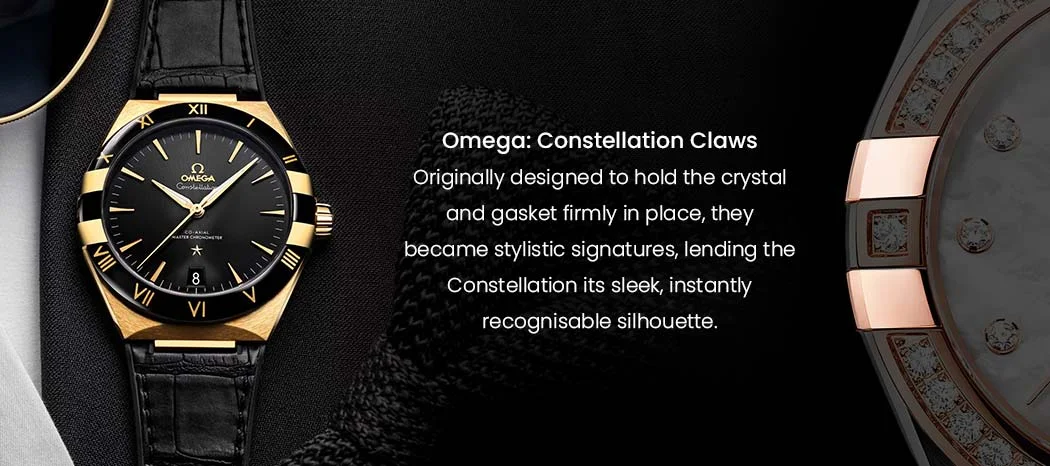
Omega has produced many icons, yet the Constellation’s claws or ‘griffes’ remain among the brand’s most distinctive details. Introduced in 1982, these polished metal grips straddle the dial at 3 and 9 o’clock. Originally designed to hold the crystal and gasket firmly in place, they became stylistic signatures, lending the Constellation its sleek, instantly recognisable silhouette. More than forty years on, the claws have become a defining hallmark, anchoring one of Omega’s most enduring collections.



Recent Posts
Recent Comments
Archives