
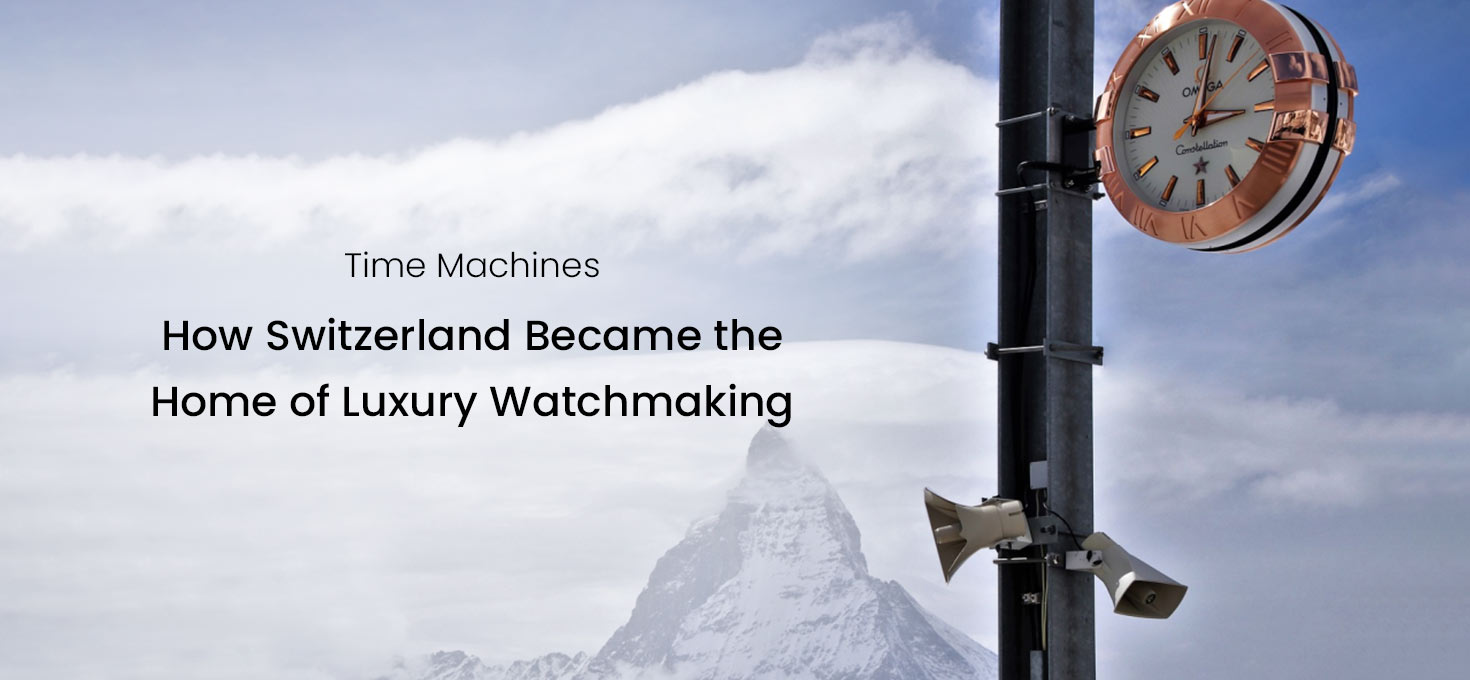
In 2024, the Swiss watch export market was valued at CHF 26 billion — accounting for over 50% of the global luxury watch scene. Today, with over 700 watch brands, ateliers, and suppliers across price tiers, timekeeping is intrinsic to Switzerland’s identity as cars are to Germany and wine to France.
With Geneva, their bustling horlogerie capital, Basel as the premier exhibition center, Vallée de Joux’s historic roots, and of course, the mighty tales of Jura Valley, Switzerland’s geography is ingrained with time. Connecting the dots between Switzerland’s ‘pre-watchmaking’ agrarian past to its present-day global domination, here’s how Switzerland became the center of the luxury watch industry.
The ‘Affair of the Sausages’
Switzerland’s tale of time began in the early 16th century — with a sausage. Germany and France were pioneering mechanical timekeeping, with Switzerland being a majority agrarian nation. Amid a series of religious conflicts in Zurich, Swiss reformer Ulrich Zwingli defended townsfolk arrested for eating sausages during Lent, insisting that faith should be voluntary rather than state law.
Nearly 500 miles North, German theologian Martin Luther also questioned the Catholic Church’s practices and ‘nailed’ his 95 theses to the Wittenberg Church castle’s door. Luther’s actions and the ‘Affair of the Sausages’ sparked violent protests, resulting in the Protestant Reformation and the French Wars of Religion. The unrest drove many skilled French and German Protestants (clockmakers, silversmiths, and jewelers) to flee their motherland. Drawn by Switzerland’s neutrality, they settled first in Geneva before moving into regions like Vallée de Joux and Neuchâtel.
Calvinist State Law & Early Watchmaking Developments
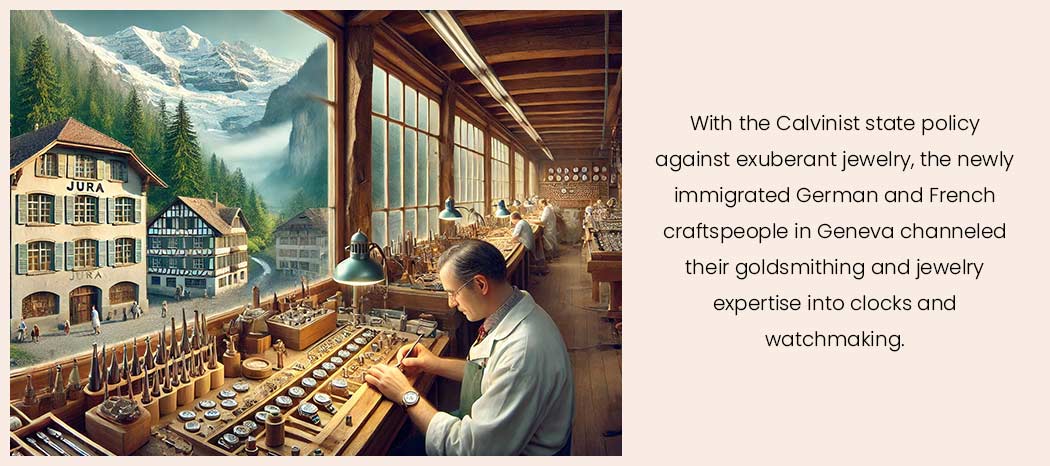
When the German and French Protestants arrived in Geneva in 1541, the state was under the strict rule of reformer Jean Calvin. One of Calvinism’s foremost policies was banning citizens from public display of wealth in the spirit of austerity and piousness. With the state policy against exuberant jewelry, the newly immigrated German and French craftspeople in Geneva channeled their goldsmithing and jewelry expertise into clocks and watchmaking.
Considering the era’s rampant innovations in timekeeping, clocks were perceived as utility tools instead of opulent decor, receiving a nod from Calvin. While the exodus stripped Germany and France of their watchmaking talent and England and the US were yet to enter the watch race, Switzerland quickly became the world’s watch capital.
Revolution Across the Land
As Swiss watchmaking’s golden roar grew louder and louder in the centuries that followed, a pantheon of legacy maisons was born: Blancpain (1735, Villeret), Vacheron Constantin (1755, Geneva), Perrelet (1777, Le Locle) Longines (1832, Saint-Imier), IWC Schaffhausen (1868, Schaffhausen), Audemars Piguet (1875, Le Brassus), and endlessly more. Slowly yet steadily, their focus shifted from precision to mechanical artistry and luxury.
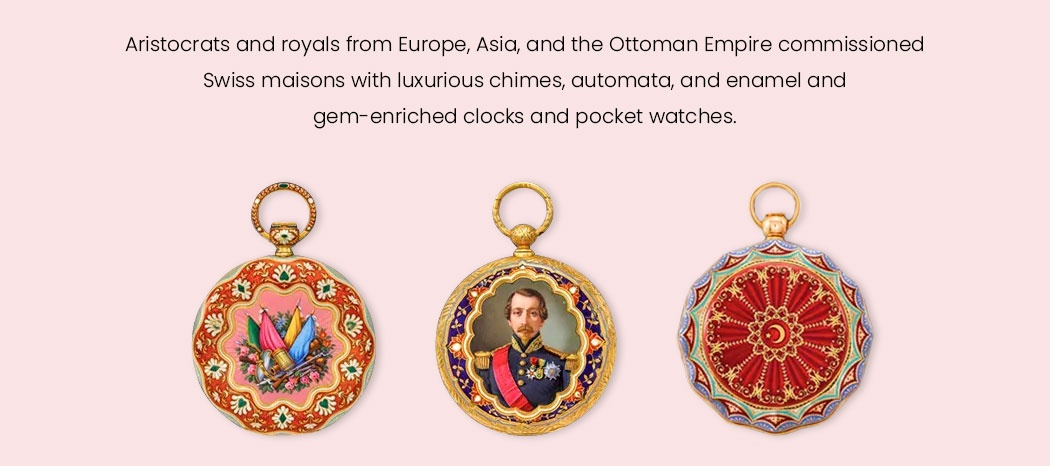
Aristocrats and royals from Europe, Asia, and the Ottoman Empire commissioned Swiss maisons with luxurious chimes, automata, and enamel and gem-enriched clocks.
The Établissage System
By the 19th century, Geneva and other Swiss towns were overflowing with cabinotiers (independent watchmakers) while much of the rural country was still agrarian. Swiss winters were long, harsh, and Jura’s poor farmers were off duty with no means of earning a living. With snowfall affecting supply and logistic chains, Geneva’s watchmakers seasonally employed these agrarian workers to make watch components. Traditionally engaged in lace-making practices, their dexterity was already sharp, proving useful for delicate craftsmanship. La Chaux-de-Fonds, Le Locle, and the Jura Valley quickly turned this decentralized network of independent craftsmen or ‘établissage’ into a working sub-economy. As national production boomed, dedicated factories in the Jura Arc supplied watchmakers with locally-made parts — later assembled by respective maisons. The Jura Arc soon became responsible for nearly 90% of Swiss watch production and earned the titles ‘Watch Valley’ and ‘Land of Precision’.
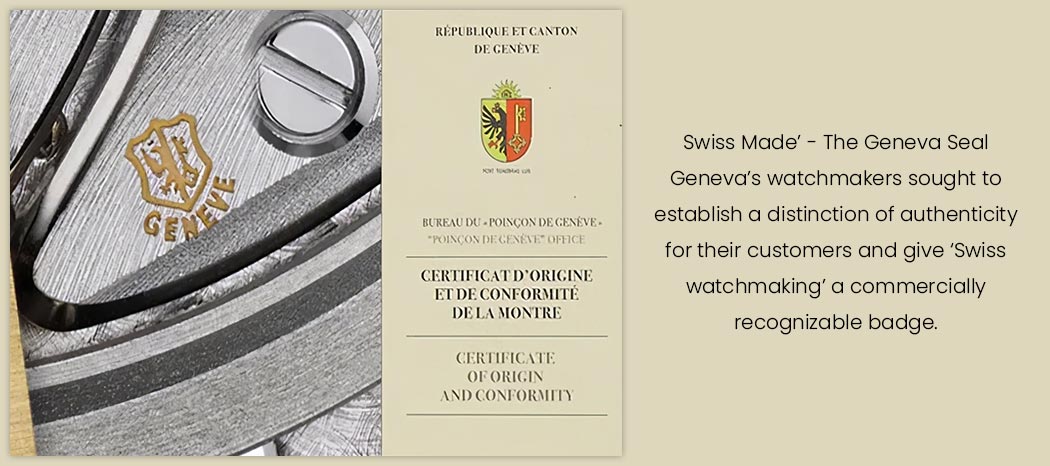
‘Swiss Made’ – The Geneva Seal
With the Swiss watch industry’s meteoric rise in the 19th century, local production became easier, widespread, and heavily industrialized. Geneva’s watchmakers sought to establish a distinction of authenticity for their customers and give ‘Swiss watchmaking’ a commercially recognizable badge. In 1886, the Canton of Geneva passed a law creating voluntary inspection rules that became the Poinçon de Genève (Geneva Seal). It’s a state-backed hallmark that certifies its end-to-end Swiss manufacturing: assembly, regulation, and finishing done in Geneva, plus strict technical and aesthetic criteria. While there are hundreds of watch brands in Geneva today, only a handful (e.g., Vacheron Constantin, Roger Dubuis, Chopard) boast the Geneva Seal on their timepieces. A 2009 legal reform shifted certification to Timelab (the Geneva Laboratory of Horology and Micro-engineering), which now issues and audits the hallmark and handles authentication. Quick note: The Geneva Seal is commonly referred to as the ‘Geneva Hallmark’.
The Cradle of Watchmaking
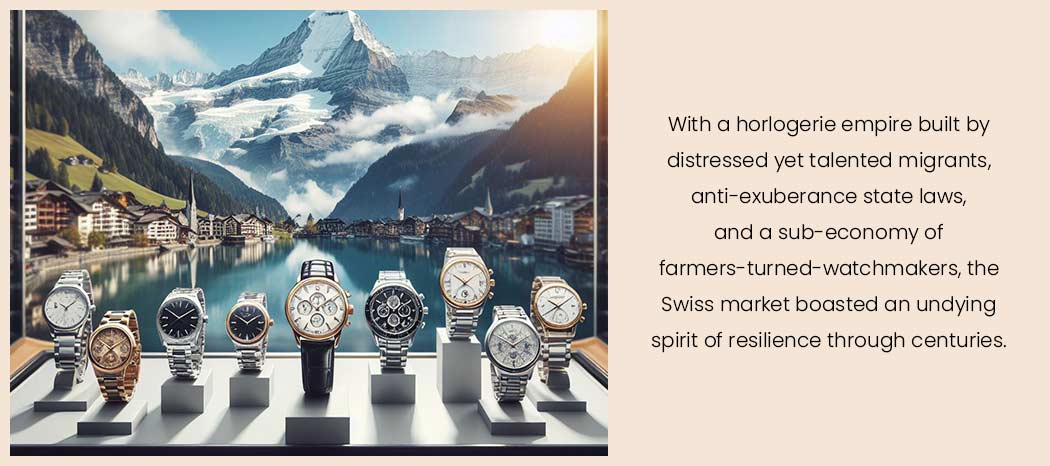
Switzerland has never looked back since. With a horlogerie empire built by distressed yet talented migrants, anti-exuberance state laws, and a sub-economy of farmers-turned-watchmakers, the Swiss market boasted an undying spirit of resilience through centuries. It faced many critical obstacles: World Wars, America’s big railway boom, and the Quartz Crisis, tilting the watch market towards battery-operated, affordable watches. Switzerland’s watch industry also endured through the World Wars, with bombs destroying European and American production facilities and their ambitions. Their ‘Swiss Made’ badge exulted their prestige in quality craftsmanship and mechanical innovation, allowing them to continue shining overseas.
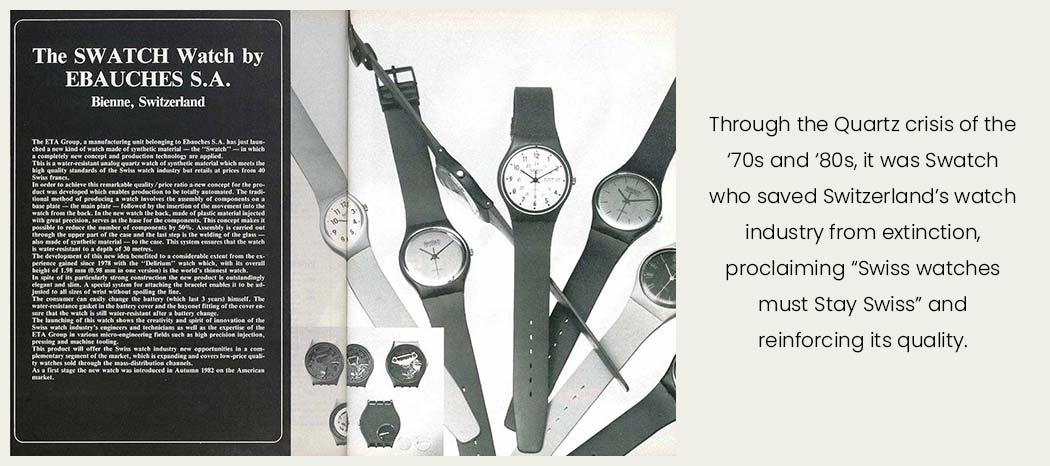
Finally, through the Quartz crisis of the ‘70s and ‘80s, it was Swatch who saved Switzerland’s watch industry from extinction, proclaiming “Swiss watches must Stay Swiss” and reinforcing its quality.



Recent Posts
Recent Comments
Archives