
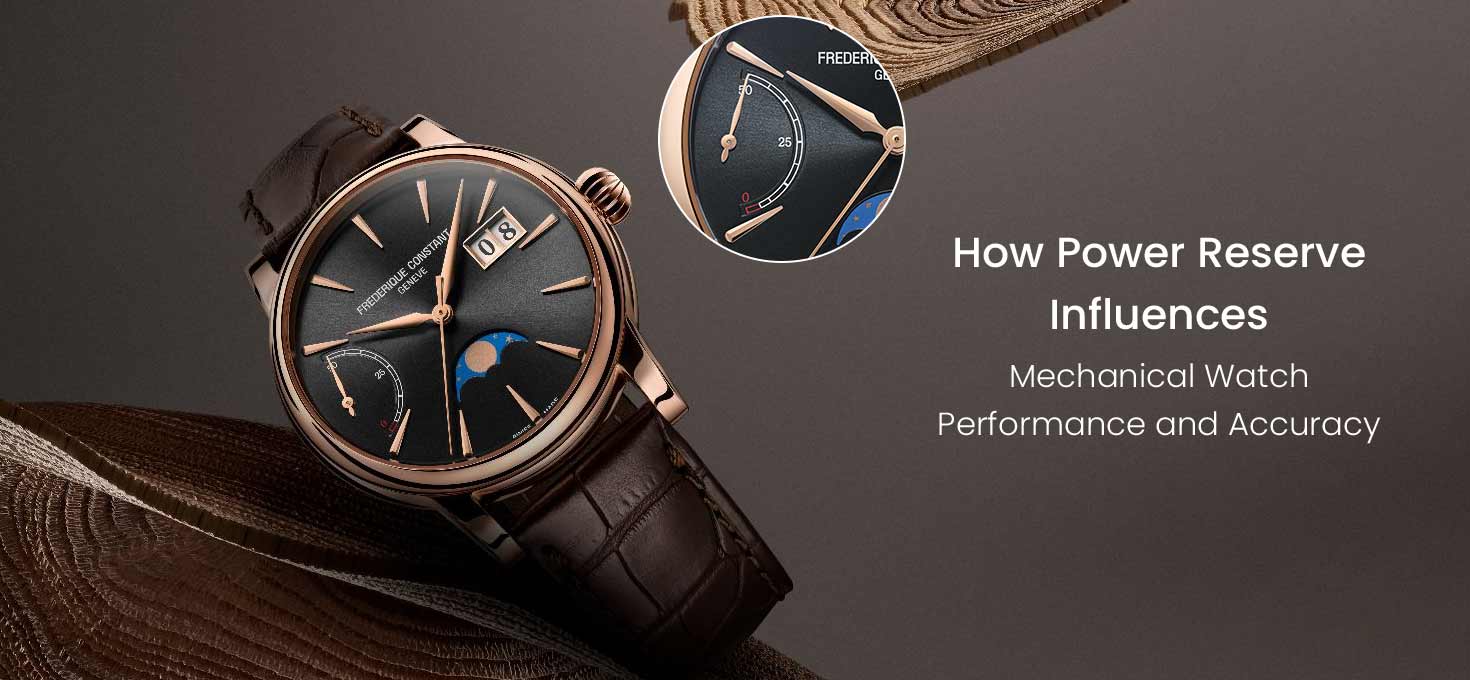
Power reserve is one of the most practical yet revealing specifications in a mechanical watch: it tells you exactly how many hours the timepiece will continue running after being fully wound. Far from being just a convenience feature, it plays a direct role in maintaining consistent timekeeping and overall reliability. For those who collect and wear luxury mechanical watches, a clear understanding of how power reserve influences performance is key to getting the most accurate and dependable results over time.
What is Power Reserve?
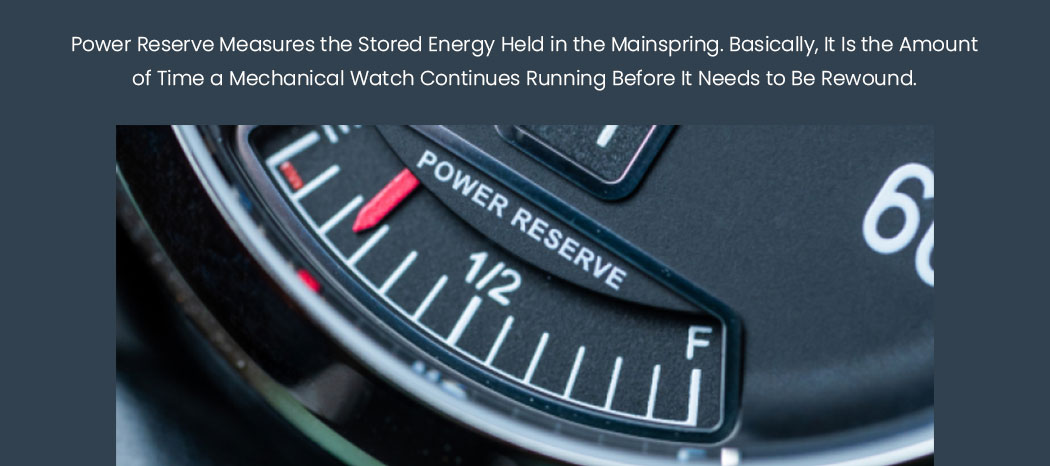
Power reserve measures the stored energy held in the mainspring that powers the gear train, escapement, and balance wheel. Once fully wound, either manually or through an automatic rotor, the watch uses this energy until it runs out. Most modern mechanical watches provide 38 to 50 hours of reserve, while many advanced luxury calibers extend this to 60, 80, or even over 100 hours through careful engineering.
This extended autonomy offers practical benefits. An automatic watch removed over the weekend often continues running without immediate rewinding. The greater value, however, lies in how power reserve influences precision rather than just runtime.
How Power Reserve Affects Performance
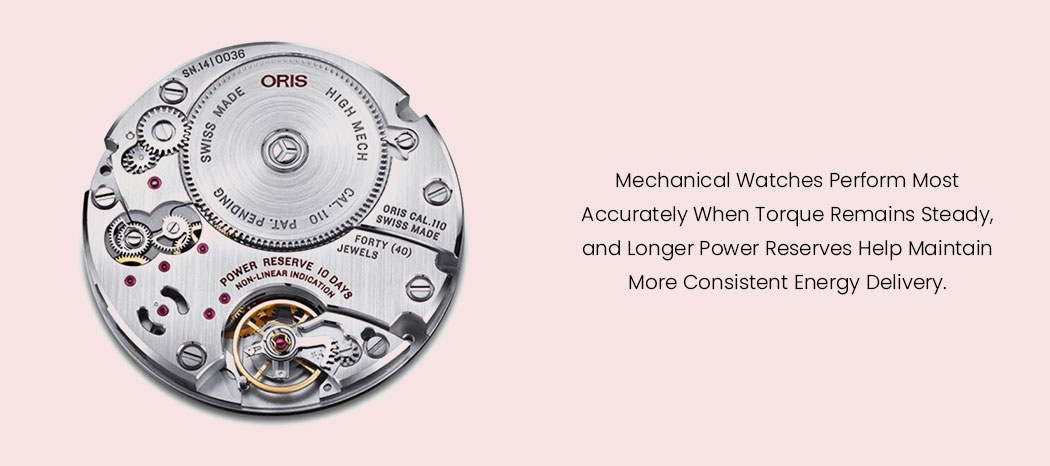
Mechanical watches deliver their best accuracy when the mainspring supplies steady torque to the balance wheel. The balance oscillates at a constant frequency, frequently 28,800 vibrations per hour in high-grade movements, controlled by the hairspring and escapement. Consistent torque supports isochronism, the ability of the balance to maintain equal periods regardless of amplitude.
At full wind, torque remains strong and stable, producing high amplitude and reliable timing. As energy depletes, torque decreases gradually. In movements with shorter reserves, this drop becomes more pronounced toward the end of the cycle. Lower amplitude causes the balance to swing faster, making the watch run ahead by several seconds per day in the final hours. Longer power reserve reduces this variation. By spreading energy release over more time, torque declines more slowly. The movement stays closer to its ideal operating state for a larger portion of the cycle. This leads to more uniform performance and better day-to-day precision. Luxury calibers designed for extended reserves often include refined components that further stabilize torque delivery.
The Role of Power Reserve Indicators
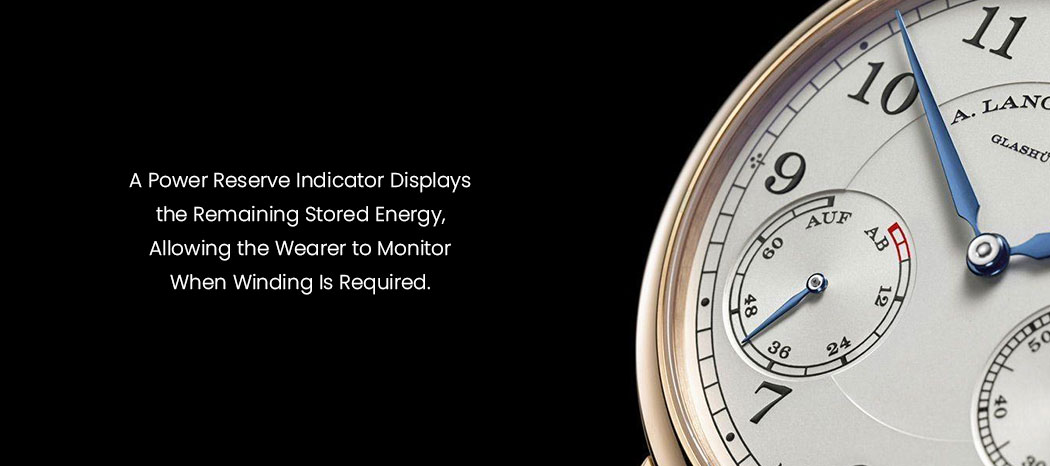
Many luxury watches include a power reserve complication, shown on a sub-dial or linear scale. This display lets owners track remaining energy precisely. It helps decide the best moment to wind, avoiding full depletion or unnecessary overwinding. For collectors who rotate several pieces, the indicator simplifies management and keeps each movement within its most accurate torque range.
Factors That Influence Power Reserve
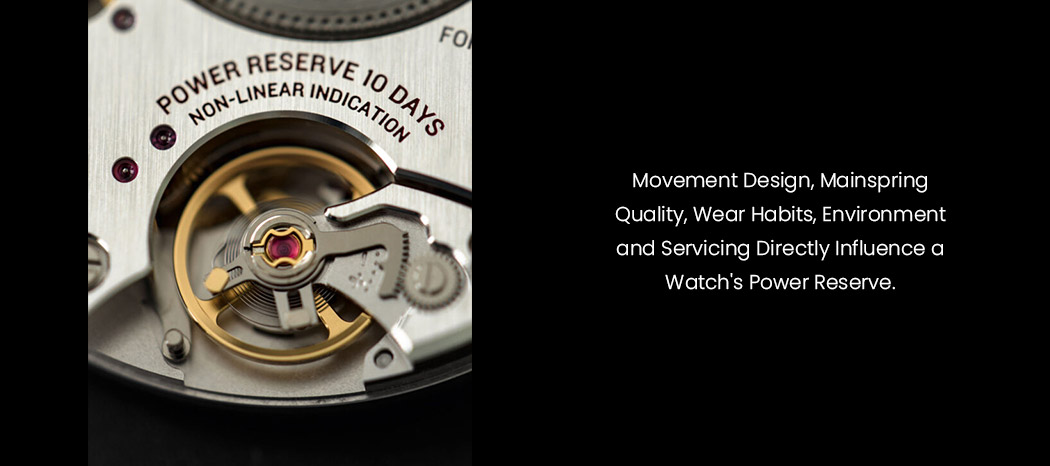
Several elements shape both the built-in power reserve and the actual runtime experienced in daily use. These range from movement design to ownership habits and surroundings.
- Mainspring Quality and Condition
The mainspring serves as the core energy source. Premium alloys in luxury movements deliver strong elasticity and excellent fatigue resistance, supporting reliable storage and release over many years. If a watch remains fully unwound for extended periods, the mainspring can develop set, a permanent loss of tension that permanently shortens future capacity. Periodic servicing addresses this by checking and replacing the mainspring as required.
- Barrel and Movement Design Efficiency
The barrel holds the mainspring, and its size or configuration determines storage potential. Larger barrels or multiple barrels increase capacity without sacrificing case proportions. Low-friction features, including polished jewels, modern lubricants, and optimized gear trains, reduce energy waste. These refinements, common in luxury calibers, produce longer and more consistent reserves while preserving accuracy across the winding cycle.
- Winding Habits and Daily Wear
Automatic watches rely on rotor movement from wrist activity. Regular wear keeps the mainspring near full tension, maximizing both duration and stability. Limited activity or occasional use results in partial winding and noticeably shorter effective reserve. Manual-wind calibers provide greater control but need consistent attention to reach and maintain optimal levels.
- Proper Storage Practices
Luxury mechanical watches undergo extensive positional testing and adjustment. Storing a watch in the same position for very long durations, however, can influence long-term behavior due to gravity and friction differences. While this primarily impacts accuracy, using a correctly set watch winder for unworn pieces keeps the mainspring partially tensioned. This prevents complete relaxation, avoids set, and maintains even lubricant flow.
- Temperature Extremes
High heat, prolonged direct sunlight, or rapid temperature shifts can affect lubricants and components. Excessive warmth thins oils, potentially increasing friction over time, while cold thickens them and raises resistance. Both scenarios can shorten effective reserve. Protecting the watch from saunas, car dashboards in summer, or freezing conditions helps preserve designed performance.
- Humidity and Environmental Exposure
Elevated humidity introduces moisture risks, leading to possible corrosion or internal condensation after prolonged exposure. This raises friction and degrades oils, indirectly reducing reserve. Storing luxury watches in stable, moderate conditions, away from bathrooms or damp areas, safeguards internal reliability.
- Magnetism
Every day, magnetic sources can affect hairsprings and other parts, disrupting energy delivery and sometimes shortening apparent reserve through erratic consumption. Many modern luxury watches incorporate non-magnetic materials, but minimizing contact with strong fields remains prudent.
- Age, Lubrication, and Servicing
Lubricants naturally degrade over years, increasing internal friction and shortening usable reserve before accuracy declines sharply. Regular professional servicing, recommended every five to seven years for most luxury pieces, refreshes oils, cleans parts, and resolves mainspring fatigue. This routine restores full efficiency and extends the life of the movement. In luxury mechanical watches, power reserve reflects engineering depth. Extended reserves demonstrate thoughtful design focused on sustained consistency rather than short bursts of convenience. Mechanical watch collectors and enthusiasts prize this feature for dependable daily performance, where stable torque across days outweighs minor gains in peak accuracy figures. Power reserve forms an essential part of the mechanical watch experience. It connects technical excellence with practical enjoyment, ensuring precision holds steady under real-world conditions. By understanding its influence and applying careful winding, protective storage, avoidance of environmental extremes, and scheduled maintenance, owners fully unlock the potential of their luxury timepieces.
Kapoor Watch Co.
Kapoor Watch Co. stands as a trusted name in luxury horology for over 5 decades, and started as Kapoor Time Crafters. We proudly operate our state-of-the-art, authorised service centre dedicated to preserving the performance and integrity of the world’s finest mechanical timepieces. With decades of expertise since the 1960s, we have built a legacy of precision, authenticity, and customer confidence. Our authorised servicing facility is equipped with manufacturer-approved diagnostic tools, genuine spare parts, and certified watchmakers trained to the highest standards. Every service, whether a routine lubrication, full overhaul, or complication adjustment, is performed with meticulous care to restore your watch to factory specifications. This seamless blend of heritage retail excellence and specialised, authorised technical support ensures that every timepiece we touch continues to tell time with the accuracy and elegance it was designed to deliver, generation after generation.


Recent Posts
Recent Comments
Archives