

Forged in 1,500-degree Celsius kilns, ‘ceramic’ is (quite literally) watchmaking’s hottest ingredient in use today.
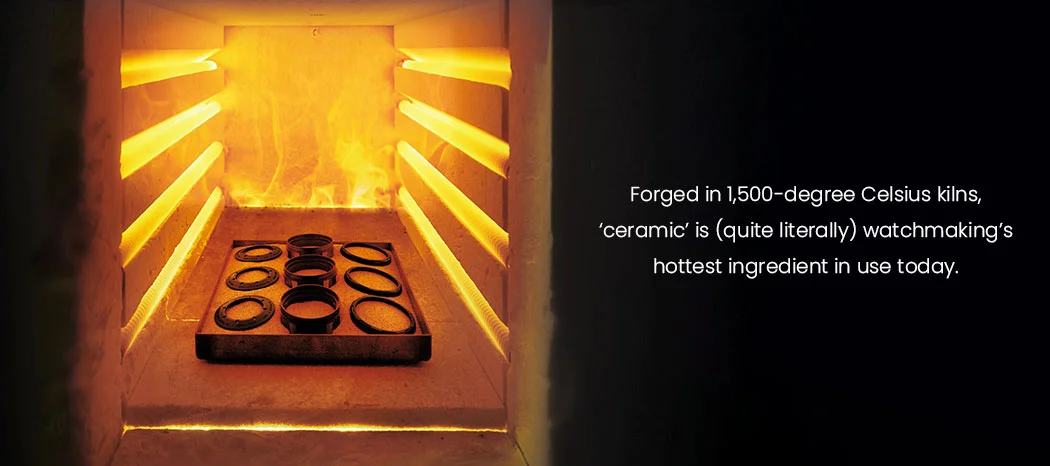
Until a decade ago, ceramics were commonly associated with potted plants, tiling, and cutlery. However, in recent times, ceramics’ reputation has gone from boring tableware to ultra-high-tech scientific substance and one of watchmaking’s most experimental avenues. Ceramic watches aren’t common, nor a niche, emerging as a cutting-edge alternative for watch cases that are lighter, tougher, and better scratch-resistant. Materializing the intersection of art and science, ceramic truly is watchmaking’s new gold with a value proposition that’s more scientific than shiny.
Ceramic, at the Dawn of Time
Humanity’s oldest recorded use of ceramics dates to 25,000 BC in Slavic regions, found in the form of fired clay-bone figurines. After spreading across Asia and Europe circa 9,000 BC, the Greeks named this substance ‘κεραμικός/keramikós’, translating to ‘pottery’ or ‘ceramic’, for its common use as food and water containers, tiles, and bricks. However, it wasn’t until the 1940s that ‘technical ceramics’ were deeply researched and developed by modern industries, experimenting with oxide magnetic materials (ferrites), ferroelectric materials, and clay as their base ingredient.
The Ceramic Revolution
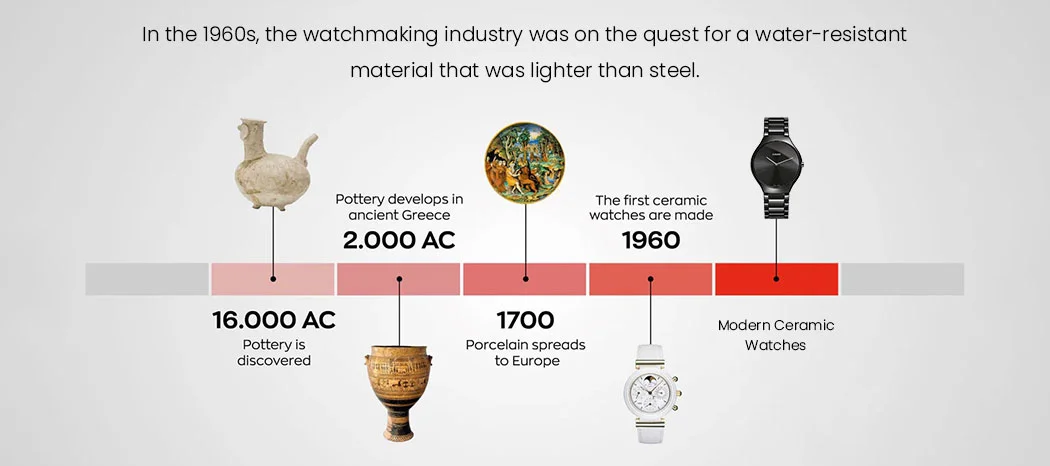
In the 1960s, the watchmaking industry was on the quest for a water-resistant material that was lighter than steel. Alongside OMEGA and IWC, Rado pioneered R&D and created the historic DiaStar watch in 1962 as “the world’s first scratch-proof watch”. With a case and bracelet crafted out of tungsten carbide, Rado created a hybrid composite of metal and ceramic. Soon after, OMEGA took the lead with the Seamaster “Black Tulip,” which featured a ‘cermet’ case and bracelet — their own metal and ceramic composite material.
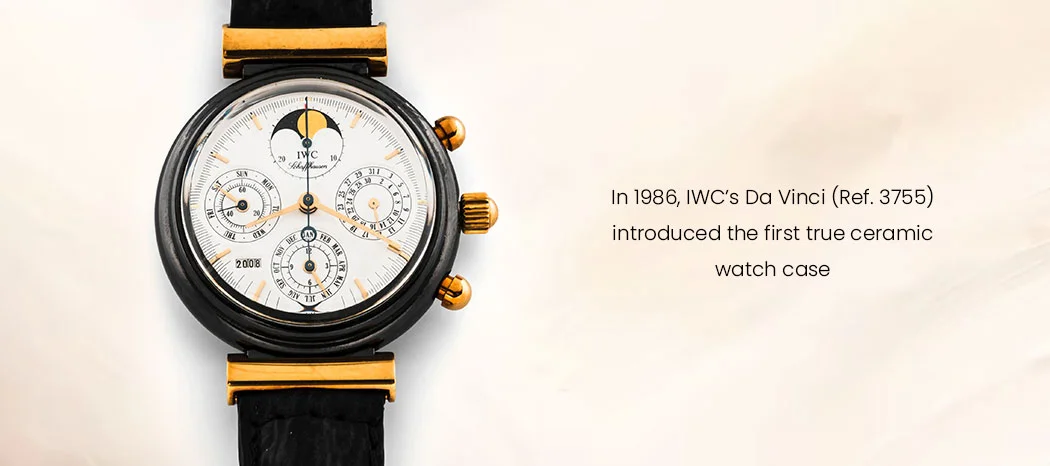
However, in 1986, IWC’s Da Vinci (Ref. 3755) introduced the first true ceramic watch case, followed by Rado’s Integral collection, which featured both a case and bracelet crafted entirely from ceramic.
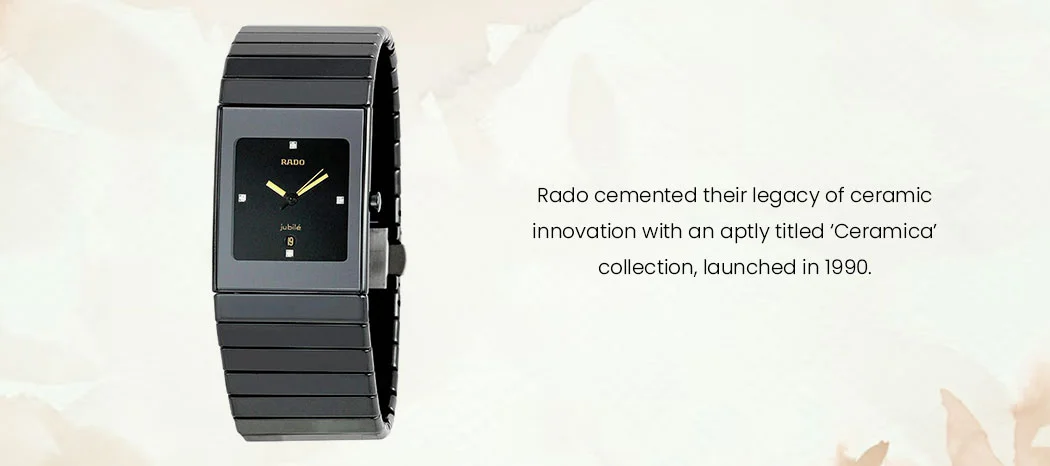
Rado cemented their legacy of ceramic innovation with an aptly titled ‘Ceramica’ collection, launched in 1990.
Why Ceramic Watches Stand Out

First things first, watchmaking doesn’t use the traditional ceramic recipes used in bathroom tiles or dinnerware. The ceramic in watchmaking is the result of years of R&D and an avant-garde manufacturing process — using blends of aluminum oxide (alumina), silicon carbide, tungsten carbide, and pure metal compounds, giving the material a premium feel.
As a high-tech alternative to carbon fiber and titanium, today’s ceramic watches also offer a litany of practical attributes like ultra-lightness, robustness, and scratch-resistance. However, ceramic watches have two more feathers in their hat: First, being a non-metallic material devoid of any nickel, they boast hypoallergenic properties. This means that ceramic watches are considerably less likely to cause irritation or any skin reactions. Second, the ability to incorporate a kaleidoscope of hues. In watchmaking, ceramic is science as much as it is substance, allowing maisons to experiment with cosmetic feats. In conclusion, ceramic watches offer the most vibrant range of case, bezel, and bracelet colour options in watchmaking, while being light, tough, and capable of withstanding the elements.
Ceramic Watches at Kapoor Watch Co.

As India’s premier luxury watch retail destination, Kapoor Watch Co. is home to globally renowned maisons pioneering the ceramic watch revolution. Right from Rado’s enduring mastery of high-tech materials to Hublot’s ‘Art of Fusion’ ceramic innovations across their collections, here’s a glance at ceramic watch novelties at Kapoor Watch Co.
IWC Schaffhausen Pilot’s Watch Chronograph 41 TOP GUN Ceratanium®
Ceratanium® is the result of half a decade of R&D at IWC. With a legacy of ceramic innovation dating back to the 1980s, this patented material is light and tough like titanium and scratch-resistant like ceramic. Draped in an all-black matte hue, its crown, case, and pushers are all crafted out of Ceratanium®. The chronograph is powered by IWC’s in-house calibre 69385 movement that’s automatically wound and offers a 46-hour power reserve. As a top-spec Pilot’s Watch, we have a triple-register dial setup and day-date window at three o’clock.
Hublot Big Bang Integral Black Magic
Recently, Hublot unveiled ‘Magic Ceramic’, believed to be the world’s first multi-colored ceramic — proof that experimentalism is eternally at the heart of Hublot. The icon at hand is cased out of 42-millimeters of high-tech ceramic, with a skeletonized dial that puts its automatic movement on display. It features a chronograph function, date display, and 72-hour power reserve.
Rado Captain Cook High-Ceramic Limited Edition
Rado’s been revered as the Swiss ‘Master of Materials’ for good reason, and when it comes to ceramic watches, they not only led the from but also pioneered their creation in the 1960s. Their new Captain Cook is cased in 43 millimeters of navy-blue high-tech ceramic with a duo-toned bezel, boasting a 300-meter water resistance. Inside, Rado’s automatic calibre R808 employs a Nivachron™ hairspring, delivering an 80-hour power reserve. All this is strapped on in contrasting dark blue rubber.
OMEGA Speedmaster Dark Side of the Moon
Crafted from a single block of black zirconium oxide ceramic, this Speedmaster pays tribute to Omega’s lunar legacy. The 44.25-millimeter case, crown, and pushers are all ceramic, while the bezel features a white enamel tachymeter scale. The caseback is engraved with “Dark Side of the Moon” — a direct reference to the Apollo 8 mission. Beneath the skeletonized dial lies Omega’s Co-Axial Master Chronometer Calibre 3869 that’s METAS-certified and offers a 60-hour power reserve. The laser-ablated bridges depict the moon’s surface, while the small seconds sub-dial at 9 o’clock features a Grade 5 titanium hand shaped like the Saturn V rocket.
Bvlgari Serpenti Spiga
Time and time again, the Serpenti sheds its skin. This time, its scales are cast in black ceramic. Combining the feminine flair and elegant Roman craftsmanship, its bracelet features two fully ceramic coils. With an 18-carat rose gold bezel adorned by brilliant cut diamonds, the black dial is contrasted by rose gold indexes and hands. This marvel of seduction and substance is powered by a quartz movement.



Recent Posts
Recent Comments
Archives