
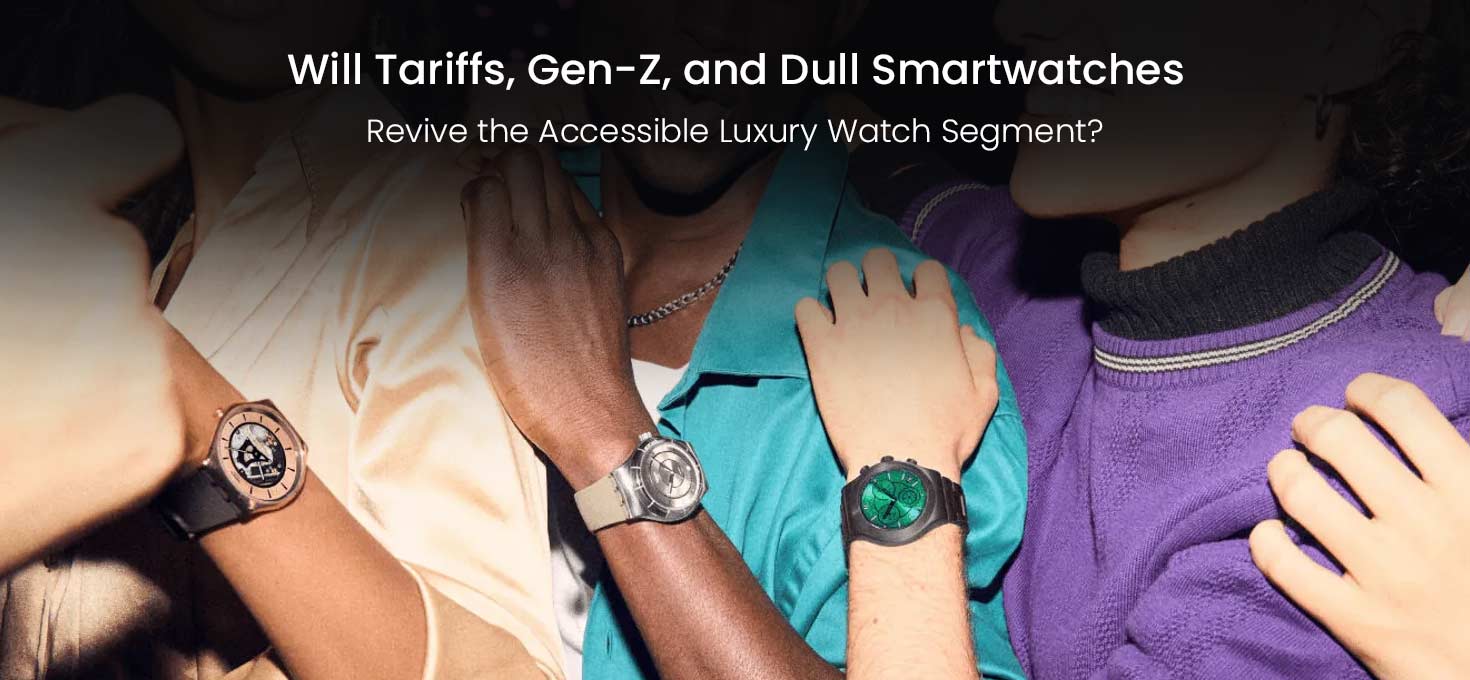
Watchmaking has stood witness to humankind’s greatest triumphs and its most challenging chapters. Be it Santos-Dumont’s historic flights, the Space Race’s daring innovations, or the Quartz revolution — watchmaking has seen the times change. And through these times, as global economic tides changed, so did the people’s financial accessibility to watches.
Beyond monetary matters, watchmaking’s innovations in diving, modern aviation, and sports timekeeping have sparked fresh interest.
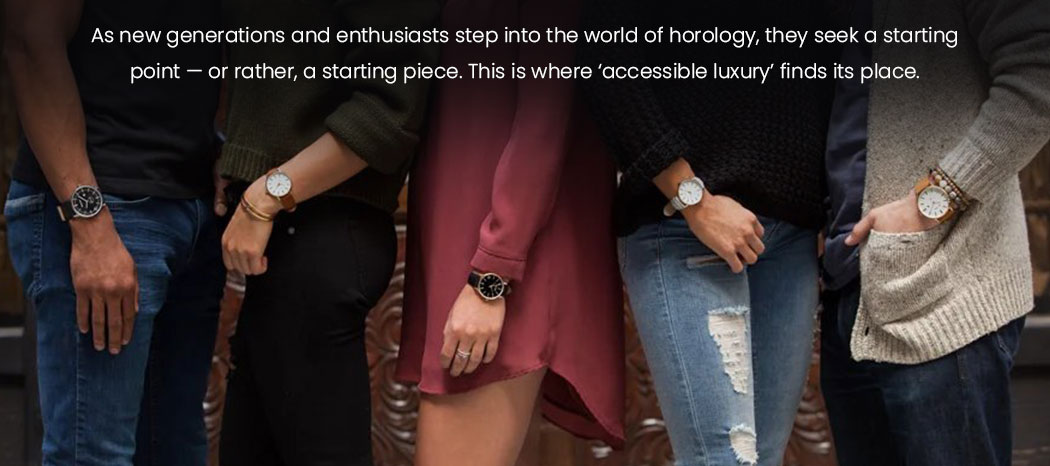
As new generations and enthusiasts step into the world of horology, they seek a starting point — or rather, a starting piece. This is where ‘accessible luxury’ finds its place. While this market segment has long existed, it is experiencing a bold renaissance today, fueled by several key forces.
Firstly, What’s ‘Accessible Luxury’?
I’d best describe ‘accessible luxury’ as “a slice of the cake, for a slice of the price”.
This market segment enables enthusiasts to enjoy a smaller, yet authentic, quotient of prestigious luxury maisons but at nearly entry-level price points.
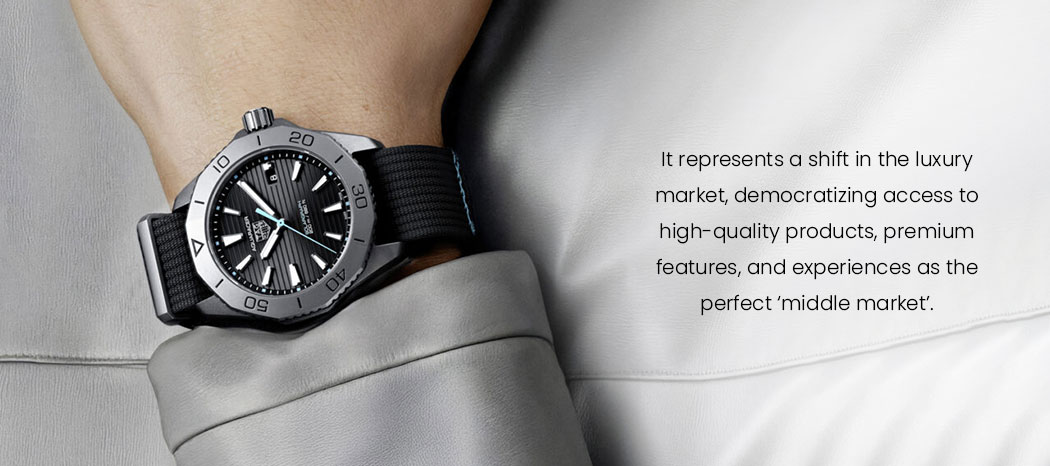
It represents a shift in the luxury market, democratizing access to high-quality products, premium features, and experiences as the perfect ‘middle market’. Forbes describes this market segment as ‘aspirational luxury consumers,’ which was a growth ticket for luxury brands since the 2008-2009 global recession. According to reports, the personal luxury goods market doubled in size between 2009 and 2019, reaching $332 billion. Post-pandemic, as consumer spending power increased, this segment saw another dramatic burst, reaching $423 billion in 2024.
The Value Proposition
Luxury watches thrive on prestige and exclusivity. Yet, for the ‘aspirational luxury enthusiast,’ maisons like Jaeger-LeCoultre, Cartier, or even higher-tier Omega models often remain just out of reach — a fact that only heightens their demand. This audience craves the heritage and exuberance these brands represent, but their purchasing decisions are still rooted in a traditional ‘value for money’ mindset. ‘Accessible luxury’ watches bridge this gap of aspiration and accessibility. At its core, ‘accessible luxury’ watches offer a taste of heritage, craftsmanship, and design whose value isn’t watered down by the price-cut — instead distilled into something authentic yet financially approachable. Take the Tissot PRX or Longines Spirit, for instance. Retaining the maison’s signature codes and appeal, they pose as a perfect entry point into premium watch collecting. This category also serves as a smarter indulgence for value-conscious buyers, justifying the purchase as aspirational and practical with quality far superior to mass-market options.
Tariff Turmoils
For over 15 years, the personal luxury goods market surged, reaching $423 billion in 2024, according to Bain. But its momentum was jolted in early 2025 when news of a hefty U.S. tariff on Swiss imports which struck the very core of Switzerland’s watch industry. With the U.S. representing 16.8% of Swiss watch exports (largest market share at CHF 4.4 billion), the 39% tariff’s enforcement from August 2025 forced an industry-wide shift. While American consumers are faced with steeper retail prices, the ripple will inevitably redirect demand into markets like Europe, Japan, and, of course, India. With Switzerland’s new FTA with India (effective October 2025), long-standing duties on Swiss imports will no longer be a hurdle to consumers, potentially positioning India as a growth market.
The Only Way is Up…Or Is It?
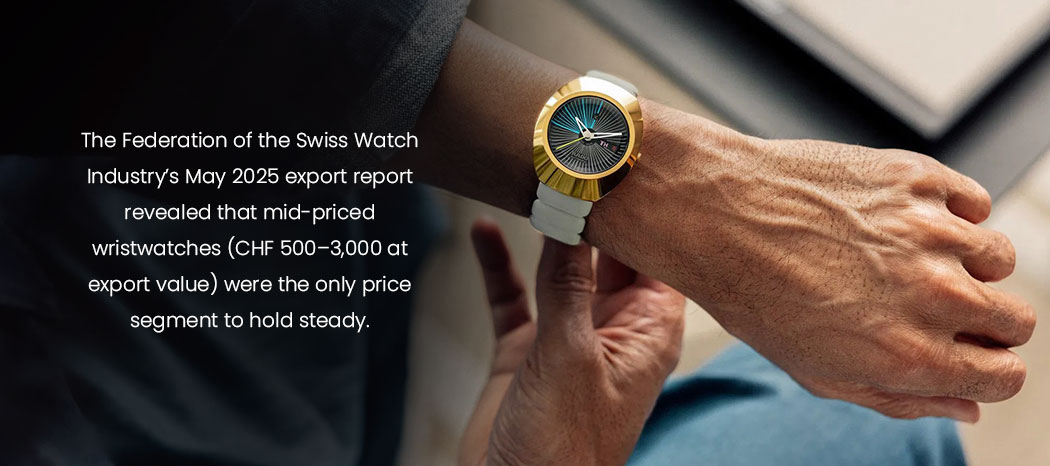
Amid these turbulent times, the Federation of the Swiss Watch Industry’s May 2025 export report revealed that mid-priced wristwatches (CHF 500–3,000 at export value) were the only price segment to hold steady, even as all other price tiers declined by an average of 11%. In the June 2025 report, this segment also recorded a 16% YoY surge. Call it a short-term spike, a long-brewing resurgence, or simply statistical luck — the accessible luxury segment is boldly regaining ground. Rooted in Swiss heritage, craftsmanship, and signature design yet offered at attainable prices, it emerges as a natural counterpoint to tariff-bloated mid-tier maisons like Omega or Cartier. Consumers who once stretched for higher price rungs will naturally recalibrate to Longines, Tissot, and TAG Heuer as accessible pathways to Swiss prestige.
The Gen-Z Effect
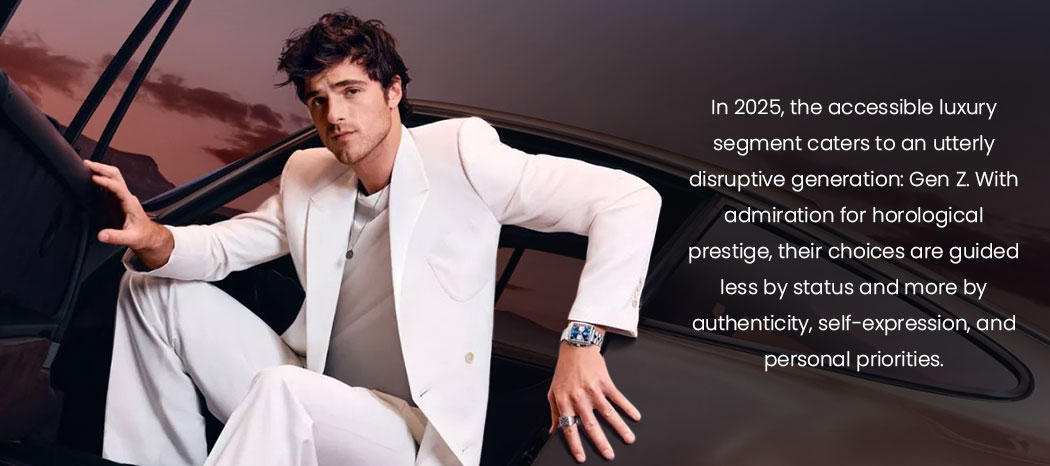
In 2025, the accessible luxury segment caters to an utterly disruptive generation: Gen Z. With admiration for horological prestige, their choices are guided less by status and more by authenticity, self-expression, and personal priorities. A 2024 Watchfinder & Co. survey revealed that Gen Z buyers with real spending power would splurge an average of $10,870 on a watch. The wider group, however, is pulling back on extravagant spending, directing money toward savings, investments, or the thriving second-hand luxury market. Digitally fluent and deeply researched, Gen Z enters the market as the most decisive watch buyer to date. In contrast to an industry historically built on exclusivity, this generation leans toward inclusivity — a value that naturally draws them to mid-range and accessible luxury brands. Gen-Z prizes high-quality craftsmanship and regard timepieces as personal investments, however, their willingness to splurge is subject to seeing a clear value proposition.
The Decline of the Smartwatch
Smartwatches are sleek, functional, and designed for the future. But when placed against the mechanical and artistic excellence of watchmaking, they’ll always fall short. Beyond the health trackers and ‘connected’ perks, they’re simply pricey gadgets. And now, for the first time since their meteoric rise in 2015, the cracks are beginning to show. BBC reports the global smartwatch market slipped by 7% in 2024. Market leader Apple felt the hardest sting, with shipments plunging 19% — its sharpest decline to date.
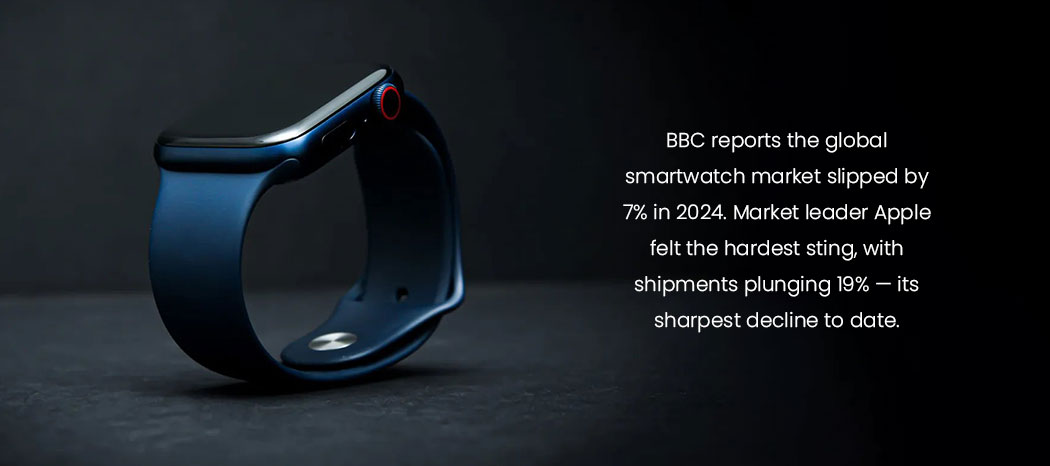
There’s no hard data linking smartwatch fatigue to luxury watch demand, but if consumers are drifting back toward traditional horology, it would hardly be a surprise. After all, while tech wears out, a well-crafted watch always endures — carrying heritage, emotion, and a soul no algorithm can replicate.
Recent Posts
Recent Comments
Archives