
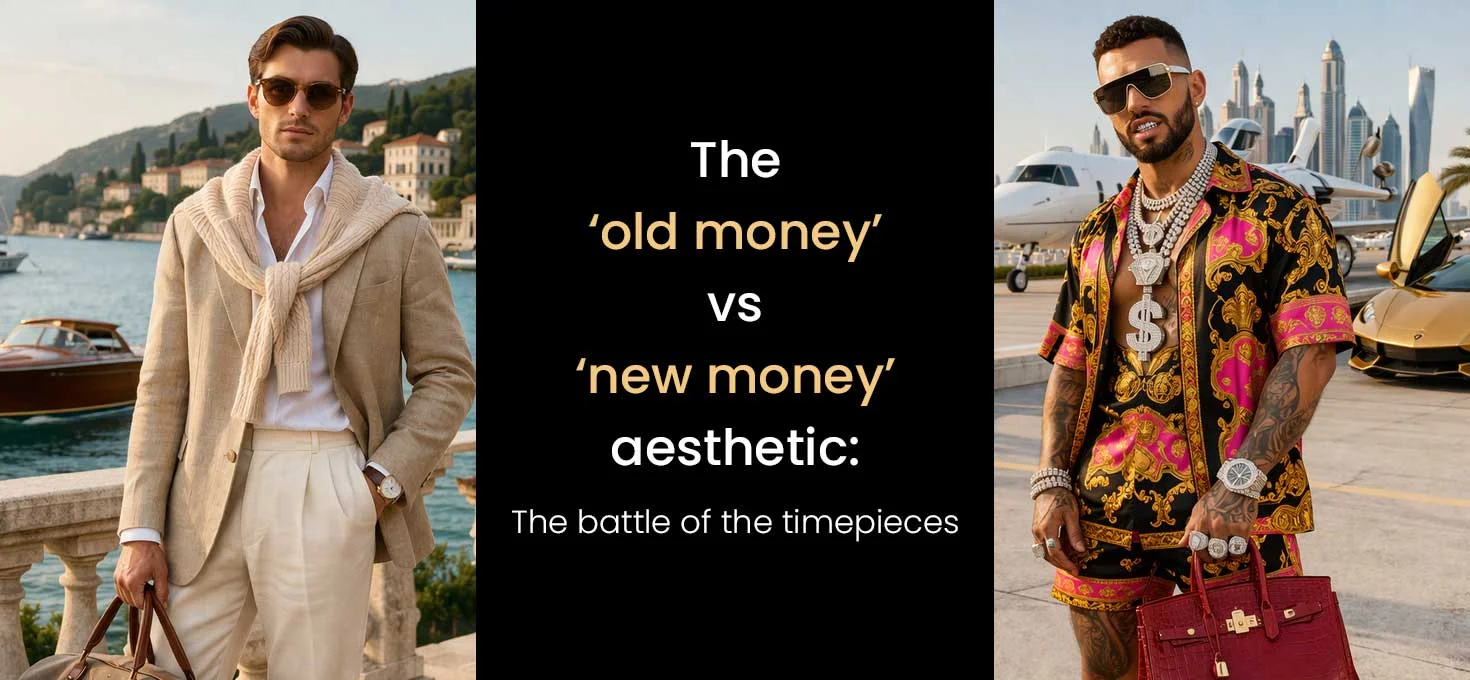
The obsession with the old money versus new money aesthetic resurfaces every couple of years and adds to the cultural dialogue around it — it was heightened by TV show Succession, and is back in conversation with the recent release of Love Story, John F Kennedy Jr & Carolyn Bessette. Instagram accounts focused on rich kid comedy like @TheGstaadGuy and @theEuropeanKid continue to keep the conversation alive. From fashion to art and automobiles to watches, this ideological divide permeates all levels of our capitalistic society. In an era where identity is curated, luxury is worn not just for pleasure, but for narrative.
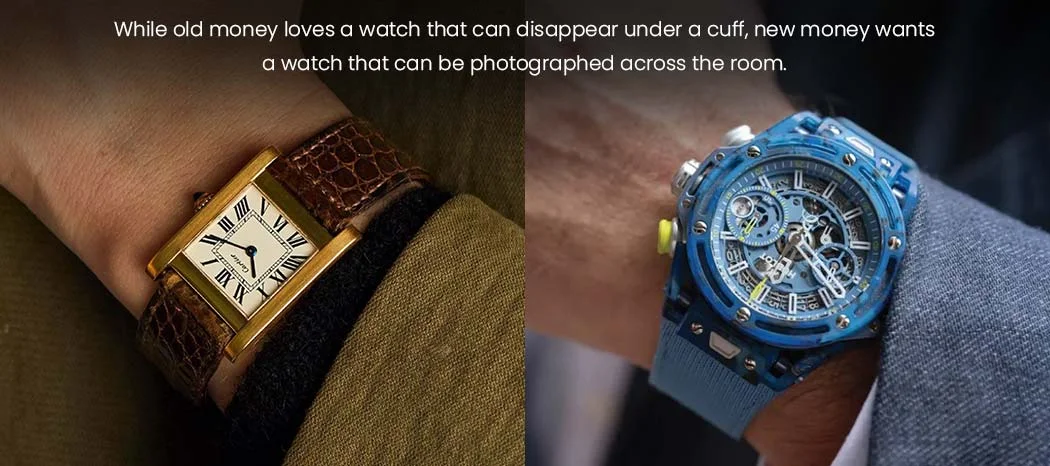
While old money loves a watch that can disappear under a cuff, new money wants a watch that can be photographed across the room. Old money whispers heritage and restraint, new money shouts innovation and excess. This clash of aesthetics is not just about style it’s about heritage, lineage and authority.
Old money elegance
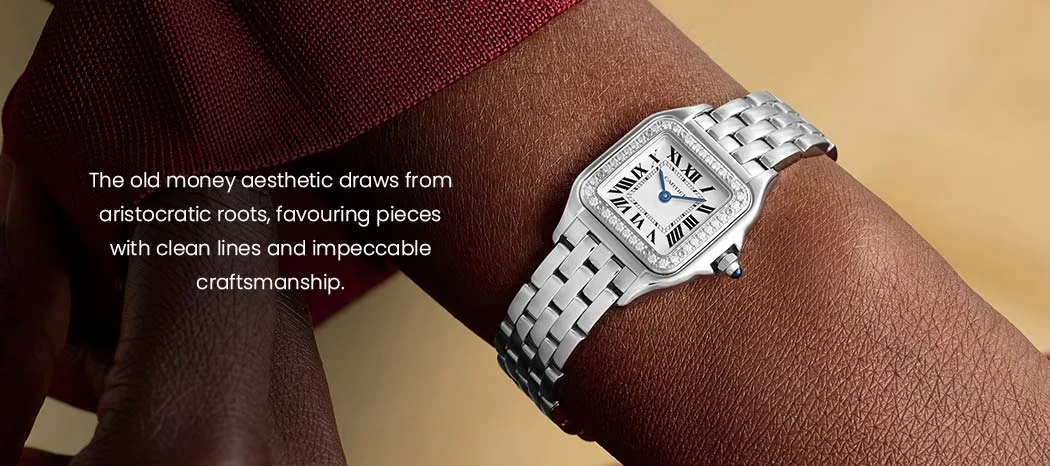
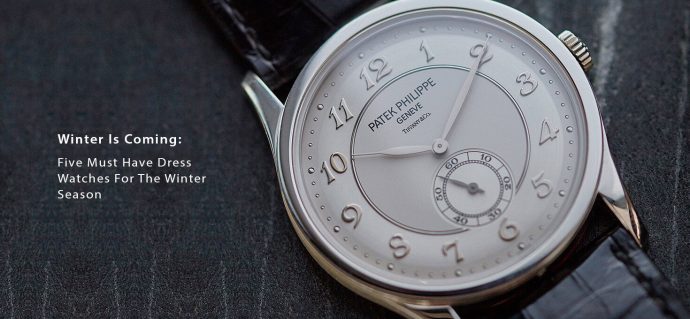
In the realm of old money, discretion is the ultimate flex. Dubbed as quiet luxury, the old money aesthetic draws from aristocratic roots, favouring pieces with clean lines and impeccable craftsmanship. These watches do not chase trends, they outlast them and look as good with a cashmere sweater as with a Savile Row suit. The Patek Philippe Calatrava born in 1932 is a prime example of this refined taste. With its slim profile, classical proportions and a minimalist dial featuring Roman numerals, it embodies the philosophy that true luxury simply is. Inspired by Bauhaus principle of ‘form follows function’, it charms with restraint and is emblematic of the brand’s tagline: ‘You never actually own a Patek Philippe. You merely look after it for the next generation.’
The Vacheron Constantin Traditionelle follows suit with origins that date back to the 1700s. Being the world’s oldest operating watchmaker, Vacheron echoes centuries of savoir faire, with the Traditionnelle being its crown jewel. Channelling neoclassical vibes, it highlights codes of the maison with its round case, dauphine hands and a small seconds subdial for that extra touch of refinement. Then there’s the Cartier Tank, an Art Deco masterpiece born in 1917, inspired by the Renault tanks of World War I. Known for its timeless appeal, it has been the timepiece of choice for the likes of Princess Diana and Jackie Kennedy. With its rectangular case and blue cabochon crown, it’s the horological equivalent of a classic LBD that has transcended into a cultural heirloom over time.
The Audemars Piguet Royal Oak is old money with an edge. A Gerald Genta 1972 signature timepiece, it introduced the world to the idea of the luxury steel watch. Its integrated bracelet, octagonal bezel, and tapisserie dial made it radical for its time. Sporty yet refined, its old money’s nod to modernity without sacrificing pedigree. Rounding out the classics is the IWC Portugieser, with its oversized case and railroad-track minute circle, marking its 1930s maritime roots. Originally created for Portuguese sailors who needed precise navigation on the high seas, it is elegant and substantial, but never loud.
New money maximalism
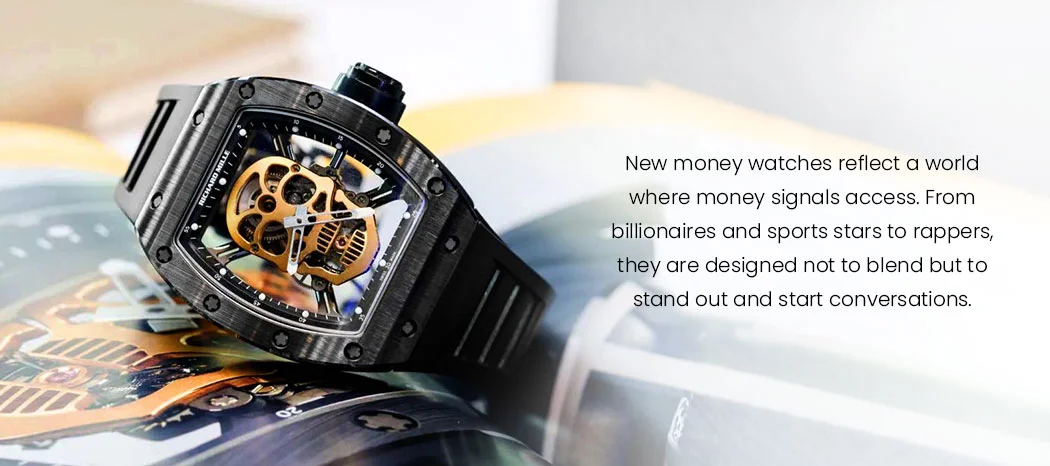
New money watches reflect a world where money signals access. From crypto billionaires to tech titans and sport stars to rappers, they are the toast of the town thanks to the nouveau rich. These watches are often bigger, bolder, technically extravagant and aesthetically audacious. Designed not to blend, but to stand out and start conversations. The Hublot Big Bang is the poster child of the art of fusion. Mixing rubber, ceramic and gold, its multi material case screams innovation with bold colours and oversized proportions. Unveiled in 2005, it captures the spirit of contemporary luxury which is futuristic, athletic and unafraid of attention.
The Richard Mille skull watch is no less than performance art on the wrist. Often called ‘racing machine on the wrist’ it incorporates avant-garde materials from F1 and aerospace engineering to achieve extreme lightness, rigidity and shock resistance. Worn by Rafael Nadal during Grand Slam matches, it is a technical marvel in its own right. The Jacob & Co. Opera Godfather takes the concept of a statement piece and cranks it to a hundred. Grand, theatrical and opulent, it features a miniature music box mechanism that plays the iconic Godfather theme, making it the ultimate tribute to the magnum opus. With holographic figures and vertical tourbillons, this limited edition timepiece is horological storytelling at its best.
Finally, the Franck Muller Infinity with its curvaceous Cintree Curvex case, paved in diamonds and vibrant hues is quite the antithesis to minimalistic dressing. With its looping infinity motifs and deliberately disordered numerals, it radiates flamboyance and confidence.


Recent Posts
Recent Comments
Archives